Camping is supposed to be simple: throw your gear in the car, head for the mountains, and wake up with the sunrise. But for most people, that’s just not how it goes. Setting up a tent is a major hassle (especially with your spouse when you’re both hangry), sleeping on the ground is miserable, and you wake up stiff, cold, and cranky.

That’s where RISE started.

“I wanted to fix two things,” says RISE Founder Todd Lawson. “First, the time and frustration it takes to set up camp — and second, the terrible sleep most people get outdoors.”


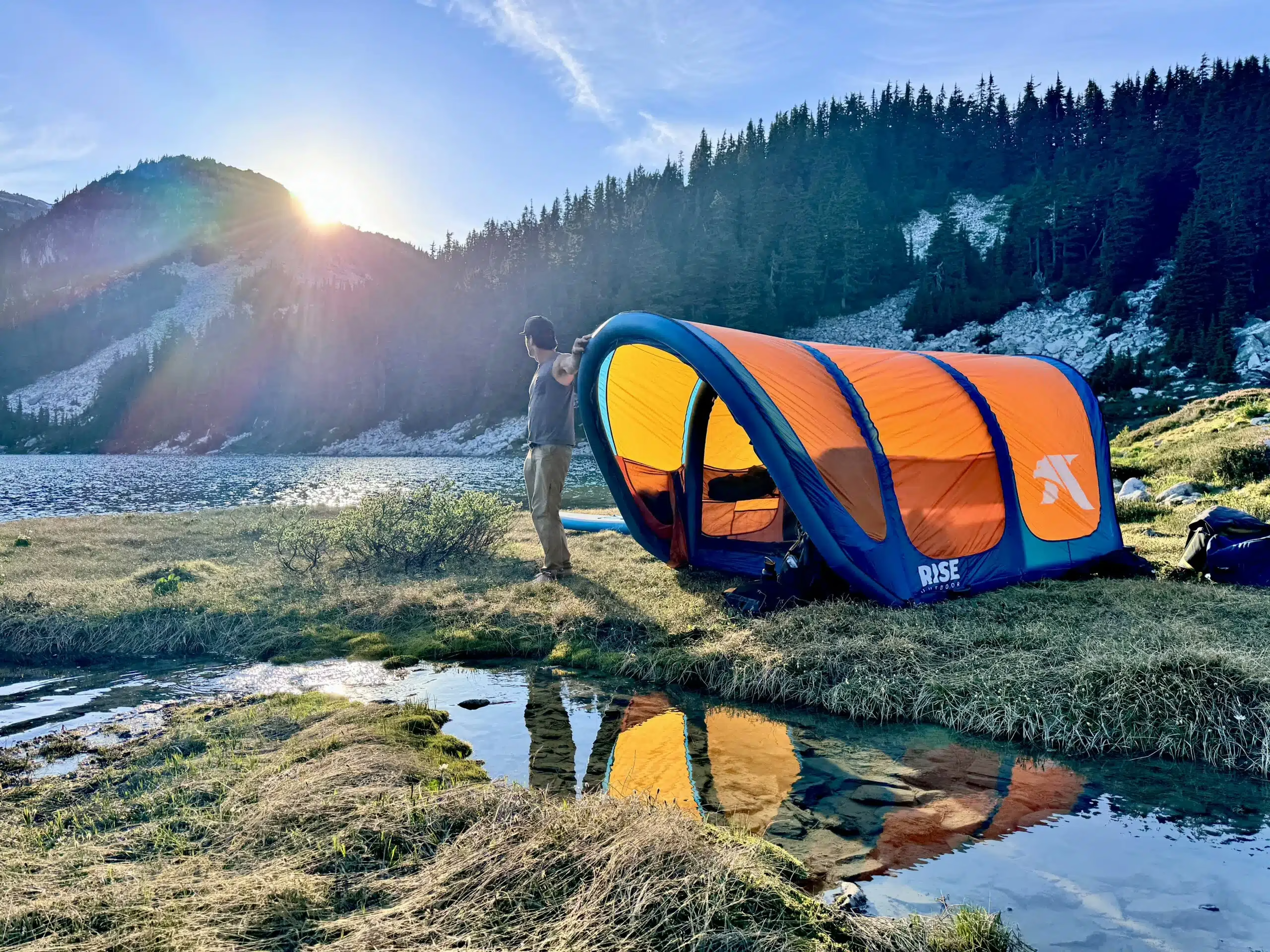
An inflatable tent, the RISE AirNEST, in forest.

So he created the AirNEST — a rugged inflatable shelter with an integrated queen-sized mattress that sets up at the push of a button. Think of it as your bedroom in a backpack, ready in two minutes flat. No poles, no pegs, no messing around. Their mission is simple: help more people experience the power of nature — and love it enough to come back again. RISE Outdoor isn’t just a gear company, it’s a movement.

“Every AirNEST we ship helps fund the RISE & SEAN Foundation,” says Lawson from their headquarters in Whistler, BC, “We send kids from developing nations on outdoor adventures that change their lives.”


An inflatable tent floats on a lake with mountains in the background.

RISE Outdoor first launched on Kickstarter in October 2024, blew through their funding goal in under seven hours, and proved the market was ready. Since then they’ve shifted to a Shopify-fulled DTC model, which meant dialing in logistics from day one.

“When you sell premium gear that weighs 30lbs., ships globally, and costs $1,500 CAD, fulfillment needs to be part of the experience,” says Lawson. “We needed more than just a warehouse. We needed a partner who gets that every box leaving the dock is someone’s next weekend, road trip, or memory waiting to happen. For us, fulfillment isn’t just logistics; it’s a promise. When someone clicks ‘buy,’ they’re trusting us to deliver a product that makes their time outside better. With Evolution Fulfillment 3PL, I know that promise is in good hands — from warehouse shelf to trailhead.”

Two tents are lit up at night in a mountain setting.

For RISE, the road ahead is wide with many lanes, but narrow in focus: more innovative products, opening up new international markets, and an ambitious goal to make RISE the most trusted name in inflatable camping gear worldwide.

“With the right partners, including Evolution Fulfillment, we’ll get there,” says Lawson. “Because when it’s this easy to get outside, more people will do it — and that’s what RISE is all about.”

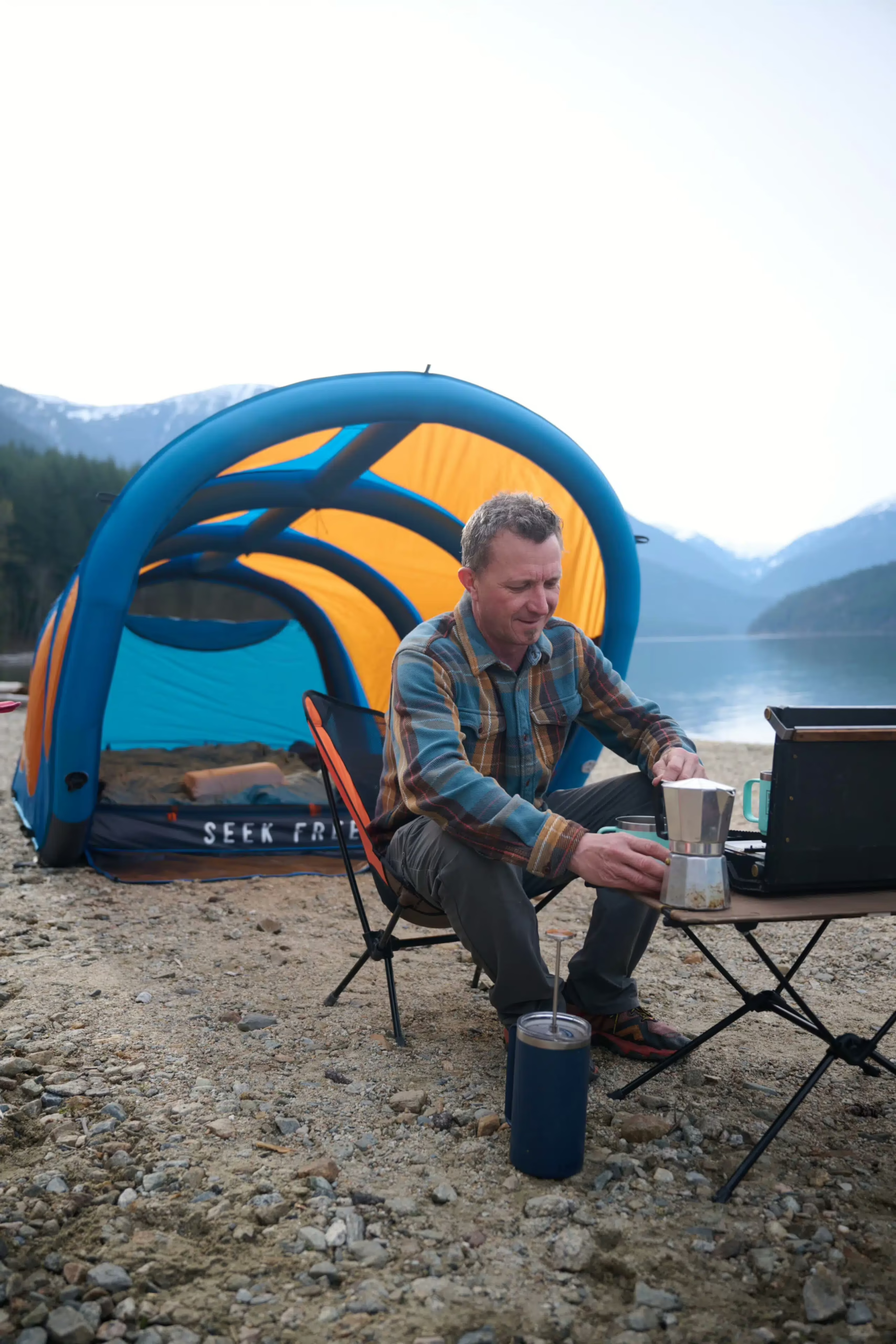
A man sits in a camping chair and makes coffee in front of an inflatable tent


Todd Lawson
Founder, RISE Outdoor Innovation Inc.
riseoutdoor.ca
tl@riseoutdoor.ca


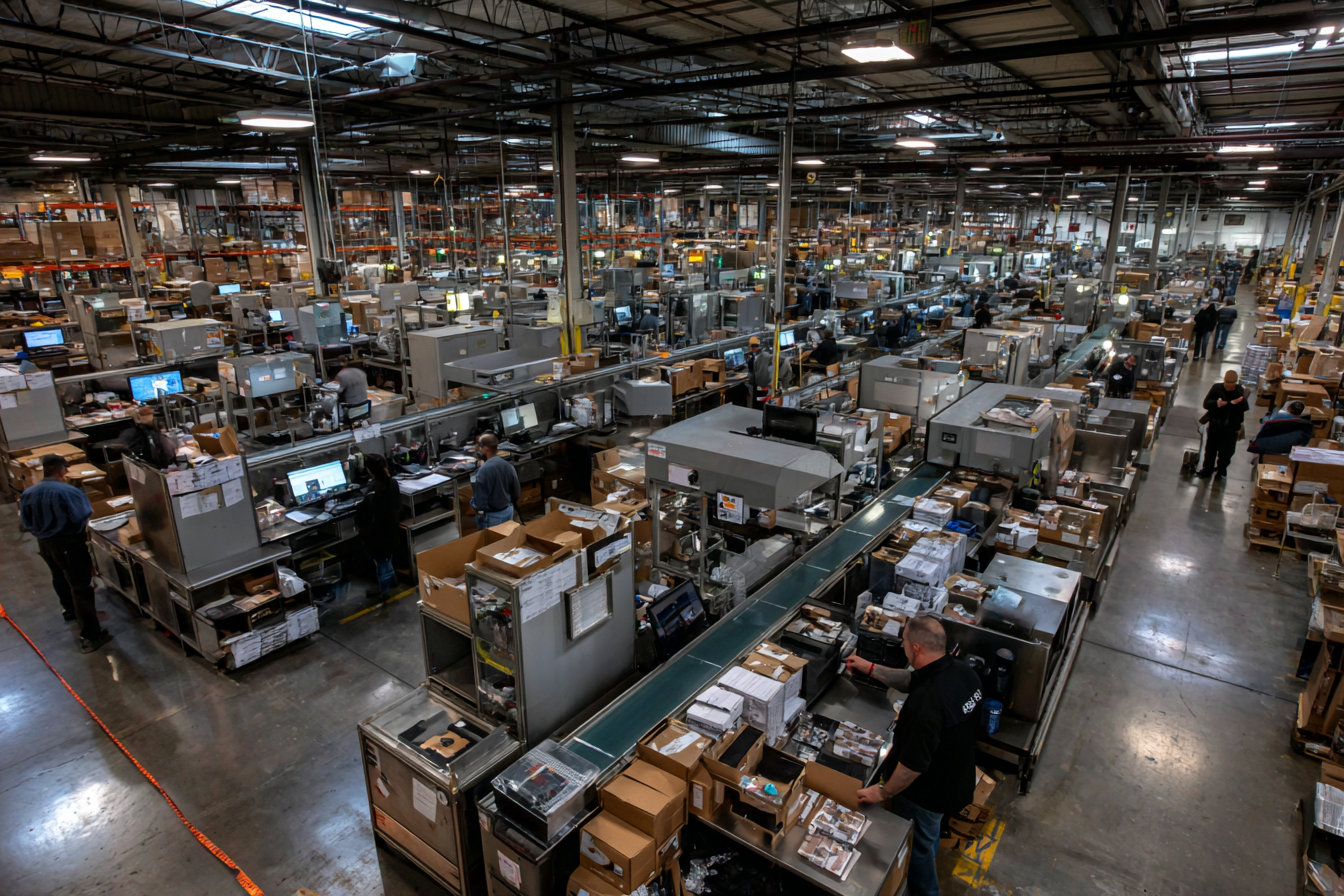
Modern 3PL fulfillment warehouse operations showing organized inventory management and shipping workflows

How much does 3rd party fulfillment cost? The simple answer is that it depends. Your pricing model, monthly order volume, and cross-border shipping strategy can significantly change your final per-order cost. Relying on a simple fee list can turn a healthy profit margin into a thin one.

This guide provides a clear roadmap for understanding the true cost of third-party fulfillment. We’ll show you how to choose the right pricing model, calculate your landed cost per order, and leverage volume benchmarks. You’ll also learn how to optimize shipping from Canada to the US and negotiate better terms to protect your profits. With real-world examples, you’ll see how to make your fulfillment strategy a driver for growth.

Key Takeaways

  • To understand 3PL costs in 2025, you need to go beyond fee lists. Focus on landed-cost scenarios, volume benchmarks (from 2,500 to 50,000+ units), and region-specific strategies like Canada-to-US shipping to protect your margins.
  • Match your pricing model to your business needs. Transactional pricing works for low volume, flat-fee models suit predictable products, and hybrid or tiered models unlock savings as you scale. The right choice depends on your average order value (AOV), product complexity, and monthly units.
  • Calculate your true landed cost per order by accounting for every line item. This includes receiving, storage, pick & pack, kitting, returns, FBA prep, shipping, duties, and packaging. A detailed formula prevents surprises and clarifies your actual profit margin.
  • Use volume benchmarks (2,500 to 50,000+ units) to forecast savings. Per-order costs decrease significantly as you scale. Modeling different volume tiers helps you identify the point where your unit economics become profitable.
  • Optimize Canada-to-US shipping with domesticated shipping. Strategies like consolidated shipping and smart customs planning can dramatically reduce your landed cost compared to standard cross-border methods.
  • Negotiate your fulfillment contract with growth in mind. Identify hidden fees, set caps on charges, and use volume-based triggers to secure better pricing as you grow. A partner like Evolution Fulfillment aligns pricing with your success to preserve margins.

Who This Guide Is For

This guide is designed for ecommerce brands shipping between 2,500 and 50,000+ units per month. Your average order value (AOV) is likely between $60 and $150, with two to three items per order. If you’re an apparel, cosmetics, or similar brand selling directly to consumers, through wholesale, and on Amazon, these benchmarks and strategies apply to you.

What is a Third-Party Fulfillment Service?

Before we dive deeper, let’s clarify. A third-party fulfillment service is a partner company that handles your logistics. They store your inventory, receive new stock, and then pick, pack, and ship orders to your customers. These services also manage returns and can offer specialized tasks like kitting. They connect to your sales channels through technology like a Warehouse Management System (WMS) or APIs to streamline the entire process.

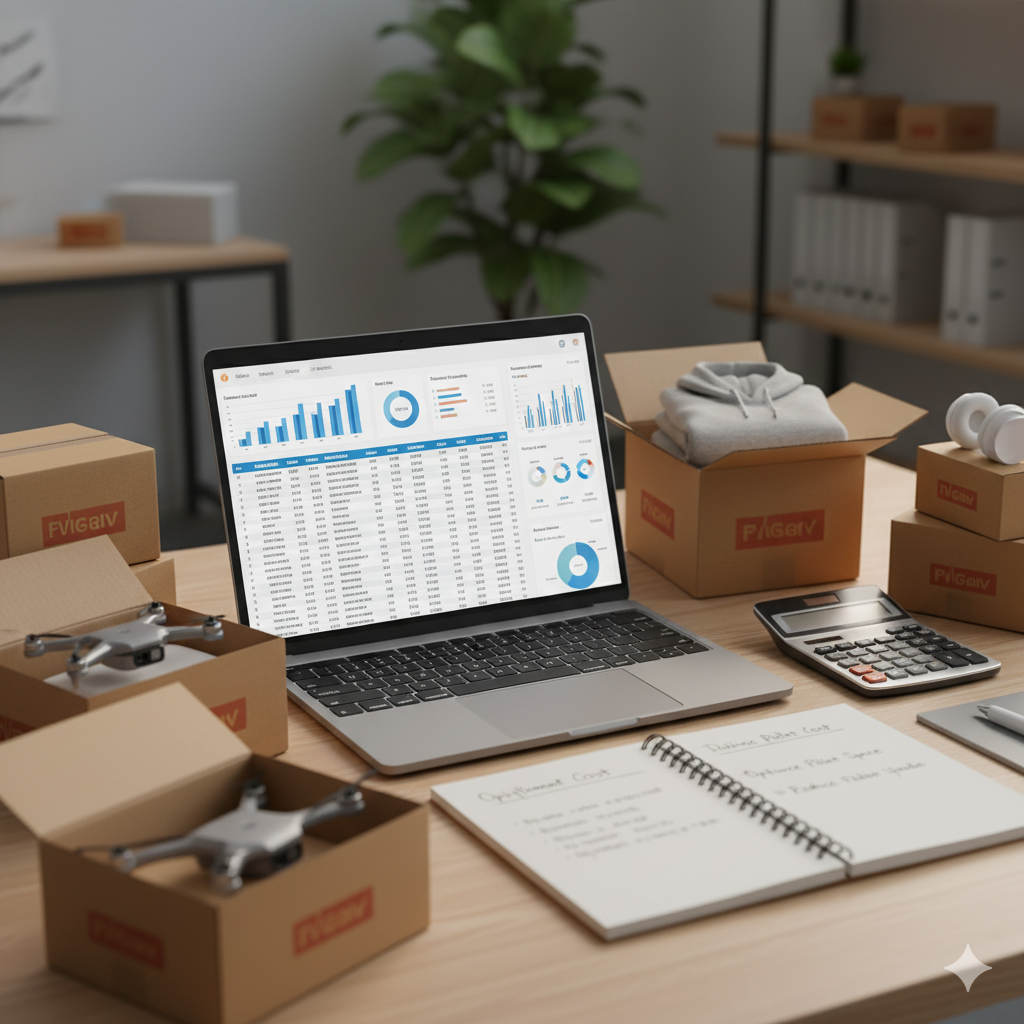
 Business owner calculating 3PL fulfillment costs with spreadsheets and shipping materials

Pricing Models: Match the Structure to Your Order Profile

Choosing the right pricing structure is more important than chasing the lowest sticker price. Your choice can impact your costs significantly as your business evolves. How much does 3rd party fulfillment cost? It starts with the model you select.

  • Transactional Pricing: You pay for each activity, like receiving a pallet or picking an item. This model is flexible and great for businesses with low or unpredictable order volumes. However, be mindful of “add-on creep,” where small fees for things like labels or extra picks can accumulate.
  • Flat-Fee Pricing: You pay a single, predictable rate for each order. This works well for brands with simple, consistent products. To avoid surprises, make sure your agreement clearly defines what’s included, especially for packaging, inserts, and returns.
  • Hybrid & Tiered Pricing: These models combine elements of the other two. Tiered pricing, for example, reduces your per-order cost as your volume hits certain milestones (e.g., 10,000, 25,000, or 50,000+ units). A hybrid model might include a flat base fee plus a variable cost for each pick, saving a brand with 10,000 orders and 2.5 picks per order up to 14%.

The 3PL Cost Stack: Building Your Landed Cost

Your true fulfillment cost is a collection of individual fees, not a single number. On average, you can expect to pay $8–$15 per domestic order and $11–$19 for a cross-border order. This includes picking, packing, packaging, and shipping.

However, factors like dimensional (DIM) weight can increase costs. A light but bulky item might be billed at a higher weight, adding $1–$2 per package. To get an accurate picture, you must break down every potential charge.

Here are the core line items to account for:

  • Receiving & Inbound Prep: $35–$55 per hour or $6–$20 per pallet.
  • Storage & Inventory Management: $15–$30 per pallet or $1–$3 per bin monthly.
  • Pick, Pack & Value-Added Services (VAS): The first pick is often $1.10–$2.40, with additional picks costing $0.25–$0.60. VAS like special kitting or FBA prep can add $0.30–$0.80 per unit.
  • Packaging Materials: The cost of boxes, mailers, and filler.
  • Shipping & Surcharges: The carrier rates plus any fuel, residential, or peak season surcharges.
  • Returns & Refurbishment: Processing a return can cost $1.50–$3.50 per order.
  • Duties, Tariffs & Brokerage: Fees for cross-border shipments.
  • Technology & Support: Monthly fees for software integrations and account management.

The Landed Cost Formula (and an Example)

To compare fulfillment partners accurately, use this formula to calculate your landed cost per order.

Landed Cost per Order = (Receiving + Storage Costs) / Total Orders + Pick/Pack Fees + VAS Fees + Packaging + Shipping + Duties/Brokerage + (Returns Cost x Return Rate) + Tech Fees

Example Calculation:

Imagine one order. The pick/pack fee is $1.60, packaging is $0.45, and shipping is $7.20. Add allocations for duties ($0.40), returns ($0.35), storage/receiving ($0.20), and tech ($0.10).

$1.60 + $0.45 + $7.20 + $0.40 + $0.35 + $0.20 + $0.10 = $10.30 per order

Use this formula to model different scenarios and compare quotes on an apples-to-apples basis.

Benchmarks by Volume Tier (2.5k → 50k+ Units/Month)

As your order volume grows, your per-unit costs should decrease. Here are some typical 2025 benchmarks:

  • First Pick Fee: Around $1.80 at 2,500 units, dropping to $1.20 at 50,000+ units.
  • Additional Pick Fee: From $0.45 down to $0.25.
  • Pallet Storage: From $24 per pallet down to $16.
  • Pallet Receiving: From $16 per pallet down to $8 (with proper compliance).

Moving from 10,000 to 50,000 orders can reduce your operational costs by 20–30%. Model these tiers to project when your margins will improve.

Worked Scenarios: From Break-Even to Profitable

Strategy matters more than a low sticker price. Here are four real-world examples:

  • Scenario A (2,500 DTC Orders): An apparel brand switched from standard cross-border shipping to a domesticated strategy. Its per-order cost dropped from $12.80 to $10.90, adding 2.2 points to its profit margin.
  • Scenario B (10,000 Orders): A brand leveraged tiered pricing and carrier incentives to cut operational costs by 18%. Better returns processing also improved the resale of returned goods by 8–12%.
  • Scenario C (50,000+ Orders): A multichannel brand used a hybrid pricing model, automation, and optimized cartonization to lower its pick/pack cost to under $1.10. SLA credits offset any service misses.
  • Scenario D (Wholesale + 5,000 DTC Orders): This brand focused on avoiding retailer chargebacks, saving 1–3% of its wholesale revenue.

Canada→US Optimization: Protecting Your Margin

For Canadian brands shipping to the US, optimization is critical. Your strategy depends on your AOV, US order density, and where your customers are located.

  • Section 321: This rule allows US residents to import up to $800 worth of goods duty-free. It’s a great option but requires disciplined shipping operations.
  • DDP + US Injection: For brands with over 4,000 US orders per month, shipping in bulk to the US Delivered Duty Paid (DDP) and injecting parcels into a domestic carrier network can cut per-parcel costs by 8–15%. One brand saved $2.10 per order this way.

Hidden Fees and Contract Pitfalls

Unexpected fees can erode your margins. Watch out for these common charges:

  • Address correction fees: $18–$22
  • Peak season surcharges: $0.40–$1.20 per package
  • One-time EDI setup fees: $500–$1,500
  • Non-compliance penalties: $25–$75 per incident

Checklist to Avoid Leakage:

  • Define fee caps and approval workflows in your Statement of Work (SOW).
  • Set maximum monthly budgets for chargebacks and testing.
  • Require transparent reporting on all passed-through surcharges.

Negotiation Playbook: Aligning Price with Growth

Come to the negotiation table with data and KPIs to align your 3PL’s pricing with your growth.

  1. Provide a Forecast: Give a 12-month forecast of your orders, shipping zones, and picks per order.
  2. Request SLA Credits: Ask for credits (5–10% of fees) if your 3PL misses service-level agreements (SLAs).
  3. Tie Pricing to Volume: Negotiate automatic price reductions when you hit volume triggers at 10,000 and 25,000 orders. This helped one brand lower its per-order costs by 22% in nine months.

3PL vs. Amazon FBA: Which to Choose?

You can and should use both where they make sense. Fulfillment by Amazon (FBA) is great for your top-selling products on the platform, but its storage fees can be high during peak season ($2.40–$6.90 per cubic foot), and restock limits can be a challenge. A 3PL offers flexibility for multichannel sales, custom branding, and kitting. Using FBA for top ASINs and a 3PL for DTC and other channels helped one brand cut its total landed cost by 9%.

Who is the biggest 3PL company?

While global carriers and logistics giants dominate the market by revenue, the biggest company is not always the best fit. A better question is: who is the right partner for your brand? The right 3PL is one that understands your business, models your landed cost, and aligns its services to protect your margins.

Evolution Fulfillment’s Brand Fulfillment Model is built on this principle. We combine robust technology, Canada-US domestication expertise, and SLA-aligned pricing to lower your costs and reduce errors. Our goal is to preserve your margin as you scale.

Frequently Asked Questions

How much does 3rd party fulfillment cost per order in 2025?

For direct-to-consumer (DTC) brands, expect $8–$15 for a domestic order and $11–$19 for a cross-border one, including shipping. Your final cost depends on your complete landed-cost calculation.

What fees should I expect from a 3PL?

You should expect fees for receiving, storage, pick/pack, packaging, shipping and surcharges, returns, duties, and technology. You may also see fees for value-added services.

How do I calculate landed cost including duties?

Use the formula provided above. Be sure to include any brokerage or DDP fees and allocate fixed costs like receiving and storage across your orders.

The Right Partner Protects Your Margin

The cost of third-party fulfillment in 2025 is not about a single rate. It’s about a fully modeled landed cost that accounts for your AOV, items per order, return rate, and cross-border strategy. The typical $8–$19 per-order range is just a starting point.

By choosing the right pricing model, calculating every line-item fee, and negotiating volume-based discounts, you can compress your costs as you scale. For Canadian brands, smart domestication strategies can add several points to your margin. The key is to find a partner who helps you manage these levers.

Ready to see how these strategies can impact your bottom line? Explore Evolution’s Canadian warehouse and domestication services to see how we help brands preserve their margins.

Discover the path to smarter logistics and greater profitability with Evolution Fulfillment. Visit Evolution Fulfillment to learn more about how our Canadian warehouse and domestication services can transform your business operations.

Take control of your costs, streamline your processes, and protect your margins today. Contact us now to get started!


Choosing a logistics partner can make or break your brand’s growth. If you’re asking, “What is a third-party fulfillment service?”, you’ve come to the right place. This guide explains exactly what a 3PL does, how a fulfillment center works, and what capabilities matter most when you sell across multiple channels. We’ll move beyond simple definitions to give you practical advice for choosing the right partner. You’ll learn how to match services to your sales channels, demand the right technology, understand pricing, and recognize when it’s time to outsource. Let’s dive into how fulfillment can become a true extension of your brand.

Key Takeaways

  • Define 3PL Clearly: A third-party logistics (3PL) partner handles your physical fulfillment, from receiving inventory to managing returns. They provide the warehouse, labor, and technology so you can focus on growing your business.
  • Map Services to Needs: Evaluate providers on their ability to handle your specific sales channels, like direct-to-consumer (DTC) picking, retail-compliant B2B prep, and custom kitting. A single, capable 3PL prevents operational headaches.
  • Prioritize Technology & KPIs: Insist on key integrations (like Shopify, Amazon, and EDI) for real-time inventory visibility. Use Key Performance Indicators (KPIs) like order accuracy and on-time shipping to measure success and ensure accountability.
  • Understand the Costs: Budget for clear pricing drivers, including storage, pick/pack fees, and value-added services. Outsource when order volume, cross-border shipping, or retail rules become too complex to manage in-house.
  • Find the Right Fit: For North American expansion, a regional mid-market 3PL might offer better Canada-U.S. shipping strategies than a global giant. Focus on partners who can blend DTC and B2B fulfillment seamlessly.

What Is a Third-Party Fulfillment Service (3PL)?

Q: What is a third-party fulfillment service? A:_ A third-party fulfillment service, or 3PL, is an outsourced partner that manages your order fulfillment operations. This includes receiving and storing your inventory, picking and packing orders, shipping them to customers, and handling returns._ Think of a 3PL as your brand’s operational backbone. You own the products and the customer relationships; the 3PL owns the logistics infrastructure. This allows you to focus on product design, marketing, and sales while they handle the complexities of getting orders out the door accurately and on time. It’s important to know how a 3PL differs from other logistics providers.

  • 3PL vs. 4PL: A 3PL is a hands-on partner that physically moves your products. A 4PL (fourth-party logistics) provider is more of a strategist who might manage your entire supply chain, including coordinating with multiple 3PLs, but they don’t handle inventory themselves.
  • 3PL vs. Freight Forwarder: A freight forwarder specializes in moving bulk shipments between locations, often internationally. They handle customs and book large-scale transport but don’t typically manage individual customer orders.

What Is a Fulfilment Warehouse?

Q: What is a fulfilment warehouse? A:_ A fulfillment warehouse, or fulfillment center, is a facility designed for rapid outbound order processing. Its layout and operations are optimized for picking individual items, packing them, and shipping them directly to customers, often within 24 hours._ This is different from a traditional warehouse, which is built for long-term, bulk storage. A traditional warehouse might store 500 cases of your top-selling product on a single pallet. A fulfillment center, however, strategically places those items in accessible bins so workers can quickly grab single units for customer orders. This operational focus on speed and order-level accuracy is what allows ecommerce brands to meet modern customer expectations for fast shipping.

A Deep Dive into 3PL Services

A great 3PL offers more than just storage space. Their services are designed to support your brand across every sales channel. Core Warehousing and Inventory Management Accuracy is everything. Top-tier 3PLs use warehouse management systems (WMS) to achieve over 99.7% inventory accuracy. When a shipment of your products arrives, their team receives it, inspects it, assigns it a storage location, and syncs the new stock levels across all your sales channels in real time. This prevents you from overselling products you don’t have. Order Processing: Pick, Pack, and Ship This is where a 3PL’s expertise really shines.

  • For Direct-to-Consumer (DTC): They receive an order from your Shopify store, pick the items, pack them with your custom-branded materials, and ship it out—all within a tight timeframe.
  • For Business-to-Business (B2B): They handle complex requirements for retail partners like Nordstrom or Saks. This includes vendor-compliant labeling, generating Advance Shipping Notices (ASNs), and meeting strict packaging rules to avoid costly chargeback fees. Value-Added Services These services adapt the fulfillment process to your unique needs.
  • Kitting & Bundling: Assembling multiple SKUs into a single product for promotions or subscription boxes.
  • Amazon FBA Prep: Labeling, poly-bagging, and packing products to meet Amazon’s strict FBA inbound requirements.
  • Returns Management (Reverse Logistics): Inspecting returned items and deciding whether to restock, donate, or dispose of them based on your rules.
  • Cross-Docking: Immediately shipping out received inventory to fill waiting orders, bypassing storage to save time and money.

Real-Time Inventory Management with WMS Technology


The Technology That Powers Modern Fulfillment

A 3PL without a strong technology stack is just a storage unit. Modern fulfillment relies on three interconnected systems.

  1. Warehouse Management System (WMS): This is the brain of the warehouse, controlling all physical inventory. It optimizes pick paths for workers, tracks item locations, and manages cycle counts to ensure accuracy.
  2. Order Management System (OMS): The OMS is the central hub for all your orders. It routes orders to the correct warehouse, prevents overselling by reserving inventory, and provides a unified view of sales across every channel.
  3. Transportation Management System (TMS): This system optimizes shipping. It automatically selects the most cost-effective carrier for each package, prints labels, and tracks shipments. These systems must integrate seamlessly with your platforms, including Shopify for DTC, Amazon Seller Central, and EDI for retail partners. Real-time data syncing is not a luxury; it’s a necessity for preventing stockouts and keeping customers happy. 2025 Trends: Automation and AI Leading 3PLs are already using artificial intelligence to forecast inventory needs, helping you reorder before you run out of stock. In high-volume facilities, robotics assist with picking to improve speed and accuracy. This technology helps your 3PL partner operate more efficiently, which translates into better service and lower costs for your brand.

Understanding 3PL Pricing Models and Costs

3PL pricing is typically variable, meaning you pay for the services you use. This converts your fulfillment costs from a fixed expense (like a warehouse lease) into a variable one that scales with your sales volume. Common costs include:

  • Storage: Billed per pallet or per cubic foot.
  • Pick-and-Pack: A fee per order plus a fee for each item in the order.
  • Receiving: A charge for processing inbound inventory.
  • Value-Added Services: Fees for tasks like kitting or FBA prep.
  • Surcharges: Extra fees for things like address corrections or peak season demand. Mid-market brands shipping 2,500–10,000 DTC orders monthly can expect an all-in cost of $4.50–$7.00 per order. When requesting quotes, ask for all-in pricing scenarios to avoid hidden fees.

When Should You Outsource to a 3PL?

The decision to outsource is about more than just order volume. It’s about complexity.

  1. Your Order Volume is Growing: If you’re shipping over 500 orders a month, the time spent packing boxes starts to outweigh the cost savings of doing it yourself.
  2. You’re Selling on Multiple Channels: Fulfilling DTC orders, Amazon FBA shipments, and wholesale POs at the same time is complex. A 3PL has the systems to manage this without errors.
  3. You Want to Expand Cross-Border: A 3PL with warehouses in both Canada and the U.S. can offer “domesticated” shipping. This cuts transit times from 7-12 days to 2-3 days and eliminates surprise duties for your customers.
  4. Your Team is Losing Focus: If your marketing or operations teams spend more time on logistics than on growth activities, it’s a clear sign you need to outsource. Let your team focus on what they do best.

How to Measure 3PL Success

You can’t manage what you don’t measure. Track these KPIs to ensure your 3PL is performing well.

  • On-Time, In-Full (OTIF): Percentage of orders shipped on time with all the correct items. Target: 98%+.
  • Order Accuracy: The rate of picking and packing errors. Target: 99.5%+.
  • Dock-to-Stock Time: How quickly inbound inventory is processed and made available for sale. Target: < 24 hours.
  • Cost Per Order: Your all-in fulfillment cost divided by your total orders. Your contract should include Service-Level Agreements (SLAs) that tie these KPIs to financial credits. If your partner fails to meet expectations, they should be held accountable. Q: Who is the biggest 3PL company? A:_ The title of “biggest 3PL company” often shifts based on how you measure it—whether by annual revenue, warehouse square footage, or global network size. Major global players like DHL Supply Chain, Kuehne + Nagel, and others consistently rank near the top. However, for many brands, the “best” 3PL isn’t the biggest. It’s the one whose services, locations, and expertise best align with your specific needs._

Benefits vs. Challenges of Using a 3PL

Benefits:

  • Scalability: Easily handle seasonal peaks without investing in more space or staff.
  • Expertise: Leverage your partner’s knowledge of retail compliance, FBA prep, and international shipping.
  • Wider Reach: Use a distributed warehouse network to get products closer to your customers and reduce shipping times. Challenges:
  • Loss of Control: You can’t personally check on an urgent order. Mitigation: Choose a partner with a real-time portal that provides complete visibility into order status.
  • Communication Gaps: You’re emailing an account manager instead of talking directly to a warehouse worker. Mitigation: Establish clear communication protocols and dedicated contacts.

Ready to transform your fulfillment into a competitive advantage?

Evolution Fulfillment provides the services, technology, and expertise your brand needs to unlock new growth. Partner with us and discover how seamless logistics can elevate your business. Contact Evolution Fulfillment Today


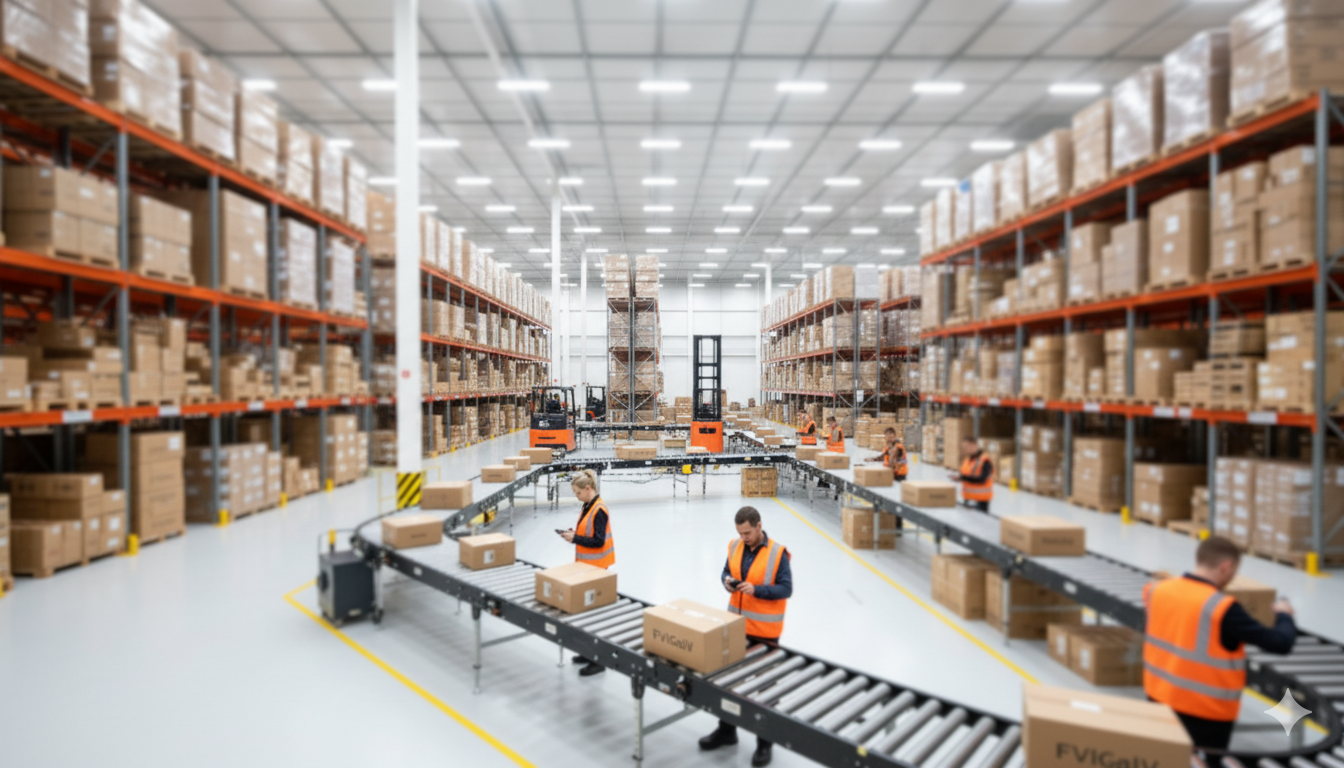
Modern fulfillment center warehouse with organized inventory and workers processing orders

Your online store just had its best sales day ever. Congratulations! But as the orders pile up, excitement can quickly turn to stress. How will you get hundreds of packages out the door on time? This is where a fulfillment company becomes your most important partner.

Fulfillment companies are the operational engine behind successful e-commerce brands. They handle the entire process from the moment a customer clicks “buy” to the moment the package arrives at their door. Choosing the right fulfillment partner can define your brand’s reputation, improve customer satisfaction, and give you the freedom to focus on growing your business instead of packing boxes.

This guide will walk you through the different types of fulfillment solutions. We’ll explain how they work, what they cost, and how to choose the right one for your brand’s unique needs.

Understanding the Role of a Fulfillment Company

So, what kind of company is fulfillment? At its core, a fulfillment company is a specialized partner that manages your inventory and ships your orders. Think of them as an extension of your team, dedicated to handling the logistics of your business so you don’t have to.

Unlike a standard shipping carrier that just transports packages, a fulfillment provider offers a complete suite of services. At Evolution Fulfillment, we serve as a strategic partner that manages the entire journey of an order. Our role includes:

  • Receiving and Storing Inventory: We accept your incoming product shipments and store them safely in our secure facilities.
  • Managing Your Stock: Our systems track every item, ensuring you know exactly what you have on hand in real time.
  • Processing Orders: When an order comes in, we pick the correct items from the shelves.
  • Packing and Shipping: We package the products, select the best shipping carrier, and send the order on its way to the customer.
  • Handling Returns: We also manage the returns process, inspecting items and restocking them for future sales.

By partnering with a company like Evolution Fulfillment, you gain access to professional-grade logistics without the massive investment in building your own warehouse and hiring a dedicated staff.

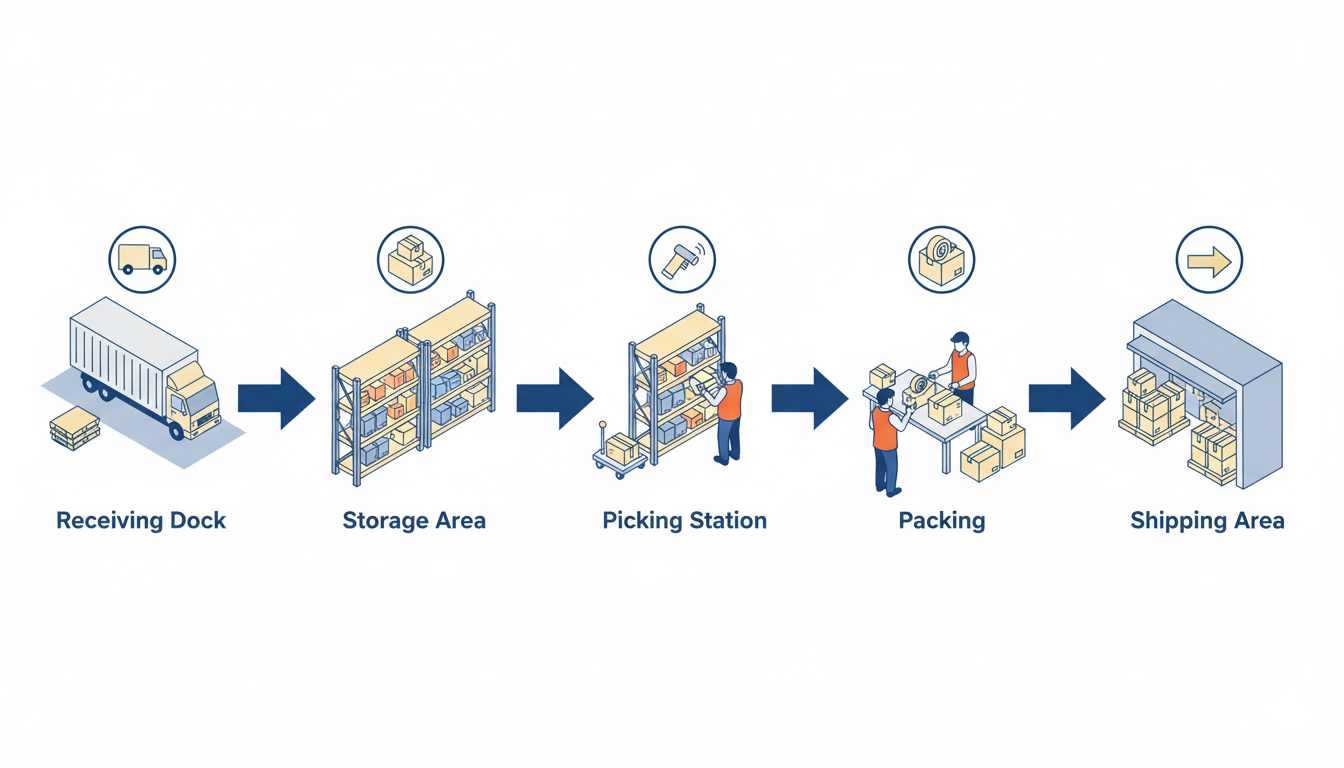
Illustrated infographic showing the complete e-commerce order fulfillment process from receiving to shipping

Key Fulfillment Models Explained

The world of fulfillment isn’t one-size-fits-all. Different models exist to serve businesses at various stages of growth. Let’s break down the most common types.

Third-Party Logistics (3PL) Providers

The most comprehensive solution is a third-party logistics (3PL) provider. What is a third-party fulfillment service? It’s a partnership where a company like Evolution Fulfillment takes over your entire supply chain, from inventory management to final delivery. This allows you to hand off the operational complexities of your business and focus on what you do best: developing great products and marketing your brand.

A modern 3PL provider integrates seamlessly with your e-commerce store. Key benefits include:

  • Scalability: Effortlessly handle a sudden surge in orders during holidays or promotions without missing a beat.
  • Expertise and Technology: Gain access to advanced warehouse management systems (WMS), optimized picking routes, and established relationships with shipping carriers for better rates.
  • Focus on Growth: Free up your time and capital to invest in product development, marketing campaigns, and customer service.

For brands looking to expand, especially into new markets like North America, a 3PL provides the local infrastructure and know-how to compete effectively from day one.

Fulfillment Centers vs. Traditional Warehouses

People often use the terms “warehouse” and “fulfillment center” interchangeably, but they serve very different purposes.

A traditional warehouse is primarily for long-term storage. It’s a static place to hold inventory with minimal movement.

So, what is a fulfilment warehouse or center? It’s a dynamic, active hub designed for speed and accuracy. At Evolution Fulfillment, our centers are built around technology that powers e-commerce.

Feature

Traditional Warehouse

Modern Fulfillment Center

Primary Goal

Static, long-term storage

Active processing of orders

Operations

Infrequent movement of goods in bulk

Constant picking, packing, and shipping

Technology

Basic inventory tracking

Integrated systems for real-time data

Focus

Storing products efficiently

Getting orders to customers quickly

Modern fulfillment centers use sophisticated software to sync with your online store, ensuring inventory counts are always accurate and preventing you from selling out-of-stock items. This technological advantage is crucial for providing a smooth customer experience.

Dropshipping

Dropshipping is a fulfillment model where you sell products you don’t actually own. When a customer places an order, you pass it along to your supplier, who then ships the product directly to the customer.

Advantages:

  • No need to invest in inventory.
  • Low startup costs and financial risk.
  • Ability to offer a wide variety of products.

Disadvantages:

  • Less control over shipping times and quality.
  • Lower profit margins.
  • Managing customer service for shipping issues can be difficult.

Dropshipping can be a great way to test new products or markets. At Evolution Fulfillment, we sometimes help brands use dropshipping as a strategic tool to validate demand in North America before they commit to holding inventory here.

Hybrid Fulfillment Models

A hybrid model mixes in-house fulfillment with outsourced services. This strategy gives you flexibility and control. For example, a business might handle its own local deliveries while partnering with a 3PL like Evolution Fulfillment to manage national or international shipping.

Another common hybrid approach is to manage core, high-margin products yourself while outsourcing seasonal or high-volume items. This allows you to maintain direct control over key products while leveraging a partner’s efficiency for others. This flexible strategy is perfect for businesses with fluctuating demand or unique product needs.

Core Services Offered by Fulfillment Companies

A true fulfillment partner offers much more than just storage and shipping. Their services are designed to support your entire operation.

  • Inventory Management: Advanced systems provide real-time visibility into your stock levels, track product movement, and even automate reorder alerts to prevent stockouts. This includes specialized protocols like first-in, first-out (FIFO) to manage products with expiration dates.
  • Order Processing and Shipping: Once an order connects to our system, our team uses optimized workflows to pick items accurately and pack them securely. We leverage relationships with multiple carriers to find the most cost-effective and reliable shipping option for every package.
  • Returns Management (Reverse Logistics): Handling returns can be a major headache. A fulfillment partner streamlines this process, inspecting returned items, restocking them if they meet quality standards, and keeping the customer informed. A smooth returns experience can turn a disappointed customer into a loyal one.
  • Value-Added Services: Many fulfillment companies offer services that help your brand stand out. At Evolution Fulfillment, we provide kitting (bundling multiple items into one package), custom gift wrapping, subscription box assembly, and branded packaging to create a unique unboxing experience for your customers.

Technology: The Engine of Modern Fulfillment

Technology is what separates a basic storage provider from a high-performing fulfillment partner. Seamless integration is non-negotiable for an e-commerce brand.

A top-tier partner like Evolution Fulfillment offers:

  • E-commerce Platform Integration: Pre-built connections to major platforms like Shopify, WooCommerce, and Amazon ensure that orders flow automatically from your store to the fulfillment center.
  • Inventory System Syncing: Real-time data exchange between your systems and the fulfillment center’s WMS guarantees accurate stock levels across all your sales channels, preventing overselling.
  • API-Based Connections: For businesses with custom-built systems, a flexible API allows for tailored integrations, ensuring all your technology works together harmoniously.

This level of connectivity gives you a complete, real-time view of your operations, from inventory levels to order status, empowering you to make smarter business decisions.

How to Choose the Right Fulfillment Partner

Selecting a partner is a major strategic decision. Here are key factors to consider.

  1. Your Business Stage and Goals: Are you a startup shipping 50 orders a month or an established brand shipping 5,000? Your order volume, growth plans, and budget will influence your choice. Look for a partner that can scale with you.
  2. Geographic Focus: Where are your customers? If you’re expanding into a new country, a partner with a local presence is essential. For brands entering Canada or the broader North American market, Evolution Fulfillment offers the infrastructure and expertise to ensure fast, affordable shipping and compliance with local regulations.
  3. Control vs. Efficiency: How much control do you want over the customer experience? Some brands want highly customized packaging for every order, while others prioritize speed and cost. Find a partner whose capabilities align with your brand’s priorities.
  4. Technology and Integration: Does the provider integrate easily with your existing e-commerce platform and other software? Ask for a demo and confirm they can support your technical needs.
  5. Cost Structure: Fulfillment pricing typically includes several components: initial setup fees, storage costs (per pallet or bin), pick-and-pack fees (per order or item), and shipping costs. Request a detailed quote and ensure you understand all potential charges.

Frequently Asked Questions (FAQ)

1. What kind of company is fulfillment?
A fulfillment company is a service provider that manages the entire order process for other businesses, primarily e-commerce brands. Their services include receiving inventory, storing it, picking and packing orders, and coordinating shipment to the end customer.

2. What is a fulfilment warehouse?
A fulfillment warehouse, or fulfillment center, is an active operational hub designed to process and ship online orders quickly and accurately. Unlike a traditional warehouse used for static storage, a fulfillment center uses technology and streamlined workflows to manage a high volume of individual orders.

3. What is a third-party fulfillment service?
A third-party fulfillment service (3PL) is a comprehensive partnership where a business outsources its entire logistics operation. The 3PL provider handles everything from inventory management and order processing to shipping and returns, allowing the business to focus on core activities like marketing and product development.

Ready to scale your business with the right fulfillment partner? Optimize your logistics for the Canadian and U.S. markets with Evolution Fulfillment’s expert warehouse services. Explore our solutions and build your strategy for sustainable growth today! https://evolutionfulfillment.com/


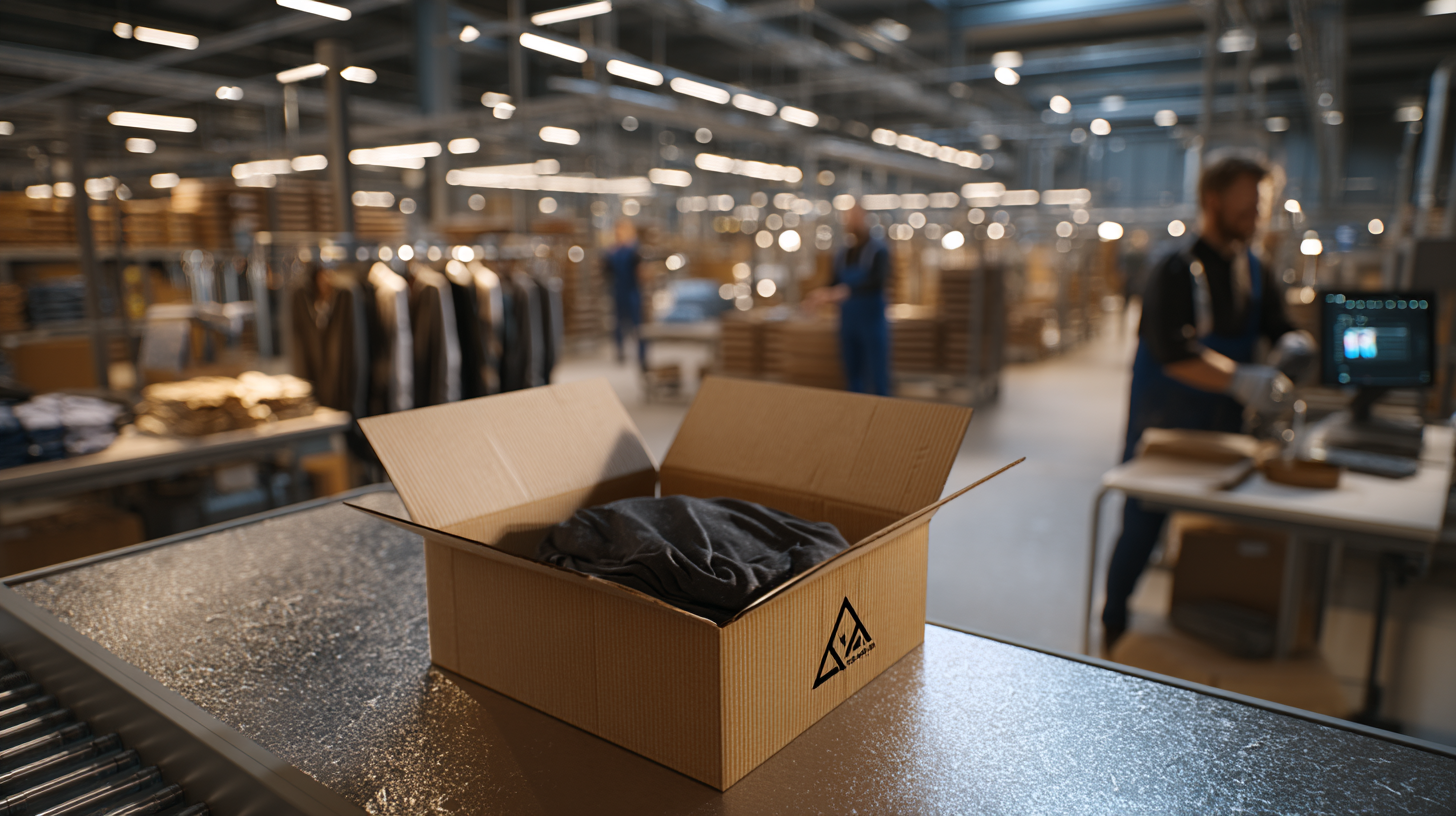
Modern apparel fulfillment center with organized clothing inventory and custom packaging

What if your fulfillment partner did more than just cut your shipping costs? For apparel brands, the right logistics partner is a secret weapon. A specialized 3PL for apparel brands understands the unique challenges of your industry—from managing countless size and color combinations to handling delicate fabrics and seasonal rushes. They can transform your fulfillment process from a cost center into a powerful tool that drives revenue, increases average order value (AOV), and builds lasting customer loyalty.

This guide explores five strategic ways an expert apparel 3PL can directly increase your profit margins while creating a superior customer experience. We will cover how to turn unboxing into a memorable brand moment, streamline cross-border shipping, master Amazon FBA prep, unify your sales channels, and turn returns into a revenue-positive opportunity.

Key Takeaways

  • Turn Fulfillment into a Brand Experience: Use custom packaging, personalized inserts, and garment care guides to increase AOV, boost repeat purchases, and reduce customer churn.
  • Simplify Cross-Border Shipping: Lower your landed costs and shorten delivery times by using domestic inventory strategies in target countries, which improves both your margins and the customer experience.
  • Optimize for Amazon FBA: Avoid costly penalties and delays with apparel-specific FBA prep services, ensuring your products get to customers faster while protecting your profit.
  • Unify B2B and B2C Operations: Scale efficiently through seasonal peaks by using a single, flexible system for both retail and direct-to-consumer orders, lowering your cost per order.
  • Convert Returns into Revenue: Implement an apparel-focused returns strategy that uses smart exchanges, refurbishment, and resale channels to recover value and protect customer lifetime value (LTV).

Why Your Apparel 3PL Directly Links Customer Experience and Margins

In the apparel industry, fulfillment isn’t just about moving boxes; it’s a critical part of your brand’s relationship with its customers. With ecommerce return rates for clothing often falling between 25% and 40%, and fulfillment costs eating up 12–20% of revenue, every decision matters. A specialized apparel 3PL acts as a strategic partner, managing your inventory, orders, shipping, and returns with precision.

They are experts in handling the complexities of apparel, from size and color variations to fabric care and multi-channel sales (B2B and B2C). By treating fulfillment as a key part of the customer journey, you can significantly improve your financial results. For example, one brand saw its return rates fall and repeat purchases climb simply by adding quality control checks and launching a two-day delivery option. Let’s look at five ways you can achieve similar results.

1. Create a Memorable Brand Experience with Every Order

Your fulfillment process is one of the most direct touchpoints you have with your customers. Making it special can pay huge dividends.

Why it matters: Thoughtful details in your packaging and presentation can significantly increase order value and customer retention. A curated unboxing experience with personalized touches can lift your AOV by 5–15%. Including helpful content, like a garment care guide, can even cut returns by 5–10%.

How it works: An apparel 3PL can set up a “Brand Fulfillment Model.” This involves creating rules within their Warehouse Management System (WMS) to automatically include branded packaging, personalized notes, or special inserts based on the customer or order. Imagine a customer receiving a seasonal collection in beautiful packaging with a care guide and a special offer for their next purchase. One brand that did this saw its repeat purchase rate climb by 8–12%. This approach allows you to scale personalization without slowing down your warehouse operations.

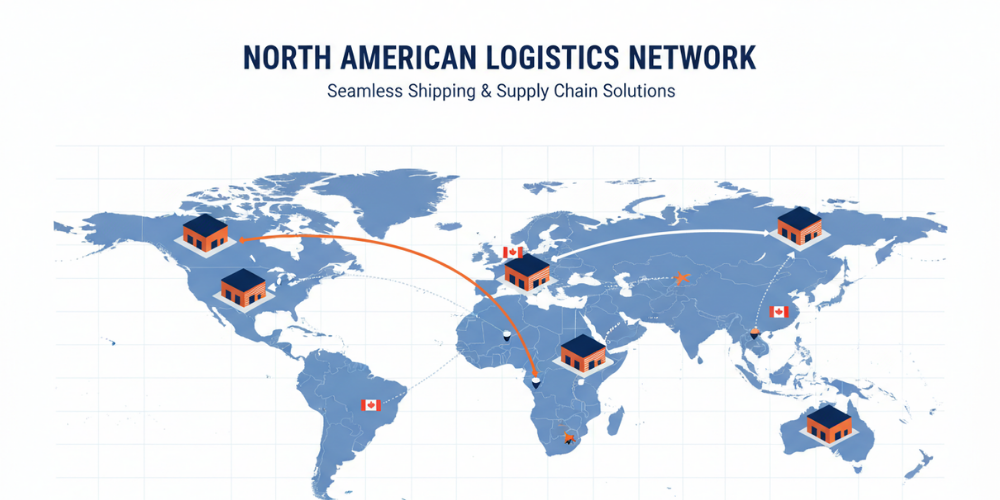
Cross-border shipping routes between US and Canada warehouses for apparel fulfillment

2. Domesticate Cross-Border Shipping to Cut Costs and Delays

Expanding into new markets like the US or Canada is a major growth opportunity, but cross-border shipping can be a drag on margins and customer satisfaction.

Why it matters: Duties and taxes can add 10–20% to your product’s landed cost, making your prices less competitive. By partnering with apparel 3PL companies that have warehouses in your target countries, you can cut transit times by 1–3 days and reduce cross-border returns. A Canadian brand that started storing inventory in the US saw its on-time delivery rate jump to over 98% while its landed cost per order dropped by 12%.

How it works: Your 3PL can help you set up an in-country inventory strategy. This involves deciding on the right inventory to stock locally, handling customs by pre-classifying products, and establishing a local return address to simplify the process for customers. Displaying duties estimates at checkout also prevents surprises and builds trust.

3. Master Apparel-Specific Amazon FBA Prep to Protect Margins

Selling on Amazon is a massive revenue opportunity, but its strict fulfillment requirements can be a minefield for apparel brands.

Why it matters: Failure to comply with Amazon’s rules can lead to penalties that shave 1–3 points off your margin, plus receiving delays of up to five days. An expert apparel 3PL knows exactly how to prepare your products for FBA, from specific folding techniques to proper polybagging and labeling. This precision prevents chargebacks and gets your products available for sale faster.

How it works: Effective FBA prep is a detailed workflow. It includes folding garments according to Amazon’s guide, using compliant polybags with warning labels, ensuring barcode accuracy, and providing photo-based quality control. By treating FBA prep as a critical compliance step rather than an afterthought, you can unlock Amazon’s full potential without sacrificing profit.

4. Unify B2B and B2C Fulfillment to Scale Efficiently

Many apparel brands sell through multiple channels, including direct-to-consumer (DTC) and wholesale (B2B). Managing these simultaneously, especially during peak season, can strain your operations and inflate costs.

Why it matters: If your inventory and labor aren’t aligned across channels, you risk stockouts, expensive expedited shipping, and missed retail deadlines. A unified fulfillment system can reduce pick times by 10–20% and eliminate the 1–2% of revenue often lost to retailer chargebacks from non-compliance. One brand that cross-trained its teams for peak season eliminated overtime spikes and maintained a 98% on-time shipping rate.

How it works: Your 3PL can use a single pool of inventory and allocate it based on real-time demand from each channel. They use smart order routing from distributed warehouses to lower shipping costs and implement specific workflows for wholesale, like creating pre-packs. This creates a flexible, efficient operation that handles seasonal swings without breaking the bank.

5. Turn Returns into Revenue with Smart Reverse Logistics

Returns are inevitable in apparel, but they don’t have to be a total loss. With the right strategy, you can recover significant value.

Why it matters: An effective returns process can be a powerful tool for customer retention and revenue recovery. Offering instant exchanges at the start of the return process can protect 15–30% of at-risk revenue. Furthermore, quickly refurbishing and restocking items within 24–48 hours can boost value recovery by 10–25%.

How it works: Top apparel fulfillment services go beyond just processing returns. They capture detailed reason codes (e.g., fit, quality) to inform your product and marketing teams. Items are graded upon arrival and routed to the most valuable next step: restock, refurbishment (steaming, re-bagging), resale on a secondary marketplace, or donation. This turns a costly problem into a strategic advantage.

The Technology Behind High-Performing Apparel Fulfillment

The right technology is the foundation that prevents margin leakage and enables great service. Real-time inventory visibility prevents stockouts and reduces the need for expensive expedited shipping. A modern WMS connected to your ecommerce platform can automatically trigger personalized offers at the packing station without slowing down the line. This combination of speed and personalization is key to scaling a premium customer experience.

Operational Nuances Many Apparel 3PLs Overlook

Small details in how garments are handled can have a big impact on your bottom line. For example, using “Garment on Hanger” (GOH) storage for delicate or high-value items preserves their finish and reduces returns due to wrinkling or damage. For more basic items, flat-pack storage is more space-efficient. An expert 3PL knows how to match the storage method to the fabric, price point, and seasonality of your products. They also manage environmental factors like humidity and lighting to protect your inventory.

Who Benefits Most from a Specialized Apparel 3PL?

If you’re wondering whether your brand is ready for a specialized apparel 3PL, here are a few indicators. You are likely a good fit if your brand is:

  • Shipping over 2,500 DTC units per month.
  • Moving over 500 pallets for wholesale.
  • Generating between $5 million and $20 million in annual revenue.
  • Selling across multiple channels (e.g., Shopify, Amazon, and US retail).

To ensure a smooth transition, you should have clean SKU data, clear routing guides for retail partners, defined returns policies, and documented packaging specifications.

Implementation Roadmap: A Phased Approach to Success

A successful partnership starts with a structured implementation plan. The process from initial discovery to a pilot launch typically takes 30–60 days. A phased pilot is the best way to reduce risk and work out any issues before you scale up.

A typical pilot approach includes:

  1. Onboarding SKUs in phases to ensure data accuracy.
  2. Validating packaging standards with test shipments.
  3. Testing API connections between your systems and the 3PL’s WMS.
  4. Simulating peak season labor models to prepare for high-volume periods.

By launching one channel at a time and setting clear performance metrics, you can ensure a seamless transition without disrupting your business.

FAQs: 3PL for Apparel Brands

What are the main benefits of using a 3PL for an apparel business?
A specialized 3PL for apparel brands helps you increase your on-time shipping rate to over 98%, reduce costly retailer chargebacks, lower landed costs for international orders through in-country inventory, and improve the customer experience with branded fulfillment.

How do 3PLs handle returns and cross-border shipping?
They implement smart returns processes like instant exchanges to protect revenue and refurbish items to recover value. For cross-border shipping, they use in-country warehousing and customs expertise to lower duties and shorten transit times, creating a seamless experience for international customers.

Final Thoughts

A specialized apparel 3PL transforms fulfillment from a necessary expense into a strategic asset. By focusing on the five key areas—branded experiences, cross-border efficiency, FBA compliance, unified operations, and value-recovering returns—you can directly improve your margins and build a loyal customer base. If your brand is ready to scale and you have your operational data in order, partnering with an expert in apparel fulfillment services could be the key to unlocking your next stage of growth

Take your apparel brand to the next level with seamless, efficient, and customer-focused fulfillment services. Partner with Evolution Fulfillment and turn your operations into a growth-driving advantage. Click here to learn how we can help your business scale.


Introduction

Canada’s third-party logistics (3PL) providers can be a powerful growth driver for mid-market apparel brands expanding into the U.S. A 3PL stores and ships your orders for you, combining domesticated cross-border delivery, deep customs expertise, apparel-specific fulfillment, and real-time tracking. The right Canada-based logistics company can lower duties, shorten transit times, and help increase sales — without simply adding cost.


Below are five key strategies: 

Domesticated shipping approaches, brand-specific fulfillment models, customs and tariff planning, phased WMS/inventory automation, and integrated returns. Together, they deliver measurable improvements in cost, speed, compliance, and customer experience. We’ll also look at how a ready-to-go, high-care partner like Evolution Fulfillment puts these into action so you can scale profitably.


Key Takeaways

Canadian 3PLs are a smart choice for mid-market apparel brands entering the US. They combine domesticated cross-border shipping, customs expertise, apparel-first workflows, and real-time tracking — producing clear gains in speed and cost efficiency.

  • Cut costs and transit time with domesticated shipping. Streamline delivery by consolidating inventory, cross-docking, and using U.S. last-mile carriers from hubs in Vancouver or Toronto.
  • Choose brand fulfillment over generic 3PLs. Apparel-specific processes like size-based pick and pack, kitting, and Amazon FBA prep protect margins and improve accuracy.
  • Turn customs and tariffs into a competitive advantage. Standardize HS codes, leverage bonded warehousing, follow CBSA/CRA rules, and use broker-led processes to avoid delays.
  • Scale with WMS, inventory sync, and phased automation. Start with core integrations, then roll out automation in manageable MVP phases for steady ROI.
  • Stand out with integrated returns linked to cross-border flows. This often-overlooked step helps fashion brands convert more customers and track measurable cost and speed improvements.


Why Leading Apparel Brands Scale US Sales with a Canada Logistic Company

A Canadian-based l ogistics company becomes essential when order volume climbs quickly and SKUs — styles, sizes, colors — multiply. By combining cross-border flows, apparel-first handling, and customs management, they cut total landed costs and shave days off transit.

Quick snippet: Bundle orders in Canada, truck them to U.S. entry hubs, then hand them to domestic carriers. This reduces duties on qualifying parcels under Section 321, minimizes handling, and achieves 2–4 day delivery to major cities with higher accuracy and a smoother customer experience.


Common triggers to outsource:

  • Monthly volume of 2,500+ direct-to-consumer units
  • High SKU variation across sizes/colors
  • Margin pressure with a 2–4 day US delivery promise

Example: Brands shipping 2,500+ D2C units monthly often save 10–25% on parcel costs with domesticated cross-border consolidation.


When a Canadian Logistics Company is the Right Lever for Mid-Market Growth

Signals to outsource:

  • Rapid surges in US demand or seasonal spikes
  • Inventory split across Shopify, Amazon, and B2B channels
  • Warehouse strain leading to rising error or return rates

Example: Managing 1,000+ SKUs with size/color variations can push pick accuracy below 99.5% without apparel-first processes.

Business outcomes to target:

  • Duty/tariff savings with clear Delivered Duty Paid (DDP) options
  • 2–4 day US delivery to top metros
  • Pick accuracy above 99.8%
  • Strong customer satisfaction (CSAT), high Net Promoter Score (NPS), and defined returns SLAs

[btx_image image_id=”1968″ link=”/” position=”center”][/btx_image]

Domesticated Cross-Border Shipping: Cutting Costs and Days in Transit

Domesticated cross-border shipping consolidates parcels in Canada, moves them as commercial freight (or via Section 321 for eligible low-value orders), and injects them into US carriers for domestic delivery.


Myth-buster: International shipping doesn’t have to be slow or expensive. Done right, it means fewer customs stops, lower postage, and faster delivery windows.

Example: Consolidating from Vancouver/Toronto and using zone skipping can remove 1–3 days from transit times.


How it works:


1.Consolidate orders in Canada

2.Linehaul to US injection hubs

3.Inject into USPS, UPS, FedEx, or regional carriers as domestic parcels

4.Use Section 321 where eligible to bypass duties


Hub strategy:


Brand Fulfillment vs   One-Size-Fits-All 3PLs: Apparel-First Operations

Apparel fulfillment demands size-specific picking, variant barcoding, and value-added services. Generic 3PLs often lack GOH handling, FBA prep capabilities, or marketplace compliance workflows.

Example: Size/color mismatches drive more than half of preventable apparel returns.


Best practices:

  • Barcode scanning at the variant level
  • Double-scan or light-guided picking for accuracy
  • Right-size packaging to cut DIM weight and damage risk
  • Inserts or branded materials for premium unboxing


Customs, Tariffs, and Compliance as a Competitive Advantage

Standardizing HS codes, leveraging bonded warehousing, and documenting Importer/Exporter of Record steps keeps goods moving and costs down. Programs like USMCA/CUSMA, Section 321, and duty drawback can all reduce landed costs when applied correctly.

Example: A single HS misclassification can add days to delivery and increase costs through re-brokerage fees.

[btx_image image_id=”1969″ link=”/” position=”center”][/btx_image]

Network Design: Vancouver/Toronto Warehousing and US Coverage

Two Canadian hubs can cover most US markets efficiently. Vancouver shortens ocean-to-shelf times for West Coast demand, while Toronto connects quickly to dense Eastern networks.

Example: Vancouver to Seattle/Portland can be 1–2 days; Toronto to NYC/Chicago often 2–3 days.


Technology and Automation: WMS, Inventory Sync, and Phased Rollouts

Integrate WMS/OMS/TMS with API-based inventory syncing. Roll out automation in phases starting small, proving ROI, then expanding.

Example: Real-time sync reduces oversells by over 90%.


Integrated Returns + Domesticated Cross-Border: A Differentiated CX

Linking returns to domesticated shipping flows reduces costs, speeds refunds, and replenishes sellable stock faster.

Example: Consolidated US returns processed in Canada can cut per-return postage by 10–15%.


Conclusion

Partnering with a Canada-based logistics provider can turn cross-border complexity into a competitive edge. Consolidating inventory in Vancouver and Toronto, using domesticated shipping, and applying apparel-specific fulfillment can reduce landed costs, trim transit times by 1–3 days, and raise pick accuracy toward 99.8%+. Integrated returns keep inventory moving and customers satisfied. When volume, SKU complexity, or delivery promises exceed in-house capacity, outsourcing with clear KPIs and a phased plan keeps risk low and results high. The right partner blends customs expertise, integrated tech, and apparel-first services to protect margins and elevate the customer experience.


Key Takeaways

Canadian fulfillment centers remain a powerful strategy for mid-market brands looking to speed up US deliveries while maintaining operational efficiency. Here’s what to focus on: strategic inventory placement near the US border to minimize transit times; streamlined cross-border shipping processes; accurate per-SKU landed-cost calculations including all duties and fees; optimized Amazon FBA cross-border processes; and partnering with a 3PL that delivers consistent, predictable results.

Cut US Time in Transit with Near-Border Inventory

Placing inventory in Canadian hubs near the US border—or spreading it across multiple warehouses—can shave days off delivery times for many US regions. This strategic approach helps meet strict delivery SLAs (promised delivery times) without investing in full US warehousing infrastructure.

Streamline Cross-Border Shipping with Consolidation and Preclearance

With the elimination of Section 321 de minimis exemptions in August 2025, brands must adapt their cross-border strategies. The focus has shifted to efficient consolidation methods, accurate HS codes (customs codes), and carrier-led brokerage to minimize delays and costs. When executed properly with Evolution Fulfillment’s proven 3PL expertise, cross-border shipping can still provide significant cost advantages through bulk shipping and USPS injection.

Model Total Landed Cost the Right Way

Don’t rely on surface-level savings. Create comprehensive per-SKU models that include:

  • Storage fees
  • Pick & pack costs
  • Long-haul transport
  • Parcel rates
  • All applicable duties and tariffs (now required on all shipments)
  • Broker fees
  • Return costs for international orders
  • Foreign exchange impact

This complete analysis will show whether Canadian or US fulfillment offers the better value proposition for each product line.

[btx_image image_id=”1962″ link=”/” position=”center”][/btx_image]

Lower Amazon Issues with Proper FBA Prep and Removal Steps

If you sell on Amazon, your 3PL should be handling FBA labels, prep work, inbound removal orders, and clear playbooks for cross-border returns. Evolution Fulfillment’s Amazon FBA services ensure compliance with Amazon’s strict requirements, avoiding unnecessary chargebacks, delays, and extra handling fees.

Pick a 3PL with an Integrated Setup

Look for a partner that offers customs brokerage, Amazon removal workflows, and ready-to-use IT tools in one package. Features like real-time APIs, EDI, OMS/WMS sync, and returns portals reduce errors and make operations predictable. Evolution Fulfillment provides all these capabilities under one roof.

Introduction

For brands selling into the US market, a Canadian fulfillment center continues to be a strategic advantage—cutting delivery times, optimizing costs through consolidated shipping, and avoiding the expense of full US warehousing. Despite changes to trade policies in 2025, Canadian fulfillment remains viable when executed with the right strategies and partnerships.

In this article, we’ll explore the most important areas to consider: where to place stock, how to optimize cross-border shipping in the current regulatory environment, calculating true landed costs per SKU, Amazon FBA best practices, and what to look for in a 3PL partner.

Why a Canadian Fulfillment Center Accelerates US Delivery

Canadian hubs near the border feed parcels into US networks faster, reducing the number of zones shipments pass through—and in turn, cutting delivery time and parcel costs. This approach is particularly effective for coastal US orders and when working with regional carriers.

Quick fact: Canadian centers close to the US border can cut delivery times by 1–3 days through strategic consolidation and direct injection into USPS, leveraging automation to minimize customs processing time.

The Near-Border Advantage for Faster Last-Mile SLAs

Hubs in cities like Vancouver and Toronto can pass parcels to USPS and regional carriers more quickly than many inland US hubs. Fewer zones mean fewer days in transit and lower shipping costs.

Example: Shipping from Vancouver or Langley to Blaine, WA reduces Vancouver-to-Seattle delivery to just 1–2 days—compared to 3–4 days from certain US hubs.

Multi-Warehouse Strategy for North American Coverage

Using both east and west Canadian hubs, paired with US injection points, can achieve 2–3 day delivery for most US markets. Stock faster-moving SKUs closer to high-demand regions to protect SLAs without needing full US warehousing.

Quantifying speed gains by region:

  • West Coast: 1–2 days faster
  • Midwest: 1 day faster with Detroit/Buffalo injection
  • Northeast: 1–3 days faster via Champlain, NY zone-skipping

Running small transit tests will confirm exact savings for your routes.

Optimized Cross-Border Shipping: Consolidation, Preclearance, and Brokerage

While the Section 321 de minimis exemption ended in August 2025, Canadian fulfillment centers have adapted with more sophisticated strategies. The focus is now on consolidation efficiencies, where multiple parcels are bundled into single cross-border shipments, dramatically reducing per-unit shipping and customs processing costs.

Preclearance & Clean Data:

Using accurate HS codes, correct values, and complete consignee details keeps shipments moving. Pair this with carrier-led brokerage and automated EDI for fewer delays. Evolution Fulfillment’s expertise in cross-border documentation ensures smooth customs clearance.

DDP vs DAP:

DDP (Delivered Duty Paid) offers a superior customer experience by eliminating surprise fees at delivery. With all shipments now subject to duties, DDP has become the standard for maintaining customer satisfaction and reducing cart abandonment.

Landed Cost Modeling: Canada vs US Fulfillment

A true landed-cost model in the post-Section 321 era must include:

  • Storage fees
  • Pick & pack costs
  • Long-haul transport
  • Parcel rates
  • Full duties & tariffs (now applicable on all shipments)
  • Brokerage fees
  • Return handling
  • FX impact

The key is finding efficiency through volume consolidation and strategic routing rather than duty exemptions.

Amazon Workflows: FBA Prep, Cross-Border Inbound, and Removals

Follow Amazon’s rules to the letter—box planning, pallet standards, labeling—and ensure your 3PL handles it all under one roof to reduce chargebacks and delays.

Have playbooks for cross-border removal orders, including quality checks, relabeling, repairs, and redeployment to DTC or back to Amazon. Evolution Fulfillment’s Amazon FBA services include comprehensive removal and redeployment strategies.

[btx_image image_id=”1963″ link=”/” position=”center”][/btx_image]

Returns Management & Reverse Logistics

Make returns painless for US customers by offering a US return address and a simple portal. Consolidate returns weekly for cost savings, and set clear refund rules to speed up processing and improve customer satisfaction.

Core 3PL Capabilities for Predictable Cross-Border Success

The ideal partner will offer:

  • Scalable pick & pack operations
  • Integrated customs brokerage with duty management
  • Multiple carrier injection strategies
  • SLA tracking and root-cause analysis
  • Real-time tech integrations with your OMS/WMS/ERP

Implementation Roadmap

  1. Model network & demand patterns
  2. Ensure data & compliance readiness for new duty requirements
  3. Run a pilot phase with duty-inclusive pricing
  4. Go live with comprehensive KPI tracking

Decision Framework

Canadian fulfillment works best for mid-market DTC brands with:

  • Significant coastal US demand
  • Products that benefit from consolidated shipping
  • Need for buffer stock for Amazon FBA
  • Desire to avoid full US warehousing costs

However, US-based fulfillment may be better for bulky, heavy, or highly regulated goods where duty costs outweigh consolidation benefits.

Bottom Line:

Near-border Canadian fulfillment can still speed up deliveries by 1–3 days and optimize costs through strategic consolidation and efficient cross-border processes—without the expense of full US warehousing. While the elimination of Section 321 has changed the landscape, the right mix of consolidation strategies, preclearance processes, and strong 3PL partnerships turns cross-border shipping into a competitive advantage.

Ready to Transform Your Cross-Border Shipping?

Don’t let complex logistics hold your brand back from North American expansion. Evolution Fulfillment’s near-border warehouses and proven cross-border domesticated shipping solutions help brands like yours deliver to US customers 1-3 days faster while optimizing shipping costs through strategic consolidation.

Our white-glove approach combines cross-border expertise, pre-clearance processes, and seamless technology integration to make cross-border fulfillment efficient and predictable—without the overhead of US warehousing.


Vancouver can shave days and dollars off your North American distribution. With direct port, rail, road, and air links that shorten transit windows to the Western U.S., Vancouver improves SLA compliance and lowers operational costs through efficient cross‑border shipping and customs expertise—advantages that protect margin and brand experience for mid‑market fashion, cosmetics, and lifestyle brands.

This article covers five strategic advantages of Vancouver warehousing: multimodal connectivity, streamlined cross‑border strategies, a Brand Fulfillment Model with white‑glove handling and FBA prep, transparent cost-and-transit comparisons versus Toronto and PNW hubs, and integrated tech, compliance, and sustainability proof points. See how the right Canadian fulfillment center and a partnership‑focused 3PL can turn Vancouver’s geography into faster delivery, lower costs, and measurable commercial differentiation.


Key Takeaways

  • Exploit Vancouver’s multimodal connectivity to accelerate delivery: Vancouver’s port, rail, road, and air links enable faster, reliable routes to Western U.S. and broader North America, cutting transit times versus inland Canadian hubs and improving customer SLA compliance.
  • Use streamlined cross‑border shipping to lower operational costs and transit variability: Efficient shipping strategies—paired with customs expertise and brokerage—speed U.S. delivery and simplify returns for Canadian brands selling into the U.S. market.
  • Differentiate through a Brand Fulfillment Model tailored to fashion, cosmetics, and luxury: Position a 3PL (e.g., Evolution Fulfillment) as an extension of the brand with white‑glove handling, climate control, branded packaging, FBA prep, and returns workflows that protect margin and brand equity.
  • Make decisions with transparent cost and transit comparisons versus Toronto and PNW hubs: Publish side‑by‑side operational cost, labor, and transit-time analyses and ROI case studies to prove Vancouver’s commercial advantages and convert evaluation-stage buyers.
  • Win trust with integrated tech, compliance, and sustainability claims: Combine WMS real‑time tracking, customs/compliance support, and eco‑efficient warehousing practices—backed by case studies—to reassure brands about accuracy, speed, and ESG commitments.

Why Vancouver Warehousing Is a Strategic Move for North American Distribution

Vancouver warehousing means a Canada-based hub that uses the Port of Vancouver, CN/CPKC rail, road, and YVR air links to speed U.S. delivery, reduce operational costs via efficient Type 86 flows, and inject parcels into U.S. carriers to meet domestic SLAs.

Port of Vancouver = Canada’s largest; border ~56 km; Type 86 e-manifesting for expedited clearance. Example: a fashion brand cut West Coast delivery from 3–4 days (Toronto) to 1–2 days (Vancouver). Takeaway: shorter inbound + fast U.S. injection = lower operational costs and happier customers. Next: see multimodal connectivity.

Who This Approach Fits Best

Decision criteria: 2,500+ monthly outbound units or 500+ pallet moves; $5–20M brands; multichannel (retail + DTC).

Example: apparel + cosmetics mix, 2,000 SKUs, retail windows + direct sales.

Takeaway: complexity + U.S. growth = strong fit with a Canada logistic company offering brand services.

[btx_image image_id=”1958″ link=”/” position=”center”][/btx_image]

The Connectivity Advantage: Port, Rail, Road, and Air

This Canadian fulfillment center compresses time-in-transit and variability through multimodal options.

Port of Vancouver: Fast Ocean Access and Reliable Throughput

Asia→Vancouver sailings are typically 1–2 days faster than many PNW alternatives; shorter drayage from terminals to DCs reduces variability. Example: container availability variance fell versus inland imports. Takeaway: faster inbound replenishment stabilizes inventory. Keyword: canada logistic company.

Rail Links: CN and CPKC for DC Bypass and Intermodal Speed

Intermodal emits ~3–4x less CO2e than trucking and runs on predictable schedules. Example: DC bypass shipments to US Midwest meet tighter cutoffs. Takeaway: speed and resilience at lower emissions. Keyword: canadian fulfillment center.

Road Networks: Proximity to U.S. Border Crossings

Typical West Coast injection to US zones = ~1–2 days; strong parcel/LTL options enable zone-skipping. Example: zone-skipping cuts parcel surcharges on coast-to-coast moves. Takeaway: faster last-mile for West/Mountain regions. Keyword: canada logistic company. (see U.S. border crossings)

Air Freight: YVR Connectivity for High-Value and Expedited SKUs

Broad transpacific lift with late cut-offs supports urgent replenishment. Example: seasonal drops hit 2-day SLAs via air bridge. Takeaway: air bridges cover demand spikes. Keyword: canadian fulfillment center. (see YVR cargo)

Streamlined Cross-Border Shipping: How It Works and Why It Lowers Costs

Short answer: Type 86 flows + U.S. carrier injection make Canada→U.S. parcels behave like domestic shipments, improving speed and stabilizing TiT. Keyword: canadian fulfillment center.

The Mechanics: Type 86 and U.S. Carrier Injection

Process (simplified):

  1. Pick & pack in Canada with proper customs documentation.
  2. Type 86 e-manifesting for expedited customs clearance.
  3. Zone-skip and inject parcels into USPS/UPS/FedEx hubs in the U.S.

Example: cosmetics DTC achieves predictable TiT through efficient customs processing. Takeaway: stable TiT and operational efficiency. Keyword: canada logistic company.

Returns Made Simple: U.S. Return Address, Consolidation, and Refurb

Consolidated brokerage reduces processing fees; refurb/restock recovers margin. Example: apparel grading and restock within 48 hours. Takeaway: returns stop eroding LTV. Keyword: canadian fulfillment center.

Compliance and Risk Controls

Denied-party screening, FDA/CBP checks for cosmetics (Importing cosmetics), and audit trails in WMS reduce regulatory risk. Example: lot/expiry validation at receiving prevents relabel recalls. Takeaway: speed without compliance risk. Keyword: canada logistic company.

Vancouver Warehousing vs. Toronto and PNW Hubs: Transparent Cost and Transit Comparisons

Below is a quick decision matrix to compare TiT, drayage, operational costs, returns, and peak resilience.

Criteria Vancouver Toronto U.S. PNW
West Coast TiT 1–2 days 3–4 days 1–2 days
Drayage / inland cost Lower for coastal DCs Higher for Toronto→west Variable
Customs processing Type 86 efficiency Standard processing Domestic (no customs)
Returns handling US return address + consolidation Cross-border returns Domestic

Takeaway: model all-in operational cost, not just storage. Keyword: vancouver warehousing.

Transit-Time Benchmarks by Region

Indicative TiT: West Coast 1–2 days, Mountain 2–3, Midwest 3–4, East 4–6. Example: retail replenishment cutoffs met more often from Vancouver. Takeaway: better SLAs win share. Keyword: canadian fulfillment center.

Operational Cost Components You Should Model

Model: ocean/air + drayage + customs processing + parcel accessorials + returns + inventory-carry. Example: modeled scenarios show improved operational efficiency when zone-skipping and Type 86 are applied. Takeaway: model all-in, not just storage. Keyword: canada logistic company.

Labor, Facility, and Capacity Considerations

Stable local labor market and temp pools for peak. Example: peak ramp playbook enables scaling without SLA slippage. Takeaway: capacity without last-minute failures. Keyword: canadian fulfillment center.

Risk and Resilience Factors

Port redundancy + CN/CPKC rail options create alternatives. Example: diversion SOPs for storms. Takeaway: built-in Plan B. Keyword: canada logistic company.

[btx_image image_id=”1959″ link=”/” position=”center”][/btx_image]

A Brand Fulfillment Model Built for Fashion, Cosmetics, and Small Luxury Items

This Canadian fulfillment center provides white‑glove service protecting margin and brand experience. Transition to VAS below.

White-Glove Handling and Climate Control

Lot/expiry checks and climate zones protect sensitive SKUs. Example: luxury microfiber picks handled with single-SKU gloves to reduce damage. Takeaway: fewer damages/chargebacks. Keyword: canada logistic company.

Branded Packaging and Unboxing

Right-sizing reduces DIM weight and shipping cost. Example: gift wrap and kitting increased repeat purchase rates. Takeaway: experience = retention. Keyword: canadian fulfillment center.

Amazon FBA Prep and Marketplace Programs

Labeling, poly-bagging, cartonization for FBA/FBM; removals processed per SLA. Example: FBA removals handled within committed SLAs. Takeaway: FBA + FBM agility. Keyword: canada logistic company.

Retail Compliance and EDI

ASN accuracy and UCC‑128 labels avoid chargebacks. Example: EDI-driven ASN reduced manual checks. Takeaway: sell-through without fees. Keyword: canadian fulfillment center.

Returns Management and Refurbishment

Grading matrix and recommerce lift recovery (typical uplift example: 20–40%). Takeaway: margin protection. Keyword: canadian fulfillment center.

Technology Integration for Accuracy, Visibility, and Speed

Integrations

APIs/EDI connect Shopify, NetSuite, marketplaces; typical integration 30–45 days. Example: Shopify + NetSuite + EDI in 30–45 days. Takeaway: fewer exceptions, faster picks. Keywords: canadian fulfillment center, canada logistic company.

Visibility

Dashboards show live inventory, carrier status, customs events. Takeaway: proactive exceptions.

SLA Monitoring

Automated alerts for picks, cutoffs, and carrier injections. Takeaway: hit SLAs consistently.

Compliance, Quality, and Security

Trade: CUSMA/USMCA checks and tariff monitoring. Product: hazmat aerosols handling SOPs. Data/Security: CCTV, access controls, audit-ready WMS records. Example: audit-ready shipping records on demand. Takeaway: ship fast, stay compliant. Keywords: canadian fulfillment center, canada logistic company.

Sustainability Advantages of a Canadian Fulfillment Center in Vancouver

Inbound rail reduces CO2e vs truck; recycled packaging reduces DIM and weight. Example: intermodal shifts cut carbon and cost. Takeaway: lower carbon, lower cost. Keywords: canadian fulfillment center, canada logistic company.

ROI Modeling: Proving the Vancouver Warehousing Advantage

Methodology: model TiT, operational cost, returns, and service uplift. Scenarios: conservative, base, aggressive show operational cost savings through efficient processing and TiT -1 to -2 days West/Mountain. Margin levers: zone-skip, returns recovery, right-sizing. Keyword: vancouver warehousing. Takeaway: approvals move faster with modeled ROI.

Implementation Roadmap: From Assessment to Go-Live

Discovery (10 days): SKU audit, SLAs, peak needs. Integration (15–30 days): EDI mapping, API keys, UAT. Pilot (4–8 weeks): sample SKUs, Type 86 validation, carrier injection test, peak plan. Takeaway: value in weeks, not quarters. Keywords: canadian fulfillment center, canada logistic company.

What to Ask a Canada Logistic Company in Your RFP

  • Capabilities: lot/expiry, climate, FBA prep.
  • Cross-border: Type 86 workflows, customs expertise.
  • Tech: API rate limits, EDI testing windows.
  • Cost: all-in operational cost modeling, accessorial granularity.

Takeaway: no blind spots. Keyword: canada logistic company.

Evaluation Checklist for Decision-Makers

  • Strategic: Does modeled ROI ≥ your threshold? Are cutoffs met?
  • Operational: Type 86 workflows, EDI/API, returns SLA, climate control.
  • Financial: All-in operational cost vs. current hub; contract flexibility.

Takeaway: fast consensus. Keyword: canadian fulfillment center.

Risks and Contingencies to Plan For

Port/Rail: diversion SOPs for congestion. Regulatory: tariff monitoring and compliance updates. Demand: scalable temp labor and cross-dock options. Takeaway: fewer surprises. Keyword: canada logistic company.

How Evolution Fulfillment Delivers the Vancouver Advantage

Integrated tech (Shopify, NetSuite, EDI) + Brand Fulfillment Model across 135,000 sq. ft and three locations with 65 staff. Cross-border mastery: Type 86 e-manifesting, FBA prep, returns recovery. Specialized teams for fashion, cosmetics, and luxury plus social responsibility commitments. Example (modeled/illustrative): client regained 10% margin via returns recovery and zone-skipping. Takeaway: Evolution acts as an extension of your brand. Keywords: canadian fulfillment center, canada logistic company.

Frequently Asked Questions

  • What are the advantages of using a Vancouver warehouse for North American distribution?
    Faster West/Mountain TiT, lower drayage for coastal routes, efficient customs processing via Type 86, and strong rail/air links.
  • How much faster/cheaper is Vancouver vs. Toronto or the U.S. PNW?
    Indicative: West TiT -1 to -2 days vs Toronto; operational cost scenarios often show improvements when zone-skipping and efficient customs processing apply.
  • Can a Vancouver fulfillment center manage Amazon FBA prep and removals?
    Yes—labeling, poly-bagging, cartonization, and removals processing are standard SLAs.
  • How does Type 86 work for Canada→US shipments?
    Type 86 e‑manifesting speeds customs clearance; parcels are injected into US carriers for faster domestic delivery.
  • Do Vancouver 3PLs support climate control and retail compliance?
    Yes—lot/expiry, climate zones, ASN/EDI and retail labeling standards are routinely handled.

Final Thoughts

Vancouver warehousing delivers measurable advantages for North American distribution: faster West/Mountain transit times, lower operational costs via Type 86 flows and efficient customs processing, and resilient multimodal connectivity (port, rail, road, air). It best serves multichannel brands with scale, sensitive SKUs, and return-driven economics—helping stabilize inventory, protect margins through returns recovery and right-sizing, and reduce carbon intensity. Modeled scenarios show operational cost improvement and SLA gains in weeks, not quarters. For brands balancing growth, compliance, and customer experience, a Vancouver-based fulfillment strategy is a pragmatic lever to win market share.

Ready to evaluate a cross-border, efficient shipping solution? Learn how Evolution Fulfillment implements this model: https://evolutionfulfillment.com/fulfillment-services/


Key Takeaways

  • Distinguish storage from movement. Define each facility by its function. Amazon “warehouses” (storage pools) focus on inventory receipt and holding. Fulfillment Centers (FCs) and Distribution Centers (DCs) are designed for order processing, pick & pack, and shipping. Sortation and delivery stations optimize last-mile sequencing. For foundational distinctions, see educational overviews of warehouse and distribution centre roles.
  • Map Amazon facility types to services and fees. FBA manages end-to-end Amazon orders (storage + pick-pack + outbound fees + returns). MCF/FBM enable multi-channel fulfillment at Amazon rates. FC/DCs are Amazon’s core order processors, while sortation and delivery stations handle carrier handoffs. Each layer has distinct fee schedules and routing rules.
  • Break down the true per-order cost components. Include inbound freight, receiving and prep, storage (time-weighted), pick-and-pack, packaging materials, outbound shipping, returns handling, removals/long-term storage, marketplace fees, and kitting/assembly costs.
  • Quantify Amazon vs 3PL economics with landed cost per order. Compare the all-in cost (COGS + fulfillment + duties/VAT + last-mile), not just one-time charges. Amazon often wins on scale with simple SKUs; 3PLs can outperform on complex kits, custom packaging, and cross-border optimization.
  • Use SKU-level models for decision-making, not averages. Model high-, mid-, and low-velocity SKUs separately. Dense, small SKUs often favor FBA for lower per-unit fees, while oversized or slow-movers can be more cost-effective through 3PL or DC consolidation due to long-term storage penalties.
  • Factor cross-border/domestication into inventory strategy. Domesticating inventory (local fulfillment footprint) reduces transit times, duties, and returns friction, but it increases safety stock and carrying costs. Always model the trade-off between landed cost savings and higher working capital.
  • Prioritize control and brand experience when selecting 3PL vs Amazon. Choose 3PLs for custom packaging, inserts, subscription/boxed experiences, or seller-controlled returns. Lean on Amazon when speed, Prime SLAs, and Buy Box competitiveness are more important.
  • Account for hidden costs in Amazon ecosystems. Include inbound routing compliance fees, commingling risk, removal lead times, and packaging limitations. These factors often push mid-market brands toward hybrid or 3PL solutions.
  • Adopt a hybrid fulfillment strategy for cross-border growth. Split SKUs by role: use Amazon FBA for high-velocity domestic SKUs, 3PLs or domestic DCs for regulated, high-margin, or brand-sensitive SKUs, and MCF for multi-channel consolidation to balance costs and lead times.
  • Follow a structured vendor-selection checklist. Evaluate SLAs (OTD, accuracy), cost   transparency (line-item TCO), cross-border expertise (domestication, VAT/duties), tech integrations (API, inventory visibility), scalability, warehousing footprint, returns processing, and references for similar SKU profiles.
  • Run scenario-based cost comparisons before committing. Build 12–24 month TCO scenarios (orders/day, SKU mix, return rate, inventory days) comparing FBA-only, 3PL-only, and hybrid strategies. Stress-test for peak season surges and cross-border disruptions.
  • Leverage Evolution Fulfillment’s Brand Fulfillment Model as a blueprint. A branded, centralized 3PL layer can integrate with Amazon (MCF/FBA) to retain packaging and control, manage domestic inventory pools, and optimize cross-border domestication—ideal for mid-market brands scaling internationally.


What’s the difference between Amazon warehouse and fulfillment center and why should a mid-market brand care? A single routing decision (FBA vs a domestic 3PL or DC) can shift landed cost per order, service levels, and return experience. For seasonal or high‑margin SKUs, this swing can make or break your margin.

At Evolution Fulfillment, we build models that tie facility function to cost drivers. In this deep dive, we define storage versus movement, map Amazon facility types (FBA, MCF/FBM, FC, DC, sortation/delivery stations) to services and fees, break down per-order cost components, and show SKU‑level TCO models. You’ll get a practical decision framework, a vendor‑selection checklist, and our hybrid blueprint for domestic and cross‑border growth.

[btx_image image_id=”1951″ link=”/” position=”center”][/btx_image]

Key Takeaways Mid-Market Brands Should Internalize

  • Don’t conflate facilities. Warehouses primarily store inventory, while Fulfillment Centers (FCs) and Distribution Centers (DCs) are designed to move product—picking, packing, and shipping. Sortation and delivery stations focus on last-mile sequencing. Fees accrue where the work happens. For fundamentals, see BCIT’s overview of warehouses vs distribution centres.
  • Model the full fee stack. Factor in inbound freight, receiving and prep, time-weighted storage, pick/pack, packaging, outbound shipping and DIM charges, returns processing, removals or aged-inventory surcharges, software/integration, account management, and marketplace/platform fees.
  • Remember: storage ≠ fulfillment. Storage costs are time-based, while fulfillment costs are activity-based. Your cost model should allocate each separately to get a true picture of profitability.
  • Cross-border can make or break landed cost per order (LCO). Duties, VAT, brokerage, Importer/Exporter of Record (IOR/EOR) requirements, DDP vs DDU shipping, linehaul costs, and extra dwell days often outweigh postage savings.
  • Balance control vs speed. Amazon excels at postage density, Prime SLAs, and small/standard items. 3PLs shine with branded packaging, kitting, oversized or fragile products, regulated SKUs, and better returns control.
  • Hybrid strategies usually win. Use FBA for high-velocity Prime-native SKUs, MCF for non-Amazon channels where speed matters, and 3PL/DC setups for brand experience, wholesale/B2B, and cross-border domestication.
  • Stay aware of the 2025 fee landscape. Watch for Q4 peak storage multipliers (Oct–Dec), aged-inventory surcharges (181/271/365+ days), low-inventory-level fees (standard-size SKUs), and changes in removal/return processing fees and MCF service-level pricing.
  • Validate rates monthly. Amazon’s fee schedules and 3PL rate cards fluctuate by tier, region, and season. Always confirm against live rate cards before locking in decisions.
  • Use a vendor checklist. Evaluate providers based on SLAs (on-time delivery, accuracy), accuracy rates, warehouse footprint, cross-border expertise, WMS/API maturity, references, and transparent total cost of ownership (TCO) modeling.
  • Run scenario-based cost comparisons. Model 12–24 months of data (orders/day, SKU mix, return rate, inventory days) for FBA-only, 3PL-only, and hybrid setups. Stress-test for peak season volatility and cross-border disruptions before committing.

What’s the Difference Between an Amazon Warehouse and a Fulfillment Center?


A “warehouse” is optimized for storage and inventory posture. A “fulfillment center” (FC) is engineered for rapid movement, picking, packing, and shipping. For foundational distinctions used in Canadian supply chain education, review warehouse and distribution centre concepts.

Conflating them leads to flawed cost models. Teams that treat FC racks as “cheap storage” under-allocate labor and transportation and overstate margins. We correct that early in every Evolution Fulfillment engagement.

A distribution center (DC) balances bulk movement and replenishment between nodes. Sortation and delivery stations handle downstream batching and last‑mile injection.

Facility functions determine where fees accrue. Storage is time‑based; movement is event‑based. Your model must follow the flow.

Facility-by-Function: Storage vs Movement

Not all facilities are created equal warehouses and DCs are designed to hold and move inventory in bulk (pallets or cases), while fulfillment centers (FCs) specialize in breaking inventory down into orders (eaches, kits) under strict SLAs. On the tail end, sortation and delivery stations sequence parcels for efficient carrier handoff.

The Cost Drivers Split in Two

  • Storage is time-weighted. You’re charged based on how long goods sit in a space. For example, a standard bin of 0.7 ft³ at $1.00/ft³/month costs about $0.70/month, while a pallet ($22–$35/month) spreads cost over all units it holds.
  • Movement is event-priced. Every action—receiving, picking, packaging, and outbound shipping—incurs per-unit fees. A typical structure might be $2.70 for the first pick + $0.45 per additional item. Factor in DIM-based postage, and packaging choice (box vs. mailer) can swing costs by $3 or more per order.

Why We Separate Them

At Evolution Fulfillment, we separate storage and movement into different cost centers. This prevents overhead from “hiding” labor and transport costs, ensuring each SKU gets an honest, activity-based allocation. That clarity helps brands see where their margin is really going—and make smarter decisions about SKU placement and packaging.

Amazon Network 101: FC, DC, Sortation, and Delivery Stations

Amazon’s logistics network is layered, with each type of facility serving a distinct role. Understanding these functions helps brands map services to fees and see exactly where costs accrue.

Fulfillment Center (FC)

This is the engine of Amazon fulfillment, where individual units (eaches, kits) are picked, packed, and shipped for FBA and MCF.

  • Fees vary by size tier (small, standard, oversize, special handling).
  • Prep, labeling, and accurate dimensions are critical. Even the packaging choice (envelope vs. box) can swing costs.

Distribution/Receive Center (DC)

Acts as Amazon’s inbound gateway.

  • Receives shipments from vendors or 3PLs.
  • Cross-docks inventory to FCs or holds reserve stock.
  • Fees show up as inbound freight, placement/service fees, and storage for buffer inventory.

Sortation Center

This is where parcels are consolidated and routed by region.

  • Parcels are inducted into Amazon Logistics or partner carriers.
  • Costs are embedded inside FBA/MCF outbound fees.

Delivery Station

The final staging point before orders reach the customer.

  • Amazon couriers or third-party drivers pick up here.
  • For FBM or 3PL shipments, you’ll see costs as carrier surcharges (residential, DAS, fuel).

[btx_image image_id=”1950″ link=”/” position=”center”][/btx_image]

Channel Flows in Action

  • • FBA: Vendor/3PL → DC → FC pick/pack → Sortation → Delivery.
  • • MCF: Non-Amazon orders run through the same FC → Sortation → Delivery flow, but branding options are limited.
  • • FBM: Seller or 3PL stores, picks, packs, and ships directly to carriers. Buy Box eligibility relies on SLA and price.

[btx_image image_id=”1954″ link=”/” position=”center”][/btx_image]

Map Amazon Facility Types to Services and Fees

FBA/MCF leverage FCs for pick/pack and storage, DCs for inbound placement, and Amazon Logistics (sortation/delivery) for last mile on eligible lanes. FBM bypasses Amazon’s FCs, using your 3PL/DC and third‑party carriers.

Fee mapping by activity:

  • DC/Placement: Inbound freight and placement/service fees.
  • FC Storage: Monthly $/ft³ with seasonality and aged-inventory surcharges.
  • FC Fulfillment: Pick/pack and outbound by size/weight/DIM tiers; category-specific returns.
  • Sortation/Delivery: Included in FBA/MCF outbound; in FBM, appears in parcel labels.
  • Admin: Low-inventory-level fees (select standard-size SKUs), refunds/returns, removals, and disposal.

At Evolution Fulfillment, we keep this mapping live in your dashboards, so finance and ops see the same truth.

[btx_image image_id=”1952″ link=”/” position=”center”]FBA Warehouses in North America[/btx_image]

FBA (Fulfillment by Amazon)

FBA handles end-to-end for Amazon channel orders:

  • Storage: Monthly $/ft³ with higher Oct–Dec multipliers. Validate your 2025 schedule by region. For example, a 10″×6″×4″ unit (0.14 ft³) at $1.00/ft³ costs ~$0.14 per unit per month.
  • Fulfillment: Pick/pack/outbound priced by size/weight/DIM. A small standard at 8 oz may land in a lower bracket than a 1.2 lb unit that crosses a weight tier.
  • Returns: Category-based processing. Apparel/footwear often incur per-return fees plus potential disposal if not restockable.
  • Aged inventory: Surcharges after 181/271/365+ days escalate with cubic feet and age band.
  • 2025 hotspots: Peak storage multipliers, low-inventory-level fees on standard-size, inventory placement/service fees, and higher removals during peak. Validate monthly updates.
  • FBA wins on Prime-native velocity where postage density and 1–2-day SLAs monetize. Evolution Fulfillment helps clients plan coverage days to avoid low-inventory-level fees while protecting Buy Box.

MCF (Multi-Channel Fulfillment)

MCF uses Amazon FCs to fulfill non-Amazon orders:

  • Rates vs FBA: Separate schedule by size/weight and service level (Standard, Expedited, Priority). Expect a ~$0.50–$2.50/order premium over FBA outbound for the same SKU.
  • Branding/packaging: Ships in non-branded packaging with constraints—limited custom tissue, inserts, or gift wrap at scale.
  • Integration/API: Reliable native apps and Order Routing APIs. Manage address validation and holds to avoid mis-picks.
  • When to prefer MCF vs 3PL: MCF can beat 3PLs on small/standard parcels in 2-day footprints when you lack carrier discounts. If you require custom packaging or high insert complexity, a 3PL often wins.

Evolution Fulfillment frequently pairs MCF for DTC speed with our branded 3PL flows for gifting and subscription experiences.

[btx_image image_id=”1955″ link=”/” position=”center”]Multi Channel Fulfillment by Amazon[/btx_image]

FBM and Seller-Operated/3PL Fulfillment

FBM relies on the seller or 3PL to meet Amazon SLAs:

  • SLAs/Buy Box: On-time delivery, valid tracking, and price competitiveness drive Buy Box share. Missing 2-day promises in key metros depresses conversion.
  • Tracking/compliance: Maintain 98–99% on-time and <1% defect rates for safety.
  • Cost/control advantages: Oversize, fragile, hazmat, or kitting-intensive products often favor a 3PL.

Evolution Fulfillment helps brands hit FBM SLAs with custom packaging, serial/lot capture, and negotiated carrier programs that reduce all-in costs on non-standard items.

Sortation/Delivery Stations and Carrier Handoffs

Linehaul ends at sortation; last-mile begins at delivery stations:

  • Who pays: In FBA/MCF, outbound rates are all-in for these legs. In FBM/3PL, you pay carrier labels with fuel, DAS, and residential surcharges itemized.
  • Fee visibility: Amazon embeds sortation; 3PL invoices show parcel cost + surcharges. Your WMS should map these to LCO.
  • DIM example: A 14″×10″×8″ carton at 1.8 lb actual but 7.0 lb DIM jumps to Zone 6 DIM pricing. Right-sizing or switching to a poly at 0.9 lb actual can cut $3–$5 per order. For a neutral definition of chargeable dimensional (volumetric) weight, see IATA’s air cargo tariffs and rules overview.

Evolution Fulfillment’s cartonization engine auto-selects the lowest-cost compliant packaging to avoid DIM surprises.

Operational Workflows: Receiving, Storage, Pick & Pack, Returns

Every stage of the fulfillment process, receiving, storage, pick/pack, and returns adds both time and cost. Managing these steps with clear SOPs (standard operating procedures) prevents chargebacks, keeps costs predictable, and protects cash flow.

Inbound Compliance and Prep

The receiving stage sets the tone for the rest of the process. Errors here ripple downstream into higher costs and delays.

  • ASNs and labels: Incorrect purchase order (PO) or advance shipment notice (ASN) mapping—or missing SSCC/GTIN labels—triggers non-compliance penalties. For barcode/labeling best practices, see the GS1 Canada distribution centre guideline.
  • Carton/pallet routing: Appointment windows, pallet height/weight caps, and floor-load rules must be followed to avoid dwell time charges.
  • Prep rules: Poly-bag suffocation warnings, bubble wrap, barcode placement, and label coverage all affect compliance. Outsourcing FNSKU labeling costs more per unit, but during peak season it often preserves throughput.
  • Penalties and dwell: Non-scannable barcodes, mixed SKUs in a carton, or unannounced overages trigger manual handling billed at hourly rates.
  • SOPs: Pack-to-spec checklists, cartonization manifests, barcode validation, pre-ship audits, and prebooked appointments reduce risk.

[btx_image image_id=”1953″ link=”/” position=”center”]Amazon Order Management Infographic[/btx_image]

At Evolution Fulfillment, we enforce a pre-receipt audit that catches inbound errors before stock hits the dock—shortening dock-to-stock time and preventing costly defects.

Storage and Time-Weighted Inventory Costs

  • Inventory carrying cost grows with every extra day in storage. Understanding the tiers and timing is key:
  • Tiers: Standard, oversize, or special-handling (hazmat/liquids). Each comes with its own rate card, often rising in Q4.
  • Cubic-foot calculations: (L × W × H in inches ÷ 1728) = ft³. Multiply by $/ft³ and the months stored.
  • Aged thresholds: Surcharges at 181/271/365 days often exceed base storage rates.
  • Buffer vs. safety stock: More days on hand increase exposure to aged fees.
  • Seasonality: Pre-staging in upstream DCs or bonded warehouses can help you avoid costly in-season FC storage.

We calibrate reorder points by node, so brands don’t end up paying Q4 storage rates for SKUs that move slowly.

Pick-Pack and Packaging Standards

  • Packaging is where accuracy, costs, and brand experience intersect.
  • Envelope vs. box: Small changes in dimensions can shift DIM weight and affect shipping cost brackets. Inserts and dunnage add ounces that tip parcels into higher fee ranges.
  • Amazon vs. 3PL: Amazon optimizes for protection and speed; 3PLs enable customization, kitting, and branded unboxing.
  • Sustainability: Right-sized, recyclable mailers can lower both cost and emissions, sometimes dropping a SKU into a cheaper weight class.
  • Accuracy and SLAs: Always compare pick/pack fees against Amazon’s embedded fulfillment fees on a true apples-to-apples basis.

At Evolution Fulfillment, we run packaging trials to balance cost savings with damage prevention, ensuring lower landed costs without risking SLA performance.

Returns, Removals, and Dispositions

  • Returns and removals don’t just affect customer experience—they directly shape your cash flow and margins.
  • Returns intake: Amazon charges category-based fees, while 3PLs typically price per RMA plus grading.
  • Grading/resell: Define clear A/B/C grading criteria and refurbishment rules to recover as much value as possible.
  • Removals: FBA removal/disposal fees rise during peak and may take weeks to complete. Inventory continues accruing storage fees until it exits the FC.
  • Timelines: Plan removals proactively to avoid aged surcharges.
  • Liquidation/donation: Weigh the recovery value from liquidation markets against carrying costs—or use donation programs to minimize loss.

Our returns team accelerates refurbishment and funnels inventory back into the most profitable resale or donation path.

Cost Model Foundations: What to Include Per Order

Per-order modeling must combine activity-based costs and time-based storage into a single LCO. Go beyond headline fees. Allocate software, integrations, and account management.

Evolution Fulfillment provides SKU‑level LCO dashboards, so finance can forecast and ops can act.

Landed Cost Per Order (LCO) Formula

LCO = Inbound Freight + Receiving/Prep + Placement/Labeling + Time-Weighted Storage + Pick/Pack Labor + Packaging Materials + Outbound Postage (incl. DIM/fuel) + Marketplace Fees (referral/MCF uplift) + Returns/Refund Reserve + Removals/Aged Surcharges (allocated) + Software/Integration + Account Management + Cross-Border (Duties/VAT/Brokerage) + Payment/Fintech Fees.

Components:

  • Inbound freight: Allocate by units on the load.
  • Receiving/prep: Include labeling and rework.
  • Storage: ft³ × $/ft³ × months/12; add peak multipliers and aged bands.
  • Pick/pack: First-pick + add-ons; or FBA/MCF per-unit fulfillment.
  • Packaging: Materials at actual cost.
  • Outbound: Zone/DIM with fuel.
  • Marketplace fees: Referral rates; MCF premiums for faster service.
  • Returns: Rate × cost per return.
  • Removals/aged: Expected removals and surcharges allocated per unit.
  • Cross-border: Duties/VAT, brokerage, DDP vs DDU.
  • Overheads: WMS/OMS, integrations, account management.
  • Payment: Gateway and settlement fees by channel.

For industry-standard definitions of total cost to serve and landed cost metrics, see ASCM’s Digital Capabilities Model references to Total Cost to Serve and Total Network Landed Cost

Variable vs Fixed Allocations

  • Variable: Pick/pack, packaging, postage/DIM, returns processing, per-unit FBA/MCF fees, duties/VAT.
  • Semi-variable: Receiving/prep, removals, aged inventory surcharges.
  • Fixed/allocated: WMS/OMS/API, account management, BI/analytics.
  • Peak surcharges: Holiday storage multipliers; carrier peak adders.
  • DIM pricing: Manage with cartonization logic to auto-select mailers and avoid DIM jumps.

We separate these buckets so you can test scenarios without double-counting.

Amazon 2025 Fee Landscape: FBA and MCF

Amazon’s 2025 fulfillment fees continue to evolve. Expect sharper differentiation by size tier and weight bracket, heavier storage pressures in Q4, and more refined surcharges. Always validate against the live 2025 Amazon rate cards, since tiers and seasonality vary by region and can be updated mid-year.

FBA: Size Tiers, Weight Brackets, and Storage Seasons

  • Tiers: Amazon fulfillment fees are based on four categories—small standard, standard, oversize, and special handling.
  • Weight brackets: Crossing a threshold can add several dollars per order. For example, a SKU that shifts from 1.0 lb to 1.2 lb may jump into a higher bracket.
  • Storage seasons: From October through December, multipliers often run 1.5×–2× higher than base rates.

Example: A 1.0 lb standard-size SKU held for 45 days may cost pennies in storage during the off-season, but face meaningful multipliers in Q4.

At Evolution Fulfillment, we stress-test packaging options early to help brands keep SKUs inside favorable weight brackets and storage tiers.

MCF: Rate Cards and Service Levels

Amazon’s Multi-Channel Fulfillment (MCF) program runs in parallel with FBA but applies a different fee structure.

  • Service levels: Standard: 3–5 business days, Expedited: 2–3 business days, Priority: 2-day delivery
  • Pricing: MCF carries a premium over FBA for the same SKU—typically $0.50–$2.50 per order more. The spread widens at higher shipping zones and during peak periods.
  • Branding limits: MCF ships in non-branded packaging, which is fine for replenishment or commodity SKUs, but limiting for lifestyle, gifting, and subscription experiences.
  • Integration: Route only eligible SKUs into MCF. Complex kits, custom packaging, or high-insert products are better suited to your 3PL.

We route DTC orders dynamically between MCF and our 3PL operations based on margin and brand goals.

How Much Does 3rd-Party Fulfillment Cost in 2025? (3PL Pricing Ranges)

So, how much does 3rd-party fulfillment actually cost? The short answer: it depends on activity and postage. For mid-market brands, pricing is activity-based, and ranges vary by region, season, and volume. Think of the numbers below as directional benchmarks always confirm with live quotes before locking in.

Typical 3PL Line Items

Here’s what you can expect on a standard 3PL rate card:

  • Setup/Implementation: $0–$5,000 one-time. Integrations run $0–$500 per connector. Onboarding: 2–6 weeks.
  • Receiving: $35–$55/hour or $5–$12/pallet. Carton-level: $0.15–$0.40/carton. Labeling: $0.20–$0.40/unit.
  • Storage: $15–$35/pallet/month, or $0.50–$1.20 per ft³. Bin storage: $1.00–$4.00/bin/month. Q4 surcharges are common.
  • Pick/Pack: $2.00–$3.50 for the first pick; $0.25–$0.75 for each additional unit. Lot/serial capture: +$0.05–$0.15.
  • Packaging: Mailers: $0.12–$0.30. Boxes: $0.35–$1.20. Dunnage: $0.05–$0.20. Branded packaging: cost + 5–15%.
  • Inserts/Kitting: $0.10–$0.45 for simple inserts. Complex kitting/assembly: $40–$75/hour.
  • Returns (RMA): $2.50–$5.00 per unit (basic QC included). Refurbishing: $0.50–$2.00.
  • VAS (Value-Added Services): FBA prep, ticketing, GOH, compliance photos at $40–$85/hour.
  • Account Management: $250–$1,000/month (sometimes bundled with reporting/BI).
  • Postage: Carrier labels at negotiated rates. Markup: 0–10% or pass-through. Fuel/DAS/residential surcharges apply.

[btx_image image_id=”1949″ link=”/” position=”center”][/btx_image]

At Evolution Fulfillment, we quote transparent line items and build SKU-level models with you, so there are no surprises.

All-In Benchmarks by Order Profile

To make it more practical, here’s what all-in fulfillment + postage might look like:

  • Small/light DTC (≤1 lb, 1–2 units): Ops $3.00–$5.50; Postage $4.50–$8.50 → $7.50–$14.00 all-in.
  • Multicart (3–5 units): Ops $3.75–$7.00; Postage $6.50–$10.50 → $10.25–$17.50 all-in.
  • Oversize/fragile (≥10 lb or large DIM): Ops $5.50–$12.00; Transport $12–$28 → $18–$40 all-in.
  • Subscription/kitting: Ops $4.50–$8.50; Postage $4.50–$9.50 → $9.00–$18.00 all-in.
  • Wholesale/B2B (case/pallet): Ops $20–$60; LTL $80–$300+.

Evolution benchmarks your SKUs against these ranges, then negotiates carrier tiers to help close any cost gaps.

Build SKU-Level Models (Not Averages)

Average orders hide pain and opportunity. Model by SKU clusters—velocity, size tier, return rate, and seasonality—then roll up to channel P&L.

Evolution Fulfillment’s analysts segment SKUs and reveal where FBA, MCF, or 3PL wins.

Velocity and Size-Tier Scenarios

Not all SKUs are created equal and they shouldn’t be modeled as if they are. Different product profiles behave very differently when it comes to fulfillment economics.

  • Dense smalls (≤8 oz): Amazon FBA/MCF usually dominate thanks to their postage scale and fast shipping speeds.
  • Standard-size (1–2 lb): Costs come down to packaging choices and zone distribution—sometimes Amazon wins, sometimes a 3PL does.
  • Oversize or slow movers: Long-term storage fees and aged-inventory penalties can make Amazon prohibitively expensive. These SKUs are often better off in a 3PL/DC consolidation model or FBM setup.
  • Kits and bundles: Pre-assembling kits reduces peak complexity. Amazon prefers pre-kitted SKUs because it keeps fulfillment smoother.
  • Returns-intensive categories: Items like cosmetics or apparel typically benefit from a 3PL’s grading and refurbishment process, which can recover value and protect margins.

Time-in-Storage Sensitivity

Storage isn’t just about monthly costs it’s about how long inventory sits and where.

  • Days on Hand (DOH): More days = higher storage allocations and more exposure to aged inventory fees.
  • Aged penalties: Crossing Amazon’s 181/271/365+ day thresholds adds step costs that eat into margin.
  • Safety stock complexity: Spreading stock across multiple FBA nodes raises aggregate inventory. In many cases, a single 3PL hub with strong 2-day coverage can cut that down significantly.

Packaging and Brand Experience Premiums

Packaging doesn’t just protect products it also shapes brand perception and customer retention.

  • LTV/CVR lift: Branded unboxing and thoughtful inserts can boost conversion rates and repeat purchases.
  • CAC payback: Prime’s 2-day delivery badge improves conversion—but branded packaging can offset CAC by strengthening loyalty.
  • Returns moderation: Including guides, size charts, or “how-to” inserts reduces returns and lifts net margin.

At Evolution Fulfillment, we run A/B tests that measure the trade-offs between brand experience and speed, so you’re not guessing which path delivers the best ROI you’re working from real data.

Case-Modeled Comparisons: Amazon vs 3PL Economics

No single fulfillment model is universally cheaper. The right choice depends heavily on SKU profile, velocity, and returns behavior. Here are three modeled cases that highlight where Amazon vs a 3PL typically wins.

Case A: Small-Light, High Velocity (Prime-Native)

Assumptions:  8-oz small standard, 0.12 ft³, 20 DOH, apparel returns 12%, 80% Amazon / 20% DTC. Zones skew 4–7

  • FBA: Storage ~$0.01; fulfillment ~$3.40; returns reserve ~$0.24.
  • MCF for DTC: 2-day often $1.00–$2.00 below a comparable 3PL label.
  • 3PL: Ops ~$3.25; postage ~$8.50; branded packaging +$0.35 with possible CVR lift. Outcome: FBA/MCF win on speed and scale. One Evolution client cut LCO by 11% (~$420k/year on 380k orders) by moving small‑lights to FBA/MCF while keeping branded kits in our 3PL.


Case B: Standard-Size, Medium Velocity (Mixed Channels)

Assumptions: 1.6 lb standard, 13″×9″×2″, 45 DOH, returns 8%, 50% Amazon / 50% DTC/wholesale.

  • FBA: Storage pennies off‑peak; fulfillment ~$4.70.
  • MCF 2-day for DTC: ~$9.30 typical.
  • 3PL: Ops ~$3.75; mailer postage ~$8.10; insert $0.25; all‑in outbound ~$12.10. Outcome: Near tie after brand lift. An Evolution lifestyle client saw +2.4 pts CVR with branded unboxing, which offset higher 3PL ship costs on DTC while keeping Amazon orders in FBA.

Case C: Oversize / Slow-Moving or Kit Builds

Assumptions: 12 lb, 24″×16″×8″ (DIM 22 lb), 70 DOH, returns 4%, kits with 3 components.

  • FBA: Storage and aged risk drive up LCO; outbound $16–$22.
  • 3PL: Upstream DC storage ~$22/pallet/month; FBM ground ~$14.75; handling ~$4.50; pre‑kitting ~$0.80. Outcome: 3PL/DC beats FBA by $5–$9/order and avoids aged penalties. An Evolution housewares client reduced LCO 20% and freed $600k working capital by shifting oversize to our DC with carton optimization.


Cross-Border and Domestication Strategy

International expansion reshapes LCO. Duties/VAT, brokerage, and longer linehauls can erase postage savings. Decide per SKU whether to ship cross‑border DDP/DDU or domesticate into local stock.

Evolution Fulfillment operates bonded and domestic nodes to balance speed and cash.

Duties/VAT, IOR/EOR, and Transit Time Trade-Offs

  • Duties/VAT: HS codes drive duty; VAT/GST adds at destination.
  • IOR/EOR: Use your entity or a provider. Mismatches trigger holds and storage fees.
  • Transit time: Cross-border small parcel adds 2–6 days. Slower delivery often reduces conversion more than you save on postage.

Domestication: When Local Fulfillment Wins

Local nodes reduce last-mile cost and improve SLAs:

  • Lead time: 2-day ground is achievable domestically.
  • Duty savings: Bulk import lowers per-unit brokerage; drawback can recover duties on returns.
  • Returns ease: Local RMAs improve CX and reduce cost.
  • Trade-off: Higher safety stock ties capital. Domesticate when weekly volume per SKU supports local stock and LCO drops by ~$1.00+ at target SLA.

Tools: Bonded Warehouses, Duty Deferral/Drawback

  • Bonded warehouses: Store duty-unpaid until release. See a professional overview of the Canadian Customs Bonded Warehouse (CBW) concept from the Canadian Society of Customs Brokers.
  • Duty deferral: Defer GST/VAT until sale to improve cash conversion.
  • Drawback: Recover duties on re-exports or returns with documentation.

Evolution Fulfillment’s Vancouver bonded DC feeds Canadian FBA for Prime SKUs and ships DTC from our domestic node to avoid double taxation.

Hidden Costs and Constraints in Amazon Ecosystems

Beyond published fees, operational realities matter. Include inbound routing penalties, commingling risks, removal delays, and packaging limits in your model.

Inbound Routing Non-Compliance and Chargebacks

  • Causes: ASN errors, label mismatches, missed appointments, mixed-SKU cartons.
  • Prevention: Pre-ship audits, carton photos, barcode verification, routing checklists, buffer appointments.

Our pre-receipt checks reduced inbound defects by 0.5% for a client, saving ~$38k annually in rework and delays.

Commingling and Brand Control Risks

  • Stickerless commingling: Pools identical ASINs across sellers and risks authenticity issues.
  • Mitigation: Use FNSKU labeling for control and monitor Voice of the Customer.

Evolution Fulfillment manages FNSKU labeling in-house to keep your quality intact.

Removal Lead Times, Aged Inventory, and Capacity Limits

  • Lead times: 2–6 weeks in peak. Aged fees accrue until exit.
  • Capacity: FC storage limits and IPI scores cap inbound.
  • Modeling: Allocate expected removal costs and cash-flow impact from longer pipelines.

We automate removal triggers and route returns to our DC before peak to avoid aged fees.

Packaging and Customization Limits

  • Constraints: Limited custom boxes, inserts, gift wraps in FBA/MCF.
  • Workarounds: Pre‑kit at a 3PL, use FBM for gifting SKUs, or MCF for speed plus “lite” branding.

Evolution Fulfillment runs dual‑SKU packaging strategies and routes by campaign.

Control vs Speed: When to Use FBA/MCF vs a 3PL

Use Amazon when speed/coverage drives conversion and your SKUs fit standard tiers. Use a 3PL when control, kitting, or oversize economics matter. Hybridize when your catalog spans both.

Choose Amazon When

  • You need Prime badges/Buy Box and can maintain low-defect, high OTD metrics.
  • SKUs are small/standard, under 18″ and <3 lb, low returns, and low kitting needs.
  • You can avoid low-inventory-level fees with 28–40 days cover.
  • You want 2-day national reach without deep carrier negotiations.
  • You can live with limited packaging customization.

Choose 3PL When

  • Custom packaging/inserts, kitting/subscriptions, or regulated SKUs require control.
  • Oversize/fragile products benefit from carton optimization and specialized handling.
  • You need unified B2C/B2B under one WMS with EDI/retail compliance.
  • Cross-border domestication and bonded storage improve cash flow and LCO.
  • You want brand-owned returns flows and refurbishment.

Evolution Fulfillment designs hybrids that deliver speed and brand together.

Adopt a Hybrid Fulfillment Strategy for Cross-Border Growth

A pragmatic hybrid maximizes speed where it pays and preserves brand where it matters. Anchor the operating model in a centralized 3PL spine, attach Amazon nodes for velocity SKUs, and use bonded/DC nodes for cross‑border.

SKU Role-Based Allocation

  • High-velocity domestic: FBA for Amazon orders; MCF for non-Amazon when 2‑day speed lifts CVR.
  • High-margin/brand-sensitive: 3PL/DC for custom packaging, gifting, and subscriptions.
  • Regulated/oversize: 3PL with hazmat/oversize expertise and carton optimization; FBM on Amazon.
  • Cross-border: Bonded/DC upstream, then release to local FBA/3PL for domesticated speed.

Inventory Pooling and Replenishment Rules

  • Reorder points: Set by node. Avoid duplicating safety stock across FCs/DCs when a single 3PL hub can serve 2‑day to 80%+ of the population.
  • Split allocations: Push A SKUs to FBA with 28–40 days cover; keep B/C SKUs at your 3PL and drip-feed to FBA as they promote.
  • Avoid stranded stock: Reconcile FC capacity, IPI, and sell-through weekly. Automate removals back to your 3PL pre‑peak.
  • Cross-border: Pool in bonded; release to local nodes when velocity thresholds are met.

Evolution Fulfillment runs these rules in your WMS/OMS with automated alerts.

Decision Matrix and Vendor-Selection Checklist

Score FBA/MCF vs 3PL vs hybrid on total cost-to-serve, SLA, cross-border readiness, and technology. Involve ops, finance, and ecommerce to weigh brand experience vs speed.

Scoring Criteria

  • SLAs: OTD %, order accuracy, cut-off times, and peak surge capacity.
  • Line-item TCO: Receiving, storage (time-weighted), pick/pack, packaging, outbound/DIM, returns, removals, aged fees, software, and account management.
  • Cross-border: IOR/EOR, DDP/DDU handling, bonded/drawback experience.
  • Tech stack: WMS/OMS/API, rate shopping, cartonization logic, channel integrations (Amazon SP‑API, Shopify).
  • Scalability/footprint: Node coverage (US/Canada), 2‑day ground maps, FBA prep capability.
  • Returns: Grading, refurbishment, secondary channels.
  • References/compliance: Retail EDI, sustainability practices, social responsibility.

What Kind of Company Is a Fulfillment Company? (Capabilities to Expect)

A fulfillment company (3PL) receives, stores, picks, packs, and ships orders across channels (DTC, marketplaces, B2B). Expect:

  • Services: Receiving, storage, pick/pack, packaging, kitting/assembly, FBA prep/removals, returns/refurbishment, B2B routing/EDI.
  • Industries: Apparel/fashion (GOH, ticketing), cosmetics (lot/expiry), lifestyle/jewelry (security), pets/housewares (fragile handling).
  • Compliance: Hazmat limits, retail chargeback prevention, customs paperwork.
  • Integration maturity: APIs for Amazon/Shopify, EDI for retail, BI dashboards, cartonization/rate shopping.

Evolution Fulfillment delivers all of the above with Canadian and US coverage.

Scenario-Based TCO Modeling (12–24 Months)

Build a rolling 12–24 month model to compare FBA-only, 3PL-only, and hybrid. Include seasonality, peak surcharges, product launches, and cross-border shifts. Use SKU clusters, not averages.

Inputs, Outputs, and Stress Tests

  • Inputs: Orders/day by channel, SKU mix, size/DIM tiers, return rates, days on hand, inbound cadence, peak volatility, zone distribution, cross-border lanes, duties/VAT, packaging standards.
  • Stress tests: +20% peak surge, +2″ carton growth, +15 days dwell, carrier peak surcharges, MCF rate changes, FBA storage multipliers, removal delays.
  • Outputs: LCO by SKU/channel, gross margin after fulfillment, working capital in pipeline, 2‑day coverage, Buy Box impact.
  • Decision readouts: Winner by segment, hybrid policy, sensitivity tornado charts, cash‑flow impacts.

Sensitivity and Break-Even Analysis

  • Storage days: +30 DOH can add $0.10–$0.50/order for standard; $1–$5 for oversize.
  • Cartonization: Switching to mailers can save $1.50–$3.50 in DIM.
  • Return rate: +5 pts in apparel adds ~$0.15–$0.25/order.
  • Duty/VAT: A 5% duty swing on $40 customs value adds $2.00/order cross-border.
  • Packaging complexity: +$0.50 custom packaging often requires ~1–2 pts CVR lift to break even at AOV $60.
  • Break-even: For a 1.6 lb SKU, MCF 2-day at ~$9.30 beats a $8.10 3PL label only if Prime-like conversion adds ≥1.3 pts CVR.

Evolution Fulfillment builds these models and pressure-tests them with your live data.

Implementation Playbook: From Model to Live Operations

Translate the model into phased go-lives. Minimize risk, validate assumptions weekly, and lock cartonization/routing logic before scaling.

Integration and Data Readiness

  • Catalog normalization: Harmonize SKUs/GTINs and bundle definitions.
  • Barcoding: FNSKU/UPC strategy and scan tests.
  • Cartonization logic: Accurate dimensions/weights; mailer eligibility flags.
  • Routing guides: Inbound appointments, palletization, ASN templates.
  • WMS/API checks: SP‑API permissions, order acknowledgments, cancel/hold flows, inventory sync (<15 min), exception alerts.

Phased Rollout and KPIs

  • Pilot lanes: 1–2 SKUs per archetype; split DTC and Amazon to compare.
  • A/B splits: Route a portion of DTC via MCF for 2‑day while maintaining branded 3PL for the rest.
  • Weekly scorecards: OTD, accuracy, LCO variance vs model, storage days, return rate, Buy Box share, stranded stock, removal lead times.
  • Exit criteria: ±5% LCO variance, ≥98.5% OTD, <0.8% defect rate, stable inventory sync.

Evolution Fulfillment manages pilots end‑to‑end and rolls winners into standard operating rhythm.

Evolution Fulfillment’s Brand Fulfillment Model (Blueprint)

Evolution Fulfillment operates as a centralized 3PL spine that integrates with FBA/MCF to balance speed, cost, and brand control. For mid-market brands in fashion, cosmetics, lifestyle, jewelry, pets, and housewares, we manage B2C and B2B under one WMS, orchestrate FBA prep and removals, and enable cross‑border domestication between the US and Canada.

Blueprint highlights:

  • Centralized 3PL layer: Receive, store, kit, and ship DTC with branded packaging; handle wholesale/EDI; manage returns grading and refurbishment.
  • Amazon interlock: Feed FBA with compliant prep/labeling; pull aged/stranded stock back via removals; use MCF selectively for 2‑day DTC where branding constraints are acceptable.
  • Cross-border optimization: Bonded/DC nodes to defer duties, avoid double taxation, and domesticate high-velocity SKUs; duty drawback workflows for returns.
  • Tech spine: WMS/API integrations to Amazon SP‑API, Shopify, and retail EDI; cartonization/rate shopping; SKU‑level profitability dashboards.

Results: A cosmetics brand achieved a 20% efficiency gain and $1.1M annual savings by shifting oversize and kits to our DC, keeping small‑lights in FBA/MCF, and domesticating Canada via bonded release.

Quick Answers to Related Questions

What services does a fulfillment company provide?

A fulfillment company (3PL) receives inventory, stores it, picks and packs orders, and ships via parcel/LTL. It also offers packaging, kitting/assembly, FBA prep/removals, returns processing and refurbishment, wholesale/EDI compliance, and cross‑border support (IOR/EOR, brokerage). Mature providers add WMS/OMS integrations, cartonization/rate shopping, BI dashboards, and retail chargeback prevention. For terminology around DC/warehouse roles and flows, see BCIT’s warehouse/DC overview.

When should I use Amazon FBA vs a third-party 3PL?

Use FBA for small/standard, high-velocity SKUs where Prime speed boosts conversion and packaging constraints are acceptable. Use a 3PL when you need branded unboxing, inserts, kitting/subscriptions, regulated/oversize handling, unified B2C/B2B, or cross‑border domestication. Many brands run a hybrid: FBA for A SKUs, 3PL for brand‑critical and oversize, and MCF for 2‑day DTC where it pencils.

What are typical setup, storage, and pick-pack rates for 3PLs?

Setup: $0–$5,000 (integrations $0–$500/connector). Storage: $15–$35/pallet/month or $0.50–$1.20/ft³, with Q4 surcharges. Pick/pack: $2.00–$3.50 first pick; $0.25–$0.75 add-ons; packaging $0.12–$1.20. Ranges vary by region, season, and volume—validate with live quotes.

Conclusion

Mid-market brands that map activities to fees, model SKU-level landed cost per order, and segment by velocity, size, and returns make better fulfillment choices. The practical trade-off is control versus speed. Use FBA/MCF for Prime-native, postage‑dense SKUs. Use a 3PL spine for branded packaging, kitting, oversize, and cross‑border domestication.

At Evolution Fulfillment, we operationalize hybrids that protect margin and elevate your brand. Ready to build a Canada‑ready, cost‑effective fulfillment spine?

Explore Evolution Fulfillment’s Canada warehouse and fulfillment services: https://evolutionfulfillment.com/fulfillment-services/warehouse-in-canada