
Key Takeaways
Canadian fulfillment centers remain a powerful strategy for mid-market brands looking to speed up US deliveries while maintaining operational efficiency. Here’s what to focus on: strategic inventory placement near the US border to minimize transit times; streamlined cross-border shipping processes; accurate per-SKU landed-cost calculations including all duties and fees; optimized Amazon FBA cross-border processes; and partnering with a 3PL that delivers consistent, predictable results.
Cut US Time in Transit with Near-Border Inventory
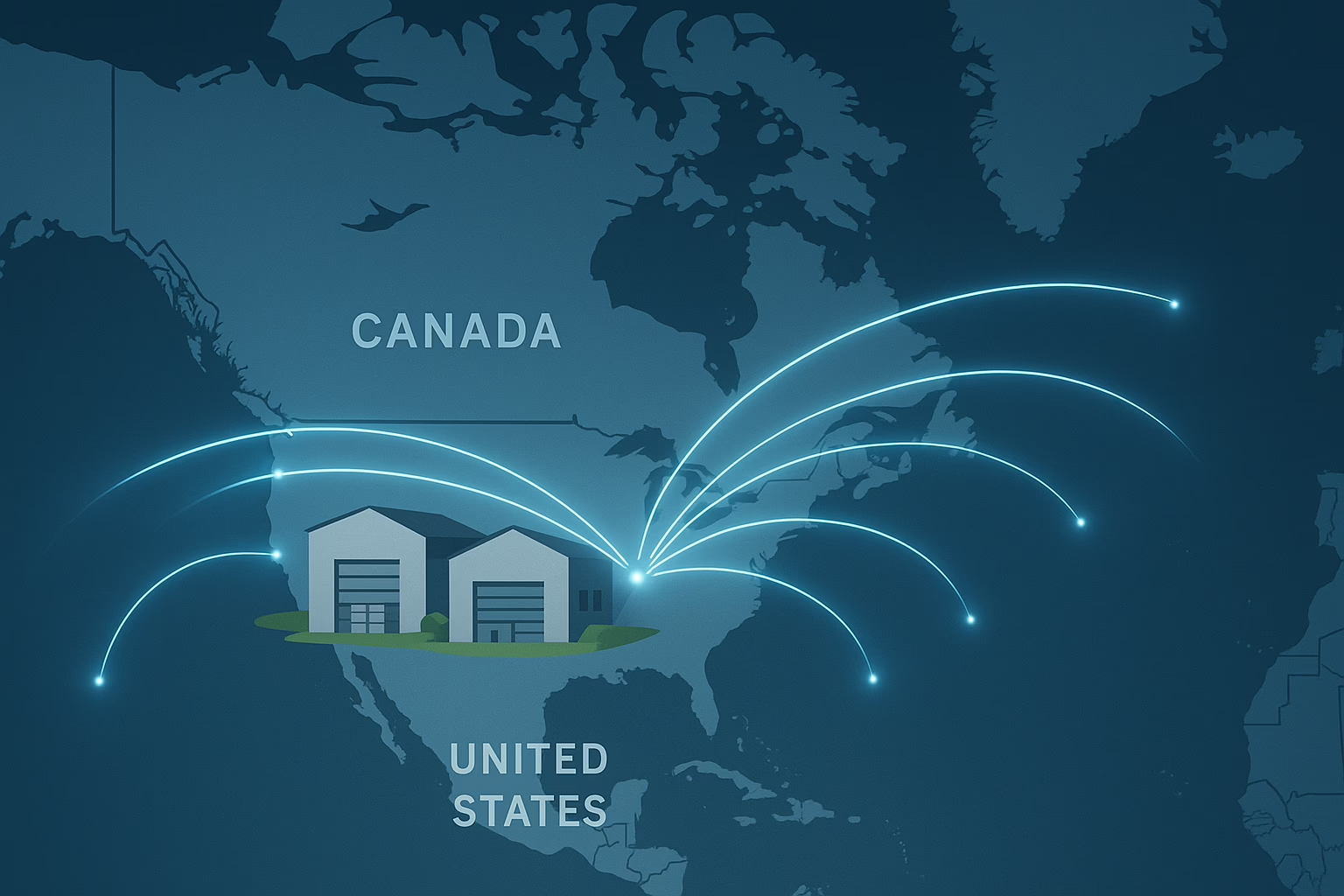
Placing inventory in Canadian hubs near the US border—or spreading it across multiple warehouses—can shave days off delivery times for many US regions. This strategic approach helps meet strict delivery SLAs (promised delivery times) without investing in full US warehousing infrastructure.
Streamline Cross-Border Shipping with Consolidation and Preclearance
With the elimination of Section 321 de minimis exemptions in August 2025, brands must adapt their cross-border strategies. The focus has shifted to efficient consolidation methods, accurate HS codes (customs codes), and carrier-led brokerage to minimize delays and costs. When executed properly with Evolution Fulfillment’s proven 3PL expertise, cross-border shipping can still provide significant cost advantages through bulk shipping and USPS injection.
Model Total Landed Cost the Right Way
Don’t rely on surface-level savings. Create comprehensive per-SKU models that include:
- Storage fees
- Pick & pack costs
- Long-haul transport
- Parcel rates
- All applicable duties and tariffs (now required on all shipments)
- Broker fees
- Return costs for international orders
- Foreign exchange impact
This complete analysis will show whether Canadian or US fulfillment offers the better value proposition for each product line.
[btx_image image_id=”1962″ link=”/” position=”center”][/btx_image]
Lower Amazon Issues with Proper FBA Prep and Removal Steps
If you sell on Amazon, your 3PL should be handling FBA labels, prep work, inbound removal orders, and clear playbooks for cross-border returns. Evolution Fulfillment’s Amazon FBA services ensure compliance with Amazon’s strict requirements, avoiding unnecessary chargebacks, delays, and extra handling fees.
Pick a 3PL with an Integrated Setup
Look for a partner that offers customs brokerage, Amazon removal workflows, and ready-to-use IT tools in one package. Features like real-time APIs, EDI, OMS/WMS sync, and returns portals reduce errors and make operations predictable. Evolution Fulfillment provides all these capabilities under one roof.
Introduction
For brands selling into the US market, a Canadian fulfillment center continues to be a strategic advantage—cutting delivery times, optimizing costs through consolidated shipping, and avoiding the expense of full US warehousing. Despite changes to trade policies in 2025, Canadian fulfillment remains viable when executed with the right strategies and partnerships.
In this article, we’ll explore the most important areas to consider: where to place stock, how to optimize cross-border shipping in the current regulatory environment, calculating true landed costs per SKU, Amazon FBA best practices, and what to look for in a 3PL partner.
Why a Canadian Fulfillment Center Accelerates US Delivery
Canadian hubs near the border feed parcels into US networks faster, reducing the number of zones shipments pass through—and in turn, cutting delivery time and parcel costs. This approach is particularly effective for coastal US orders and when working with regional carriers.
Quick fact: Canadian centers close to the US border can cut delivery times by 1–3 days through strategic consolidation and direct injection into USPS, leveraging automation to minimize customs processing time.
The Near-Border Advantage for Faster Last-Mile SLAs
Hubs in cities like Vancouver and Toronto can pass parcels to USPS and regional carriers more quickly than many inland US hubs. Fewer zones mean fewer days in transit and lower shipping costs.
Example: Shipping from Vancouver or Langley to Blaine, WA reduces Vancouver-to-Seattle delivery to just 1–2 days—compared to 3–4 days from certain US hubs.
Multi-Warehouse Strategy for North American Coverage
Using both east and west Canadian hubs, paired with US injection points, can achieve 2–3 day delivery for most US markets. Stock faster-moving SKUs closer to high-demand regions to protect SLAs without needing full US warehousing.
Quantifying speed gains by region:
- West Coast: 1–2 days faster
- Midwest: 1 day faster with Detroit/Buffalo injection
- Northeast: 1–3 days faster via Champlain, NY zone-skipping
Running small transit tests will confirm exact savings for your routes.
Optimized Cross-Border Shipping: Consolidation, Preclearance, and Brokerage
While the Section 321 de minimis exemption ended in August 2025, Canadian fulfillment centers have adapted with more sophisticated strategies. The focus is now on consolidation efficiencies, where multiple parcels are bundled into single cross-border shipments, dramatically reducing per-unit shipping and customs processing costs.
Preclearance & Clean Data:
Using accurate HS codes, correct values, and complete consignee details keeps shipments moving. Pair this with carrier-led brokerage and automated EDI for fewer delays. Evolution Fulfillment’s expertise in cross-border documentation ensures smooth customs clearance.
DDP vs DAP:
DDP (Delivered Duty Paid) offers a superior customer experience by eliminating surprise fees at delivery. With all shipments now subject to duties, DDP has become the standard for maintaining customer satisfaction and reducing cart abandonment.
Landed Cost Modeling: Canada vs US Fulfillment
A true landed-cost model in the post-Section 321 era must include:
- Storage fees
- Pick & pack costs
- Long-haul transport
- Parcel rates
- Full duties & tariffs (now applicable on all shipments)
- Brokerage fees
- Return handling
- FX impact
The key is finding efficiency through volume consolidation and strategic routing rather than duty exemptions.
Amazon Workflows: FBA Prep, Cross-Border Inbound, and Removals
Follow Amazon’s rules to the letter—box planning, pallet standards, labeling—and ensure your 3PL handles it all under one roof to reduce chargebacks and delays.
Have playbooks for cross-border removal orders, including quality checks, relabeling, repairs, and redeployment to DTC or back to Amazon. Evolution Fulfillment’s Amazon FBA services include comprehensive removal and redeployment strategies.
[btx_image image_id=”1963″ link=”/” position=”center”][/btx_image]
Returns Management & Reverse Logistics
Make returns painless for US customers by offering a US return address and a simple portal. Consolidate returns weekly for cost savings, and set clear refund rules to speed up processing and improve customer satisfaction.
Core 3PL Capabilities for Predictable Cross-Border Success
The ideal partner will offer:
- Scalable pick & pack operations
- Integrated customs brokerage with duty management
- Multiple carrier injection strategies
- SLA tracking and root-cause analysis
- Real-time tech integrations with your OMS/WMS/ERP
Implementation Roadmap
- Model network & demand patterns
- Ensure data & compliance readiness for new duty requirements
- Run a pilot phase with duty-inclusive pricing
- Go live with comprehensive KPI tracking
Decision Framework
Canadian fulfillment works best for mid-market DTC brands with:
- Significant coastal US demand
- Products that benefit from consolidated shipping
- Need for buffer stock for Amazon FBA
- Desire to avoid full US warehousing costs
However, US-based fulfillment may be better for bulky, heavy, or highly regulated goods where duty costs outweigh consolidation benefits.
Bottom Line:
Near-border Canadian fulfillment can still speed up deliveries by 1–3 days and optimize costs through strategic consolidation and efficient cross-border processes—without the expense of full US warehousing. While the elimination of Section 321 has changed the landscape, the right mix of consolidation strategies, preclearance processes, and strong 3PL partnerships turns cross-border shipping into a competitive advantage.
Ready to Transform Your Cross-Border Shipping?
Don’t let complex logistics hold your brand back from North American expansion. Evolution Fulfillment’s near-border warehouses and proven cross-border domesticated shipping solutions help brands like yours deliver to US customers 1-3 days faster while optimizing shipping costs through strategic consolidation.
Our white-glove approach combines cross-border expertise, pre-clearance processes, and seamless technology integration to make cross-border fulfillment efficient and predictable—without the overhead of US warehousing.