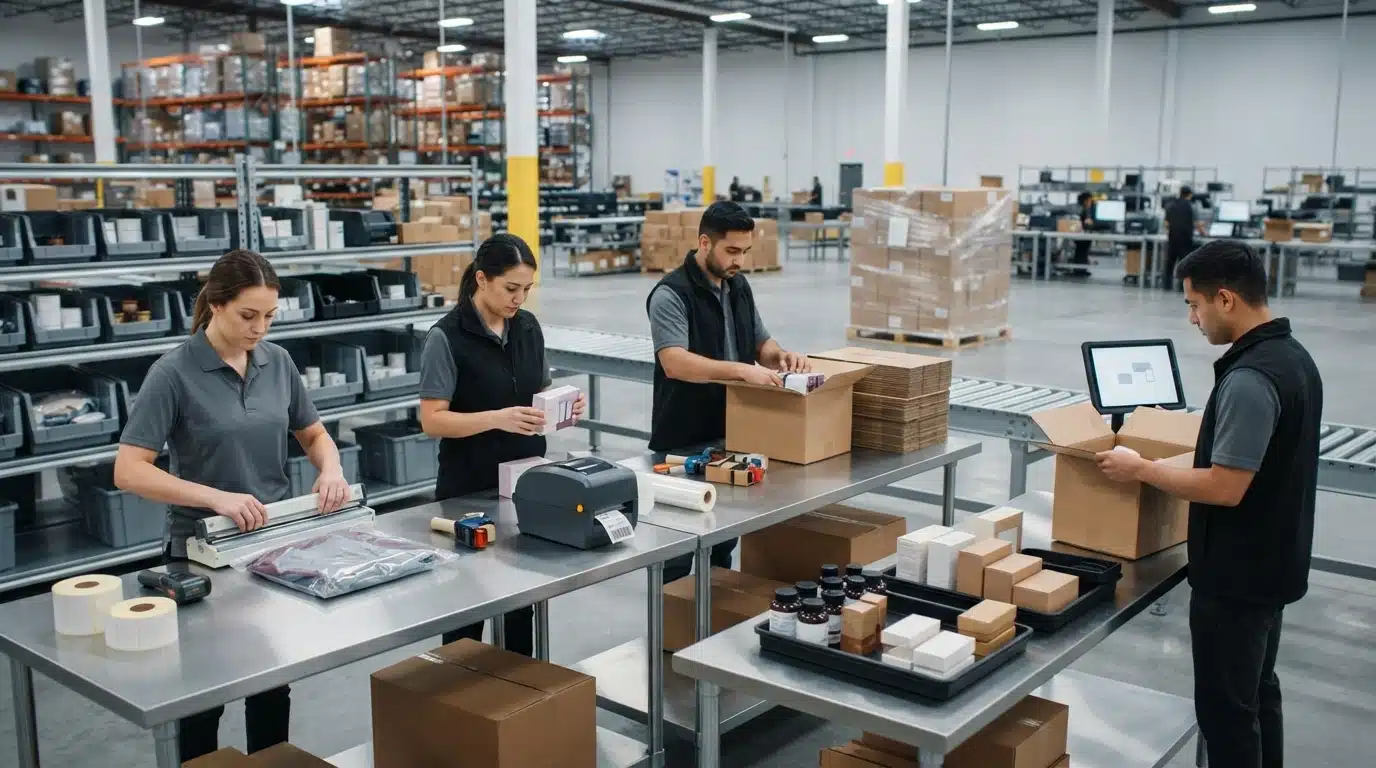
A missed barcode, the wrong polybag, or a carton label wrapped over an edge can turn a normal FBA shipment into a receiving delay. For a brand selling across Canada and the U.S., that delay affects inventory, ads, wholesale timing, cash flow, and customer promises.
That is why choosing an Amazon FBA prep center Canada brands can trust should start with a compliance checklist, not the question, “Who can label units fastest?”
FBA prep is a control point. The right partner receives inventory cleanly, checks units against Amazon requirements, labels and bags items, builds shipment plans, prepares cartons, and helps recover inventory when removals or stranded stock become part of the job.
Use this checklist to assess whether your current process or outsourced prep partner is ready for Amazon fulfillment Canada workflows across both sides of the border.
1. Confirm the Prep Scope Before Inventory Moves
A brand with 40 SKUs and one marketplace can manage prep internally. A brand running 600 SKUs across apparel, cosmetics, DTC, wholesale, and Amazon usually cannot rely on ad hoc warehouse time.
Before sending inventory to a prep center, define the scope in writing. Which SKUs are going to Amazon Canada, Amazon U.S., or both? Which units require FNSKU labeling instead of manufacturer barcodes? Which products need polybagging, bubble wrap, set labels, expiry-date checks, or suffocation warnings? Who creates shipment plans in Seller Central, and who owns exception decisions when Amazon changes prep guidance for a specific ASIN?
Amazon’s own Seller Central guidance makes one point clear: if you do not choose Amazon to prep the product, the seller is responsible for meeting FBA prep requirements before shipping. That makes the handoff between brand and prep partner a compliance checkpoint.
If your FBA prep Canada process also supports DTC and wholesale inventory, map the inventory flow before stock arrives. Evolution’s Amazon FBA prep service in Canada is built for that mixed-channel reality: Amazon prep should fit the broader fulfillment model, not sit in a disconnected corner of the warehouse.
2. Label Every Sellable Unit So Amazon Can Receive It
Labeling is where many FBA problems begin. The unit may be packed correctly, but if Amazon cannot scan the right identifier, receiving slows down or the item can be marked as stranded, mislabeled, or unfulfillable.
Your checklist should confirm:
- Each sellable unit has one scannable barcode.
- Any old, conflicting, or supplier-applied barcodes are covered when FNSKU labeling is required.
- Labels are placed on flat, visible surfaces.
- Labels do not wrap around corners, seams, curves, or shrink-wrap folds.
- Bundles are labeled as a set when the items must stay together.
- Multi-pack quantities match the listing and carton contents.
This sounds basic until a brand receives mixed supplier cartons from three factories. One carton may contain correct retail barcodes. Another may have UPCs covered by vendor stickers. A third may include the same SKU in two package versions. If nobody checks before labeling, the warehouse can apply technically correct labels to operationally messy inventory.
For Canada-US sellers, build a marketplace check into the process. A SKU prepared for Amazon.ca may not use the same workflow as the same SKU prepared for Amazon.com, especially when listings, barcodes, language, compliance, or bundle structure differ.
Reliable prep centers keep barcode control tied to receiving records, carton counts, and shipment plans. If Amazon later flags a discrepancy, the team can trace the issue back to inbound inventory instead of guessing.
3. Check Polybagging, Product Protection, and Set Rules
Polybagging is not just a packaging preference. It protects soft goods, apparel, textiles, loose pieces, and products that can collect dust or separate during handling.
Amazon-related prep guidance commonly requires clear, sealed bags with scannable barcodes visible through the bag or applied to the outside. Industry FBA packaging references also note that polybags are commonly expected to be at least 1.5 mil thick, and bags with openings of 5 inches or more often require a suffocation warning. Your team should confirm current Seller Central guidance for each ASIN before shipping, because prep requirements can vary by product type.
Use this polybagging checklist:
- Is the bag clear enough for scanning?
- Is the bag fully sealed?
- Is the barcode visible and flat?
- Is the suffocation warning present when required?
- Does the bag fit the product without too much loose material?
- Are sets marked so warehouse teams do not separate them?
- Are fragile items protected before they enter the carton?
This matters most for apparel, cosmetics, lifestyle products, small luxury items, and accessories. A scarf, glass bottle, boxed skincare item, and jewelry set all need different prep decisions.
A prep partner should be able to explain the reason behind each prep action. If the only answer is “That is what we usually do,” the process may not be strong enough for high-SKU Amazon fulfillment Canada operations.
4. Review Carton Requirements Before Shipment Creation
Carton prep is the bridge between warehouse work and Amazon receiving. A carton that leaves the facility with the wrong weight, poor labeling, weak packing, or unclear contents can lose time before the inventory is even available for sale.
Your carton checklist should include:
- Cartons are strong enough for the product and transit path.
- Carton contents match the shipment plan.
- Mixed-SKU cartons are allowed and documented when used.
- Box weight stays within current Amazon and carrier rules.
- Heavy-box labels are applied when required.
- Shipment labels and carrier labels are placed on flat surfaces.
- Barcodes are not covered by tape, straps, corners, or pallet wrap.
- Each carton has its own FBA box ID label from the shipment workflow.
Amazon has historically used a 50 lb carton limit for many FBA shipment scenarios, with special handling labels for heavier single items. Seller Central guidance also notes that FBA box ID labels and carrier labels should remain uncovered and scannable on a flat surface.
For brands shipping palletized inventory, carton compliance connects directly to dock scheduling, freight handoff, and receiving speed. A prep center that also manages storage through a Canadian warehouse for North American inventory can keep cartons, pallets, and available-to-sell stock under one operating view.
5. Build a Canada-US Marketplace Workflow, Not Two Separate Workarounds
Many brands start with Amazon Canada, then add Amazon U.S. after early traction. Others enter Canada after proving demand in the U.S. The operational question is the same: where should inventory sit, who preps it, and how do you avoid duplicating work?
A Canada-US FBA workflow should answer:
- Which SKUs are held in Canada before Amazon replenishment?
- Which SKUs should move across the border before prep?
- How are duties, customs documentation, and delivery timing handled?
- When should stock be split between Amazon and non-Amazon channels?
- Who monitors inventory aging, stranded units, and removal orders?
This is where a prep center has to think beyond labels. A brand may use Amazon for marketplace demand while still running DTC fulfillment, retail replenishment, and wholesale programs from the same inventory pool. If FBA prep decisions ignore those channels, the brand may overstock Amazon while shorting retail or DTC demand.
Evolution’s broader fulfillment services model is designed around channel mix, not single-channel warehouse tasks. For brands moving inventory between Canada and the U.S., cross-border domesticated shipping can also reduce friction when Amazon is only one part of the North American plan.
6. Prepare for Inventory Removals Before They Become Urgent
FBA prep does not end when inventory reaches Amazon. Brands also need a plan for removals, overstock, unfulfillable units, relabeling, rework, inspections, and channel recovery.
A strong removal process should define:
- Where Amazon removal inventory will be received.
- Who inspects units and grades condition.
- Which items can be restocked, relabeled, repaired, or repacked.
- Which items should move to DTC, wholesale, liquidation, donation, or disposal.
- How inventory records are updated after inspection.
- How quickly sellable stock can return to an active channel.
This is a common blind spot. A brand may have a clean inbound FBA process but no practical path for excess stock after a marketplace forecast changes. Then pallets come back from Amazon, the team has no intake rules, and inventory sits in limbo while finance waits for clarity.
If removals are part of your Amazon program, connect prep and recovery under one partner. Evolution’s Amazon order removal service supports the after-Amazon workflow, including decisions that affect margin after stock leaves FBA.
7. Ask These Questions Before Choosing an FBA Prep Center in Canada
The right partner should be able to answer operational questions without vague promises. Use this buyer checklist during evaluation calls:
- How do you verify ASIN-level prep requirements before work starts?
- How do you handle FNSKU labeling, manufacturer barcodes, and covered barcodes?
- What happens when supplier cartons arrive with mixed, damaged, or short inventory?
- Can your WMS separate Amazon-bound stock from DTC and wholesale inventory?
- Who creates shipment plans, carton labels, and carrier labels?
- What is the escalation path if Amazon rejects, delays, or flags a shipment?
- Can you receive removals and return sellable units to another channel?
- Will we have account support from people who understand our channel mix?
The best answer is not always the longest one. Look for clear process ownership, written workflows, and a working link between Amazon prep and the rest of your fulfillment operation.
8. Use FBA Prep as a Control System, Not a Patch
Outsourcing FBA prep can reduce internal strain, but it only works when the process is disciplined. A prep center should improve control over receiving, labeling, packaging, carton accuracy, shipment timing, and inventory recovery.
For brands selling across North America, that control matters. Amazon may be one sales channel, but errors there can affect forecasting, cash flow, ads, and customer trust.
If your team is evaluating an Amazon FBA prep center Canada brands can use for long-term growth, start with the checklist above. Then compare partners by how well they protect the operating model behind the shipment.
Evolution Fulfillment works with established brands that need Amazon prep to fit within a wider North American fulfillment strategy. If your FBA process is becoming too manual, too reactive, or too disconnected from your other channels, talk to our team about your SKU mix, marketplace plans, and inventory flow.
