
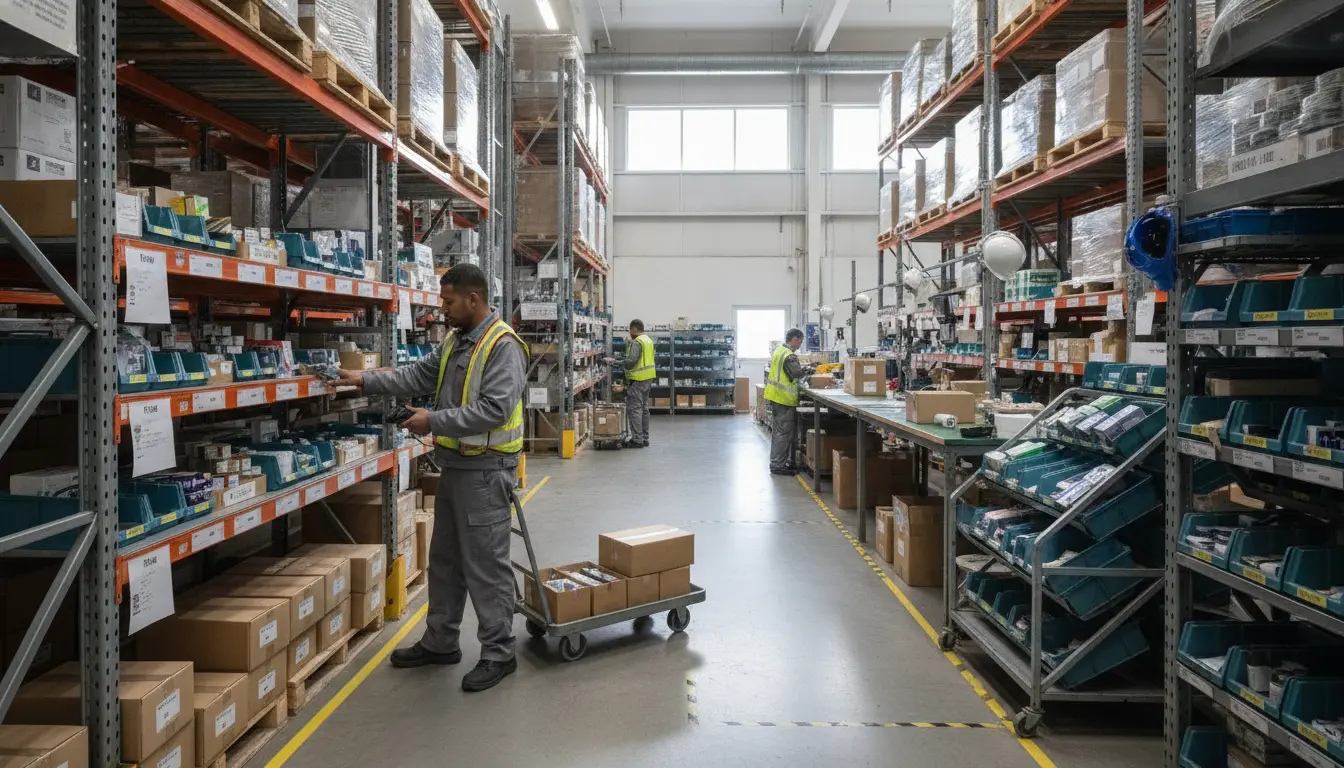
A warehouse slotting strategy is a plan for deciding where each product is stored, based on how fast it sells, how big and heavy it is, and how it is picked. The goal is simple: put the products that are picked most often in the easiest places to reach, so pickers walk less, make fewer mistakes and ship orders faster. Good slotting is not a one-time layout. It is a habit of reviewing where stock sits as demand changes.
What is slotting in a warehouse?
Slotting is the process of assigning each SKU to a storage location, called a slot. A slot might be a pallet position, a shelf, a bin or a flow-rack lane. Slotting happens when stock is first put away and again whenever demand, product mix or space changes enough to justify a move.
It is related to, but different from, two nearby ideas. Put-away is the physical act of moving received goods to their slots (see our warehouse receiving process). Layout is the permanent design of aisles, racking and pack stations. Slotting is the decision about which products go in which places within that layout.
Why slotting matters for ecommerce and wholesale brands
In a warehouse that fulfills many small orders, a large share of the labour is walking and searching. A slotting plan shortens that walk by placing the products picked most often close to where orders are packed. The effects show up in several places:
- Faster picking. Less travel per order means more orders per hour from the same team.
- Fewer errors. Clear, consistent locations and sensible neighbours reduce mis-picks.
- Better use of space. Matching product size to slot size avoids a small item taking a pallet position.
- Safer handling. Heavy items kept between waist and shoulder height reduce strain and damage.
- Easier peaks. When seasonal items are positioned in advance, a rush does not turn into a search.
The factors that decide where a SKU goes
| Factor | Question to Ask | Example |
|---|---|---|
| Velocity | How often is this SKU picked? | A best-selling basic goes near the pack station |
| Size and Weight | How big and heavy is it? | Heavy cases on lower levels, small items in bins |
| Order Profile | Is it picked singly, in multiples or by the case? | Each-picks in bins, case-picks on pallets |
| Affinity | Is it often ordered with other SKUs? | Kit components and bundle items stored close together |
| Seasonality | Does demand spike at certain times? | Holiday items moved forward before the peak |
| Handling Needs | Is it fragile, high value or oddly shaped? | Fragile items in protected locations |
| Channel | Is it for wholesale, ecommerce or both? | Case-packs for retailers kept apart from each-picks for web orders |
Evolution Fulfillment’s published approach uses three of them, velocity, dimensions and channel demand: approved units are slotted into the right storage profile, pallet, shelf or bin based on velocity, dimensions and channel demand.
Common slotting methods
ABC velocity slotting
ABC slotting ranks SKUs by how often they are picked and splits them into tiers. A common rule of thumb places the fastest roughly 20 percent of SKUs (A items) in the best locations, the next roughly 30 percent (B items) in secondary locations and the slowest remainder (C items) in the furthest zones. The exact split varies by business, because it depends on how concentrated your orders are, so treat it as a starting point, not a rule.
Affinity or family grouping
Some products are bought together or belong to a set. Storing them near each other cuts travel for multi-line orders and for kitting. This matters for brands that sell bundles or gift sets, because the components of a bundle are picked together every time.
Dedicated versus flexible locations
With dedicated slots, each SKU has a fixed home, which makes it easy for pickers to learn where things are. With flexible (or floating) slots, stock goes wherever space is free and the system tracks it, which uses space more efficiently but relies on scanning and accurate records. Many warehouses mix the two: fixed homes for fast movers and flexible space for the rest.
Pick locations and reserve locations
A pick slot holds the quantity needed for day-to-day orders, and a reserve slot, often higher up or further away, holds the overflow. When the pick slot runs low it is replenished from reserve. Separating the two keeps picking fast while keeping bulk stock out of the way.
How to build a slotting plan, step by step
- Pull your order data. Gather several months of order lines by SKU, including quantity per line and seasonality. More history gives a truer picture of what is actually fast.
- Get product dimensions and weights. Slot size depends on cube and weight, so missing data is the most common reason a plan fails.
- Classify your SKUs. Rank by pick frequency and sort into tiers. Flag seasonal items, kit components and fragile products separately.
- Define your zones and slot types. Decide which locations are premium (closest to packing, at comfortable pick height) and which are for slower movers or reserve.
- Assign SKUs to slots. Match each product’s tier, size and handling needs to a slot. Keep neighbouring SKUs visually different to reduce mis-picks.
- Record locations in the WMS. Slotting only works if the system knows where everything is. Accurate location records are what make scan-based picking possible.
- Set a review schedule. Re-check on a regular cycle and before peak seasons, because a SKU’s velocity changes as products launch, fade or trend.
An illustrative example
Imagine an apparel brand with 600 SKUs. A small share of them, mostly core basics, make up most of the order lines. If those basics sit at the back of the building while seasonal items sit at the front, every order starts with a long walk. Moving the basics to the premium zone, grouping the pieces of each outfit set together and putting last season’s stock into reserve shortens the route for most orders, without adding a person or an extra square metre. (This is a simplified example to show the logic, not a measured result.)
Signs your slotting needs attention
- Pickers cross the building for the same few SKUs every day
- The same items are repeatedly mis-picked or confused with neighbours
- Fast movers are in hard-to-reach locations while slow movers sit in prime ones
- Replenishment from reserve happens constantly during the day
- A product launch or seasonal change was not followed by any move
- Pallets sit in pick slots that were meant for small items
Slotting and the rest of the operation
Slotting depends on good inputs and feeds good outputs. Accurate receiving puts the right quantities in the right system record, and regular counts keep them right; read our guide to inventory accuracy, cycle counts and SLA reporting. Fast, accurate picking is what a pick and pack operation measures, and it is one of the numbers worth tracking on a warehouse KPI scorecard. Before a seasonal rush, slotting is one part of the preparation described in our guide to peak season fulfillment.
What to ask a 3PL about slotting
- How do you decide where my products are stored?
- How often is slotting reviewed, and who triggers a change?
- Can you keep kit components and bundle items together?
- How do you handle seasonal products before a peak?
- Can I see where my inventory is located in your system?
- Are my wholesale case-packs stored separately from ecommerce each-picks?
- Is there a charge for moving stock between locations?
Ask for answers in writing, and compare them with what you see on a site visit.
See how we store and pick your products
Evolution Fulfillment runs B2C order fulfillment and B2B order fulfillment from its Delta, BC warehouse, with a web-based WMS that gives you 24-hour access to live inventory information. Tell us about your SKUs and order mix and we will explain how they would be stored and picked. Request a fulfillment quote.
Frequently asked questions
What is a warehouse slotting strategy?
A warehouse slotting strategy is a plan for deciding where each product is stored, based on velocity, size, weight, order profile and handling needs. The aim is to put the most frequently picked products in the easiest locations to reach, reducing travel time and mis-picks.
What is ABC slotting?
ABC slotting ranks SKUs by how often they are picked and groups them into tiers. A items, the fastest movers, go in the best locations, B items in secondary locations and C items, the slowest, in the furthest zones. A common rule of thumb is about 20 percent A, 30 percent B and the rest C, but the right split depends on your order data.
How often should slotting be reviewed?
Review slotting on a regular schedule and whenever something major changes, such as a product launch, a seasonal peak or a shift in your sales channels. Velocity drifts over time, so a plan that was right six months ago may no longer be.
What is the difference between slotting and put-away?
Put-away is the act of moving received goods into storage. Slotting is the decision about which location each SKU should have. A good put-away process follows the slotting plan.
Does slotting matter for small brands?
Yes. Even a small warehouse spends much of its labour on walking and searching, so a few sensible decisions, such as keeping fast sellers close to packing and storing bundle components together, can save real time. The benefit grows as order volume rises.
How does Evolution Fulfillment slot inventory?
Evolution’s team slots approved units into the right storage profile, pallet, shelf or bin based on velocity, dimensions and channel demand, and records locations in its web-based warehouse management system, which gives clients 24-hour access to live inventory information.