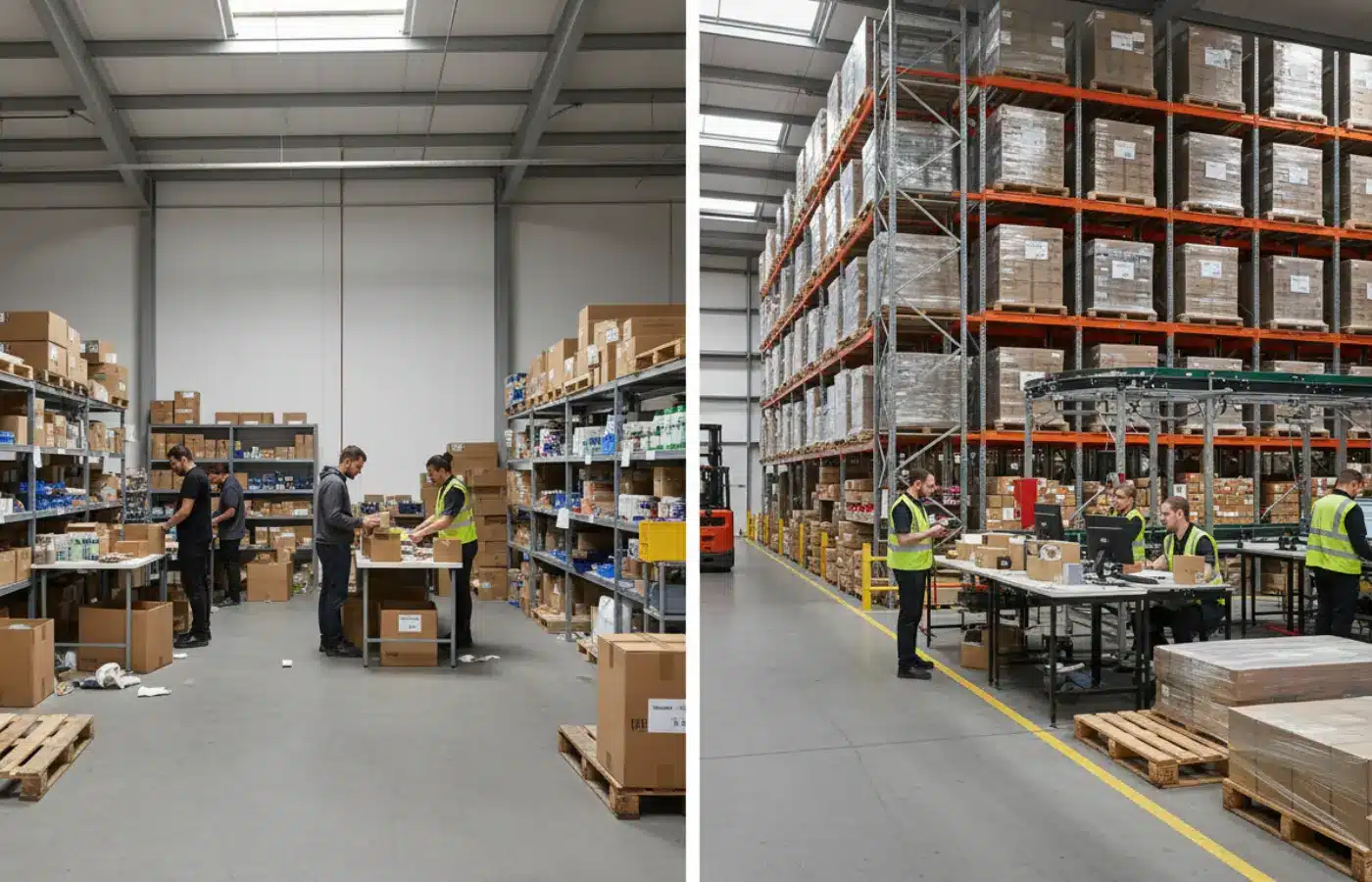
Growth puts pressure on operations fast.
A setup that worked at 300 orders per month often struggles at 3,000. Orders go out late. Returns stack up. Your team spends its week fixing exceptions instead of improving the business. Margin drops, not because demand is weak, but because operations can’t keep up.
This is usually the point where brands weigh outsource fulfillment services against keeping fulfillment in-house.
The right choice is practical, not philosophical.
Some brands should stay in-house longer than they think. Others get better results from outsourced fulfillment, including faster delivery, steadier service levels, and tighter cost control across channels. The right move depends on your order profile, channel mix, geography, and leadership capacity.
In this guide, we’ll cover:
- what in-house fulfillment actually costs,
- what 3PL fulfillment actually costs,
- how to compare total cost instead of isolated fees,
- and the operating signals that show when to outsource fulfillment.
In-House Fulfillment: What It Really Costs
In-house operations can look cheaper at first glance because costs are spread across payroll, rent, and management overhead. On paper, pick-pack cost may look low. In real operations, cost per order is often higher once you include labor swings, space limits, systems work, and error recovery.
1) Labor Cost Is More Than Pick-and-Pack Wages
Most internal models track warehouse hourly pay. Fewer include:
- supervisors and shift leads,
- receiving and inventory control labor,
- training and turnover cost,
- overtime during peak weeks,
- customer service time spent fixing fulfillment issues.
A useful labor model calculates fully loaded cost per order, including benefits, payroll tax, and non-productive time.
If overtime is constant or rework keeps rising, labor cost is already telling you the system is under strain.
2) Space Cost Includes Flexibility Risk
Warehousing is not just rent. It also includes:
- base lease,
- racking and material handling equipment,
- utilities,
- insurance,
- security,
- expansion penalties when you outgrow your footprint.
When demand is seasonal, slower months leave you with paid but underused space. In peak months, limited space creates congestion and slower picking.
For brands serving both Canada and the US, location has a major impact. A single-node in-house model can raise parcel zone cost and transit time compared with a distributed network.
3) Technology Cost Is Continuous, Not One-Time
Modern fulfillment needs more than spreadsheets and a carrier portal. At scale, you need:
- WMS capability,
- real-time inventory synchronization,
- channel integrations,
- rate shopping and label automation,
- reporting and exception visibility.
License fees are only one part of the bill. Internal IT support, integration upkeep, and process redesign are ongoing costs.
4) Error Cost Is Often Underestimated
Mis-picks, short shipments, late ASNs, and labeling errors create direct and indirect cost:
- reship expense,
- chargebacks,
- retailer compliance penalties,
- added returns handling,
- customer support load,
- loss of trust.
For brands with wholesale accounts, repeated misses can damage retailer relationships quickly.
5) Opportunity Cost Is the Quiet Margin Leak
When senior operators spend each week unblocking warehouse bottlenecks, they are not focused on:
- channel expansion,
- product development,
- wholesale growth,
- demand planning,
- strategic partnerships.
That cost is real. It may not show up as its own line item in the P&L, but it slows growth and burns leadership attention.
3PL Fulfillment: What It Really Costs
Brands reviewing fulfillment outsourcing often focus too heavily on pick-pack rates. That creates weak comparisons. A solid evaluation includes recurring and one-time 3PL cost drivers.
1) Core Transaction Fees
Most providers price around:
- receiving,
- storage,
- pick/pack,
- parcel labels,
- inserts and value-added services,
- returns processing.
Pricing should map clearly to your order and SKU profile. If it doesn’t, forecasting gets unreliable.
For a deeper fee breakdown by activity, Evolution’s 3PL pricing guide is a useful reference point.
2) Storage and Inventory Positioning
Storage is usually billed by bin, shelf, pallet, or cubic footprint. The best fit depends on product characteristics and turnover speed.
Brands with seasonal volume should confirm how pricing behaves during peak inventory build. Forecast clarity matters as much as base rates.
3) Onboarding and Implementation Cost
Moving to a new 3PL includes:
- account setup,
- SOP mapping,
- SKU and packaging rules,
- system integrations,
- test order validation,
- inbound transfer planning.
A disciplined onboarding process lowers disruption risk and gets you to stable operations faster.
4) Integration and Data Visibility
Your 3PL needs to support your actual channel mix. For multi-channel brands, this usually includes DTC storefronts, marketplaces, wholesale EDI workflows, and returns platforms.
If you run both direct-to-consumer and retailer distribution, confirm support for both B2C order fulfillment and B2B order fulfillment in one operating model.
5) Governance and Partnership Layer
With outsourced operations, communication quality drives outcomes. Strong partners provide:
- clear SLA definitions,
- proactive exception reporting,
- regular business reviews,
- transparent cost-to-serve visibility.
This is where providers separate quickly. The lowest quote is often not the best long-term margin decision.
A Practical Total Cost Comparison Framework (With Sample Numbers)
Comparing 3PL vs in-house well requires a full landed fulfillment cost model over a fixed period, usually 12 months. Here is a framework growing brands can use.
Step 1: Define Your Baseline Inputs
Use trailing 6-12 month data:
- monthly order volume,
- average lines per order,
- SKU count and storage footprint,
- channel split (DTC, wholesale, marketplace),
- return rate,
- average parcel zones,
- peak-to-baseline volume ratio.
Step 2: Build Full In-House Annual Cost
Include:
- labor (warehouse + supervision + admin touchpoints),
- facility cost (rent + utilities + insurance + equipment),
- software and integration cost,
- packaging materials,
- parcel spend,
- error/chargeback/rework cost,
- management opportunity cost.
Step 3: Build Full 3PL Annual Cost
Include:
- receiving,
- storage,
- pick/pack,
- shipping,
- returns processing,
- value-added service fees,
- one-time onboarding/integration,
- internal transition management effort.
Step 4: Compare Cost Per Order and Service Outcomes
Evaluate both:
- direct cost per order,
- performance impact (speed, accuracy, compliance, peak capacity).
A lower unit cost that hurts delivery performance may not be cheaper overall.
Sample 12-Month Comparison (Illustrative)
Assume a growing brand at 5,000 orders/month average, 2.0 lines/order, moderate wholesale mix, and seasonal peaks up to 2.5x baseline.
In-house annual cost (illustrative):
- Labor (including overtime + supervision): $640,000
- Facility + utilities + insurance + equipment: $310,000
- Software + integrations + IT support: $95,000
- Packaging + consumables: $82,000
- Error handling, chargebacks, reships: $78,000
- Additional temporary peak staffing: $70,000
- Leadership/management opportunity cost allocation: $90,000
- Total: $1,365,000
At 60,000 orders/year, that is approximately $22.75 per order before considering strategic drag.
3PL annual cost (illustrative):
- Receiving + storage: $260,000
- Pick/pack + value-added handling: $470,000
- Returns processing: $58,000
- Integration + onboarding (year 1): $40,000
- Internal transition management allocation: $25,000
- Performance-related rework and penalties (reduced): $28,000
- Total: $881,000
At 60,000 orders/year, that is approximately $14.68 per order in year 1. In year 2, with onboarding behind you, effective cost drops further.
This example won’t match every brand, but it shows why in-house vs 3PL fulfillment decisions should be based on full-cost modeling, not isolated pick fees.
Decision Triggers: When to Outsource Fulfillment
If you are unsure when to outsource fulfillment, watch for these operating signals.
1) Order Volume Is Growing Faster Than Team Capacity
Common threshold signals include:
- overtime becoming standard,
- error rates rising with volume,
- delayed receiving during promotions,
- late cutoffs and shipment backlogs.
For many brands, this shows up between roughly 1,500 and 5,000 monthly orders, depending on product complexity and channel mix.
2) Channel Complexity Is Increasing
If you are managing DTC, wholesale compliance, and marketplace requirements at the same time, process variance rises quickly.This is where integrated workflows matter. Evolution’s Brand Fulfillment Model fits brands that want to keep strategic control while handing off execution complexity.
3) Seasonal Peaks Create Recurring Disruption
When peak periods force emergency labor, temporary process shortcuts, or repeated service slippage, your model is likely capacity-limited.A scalable partner can absorb peak demand without forcing full-year fixed-cost expansion.
4) Cross-Border Shipping Is Eroding Margin
For brands shipping across Canada-US lanes, cross-border friction can hurt both delivery speed and landed cost.If duties, transit delays, and zone costs are climbing, a domesticated strategy may improve economics. Learn more about cross-border domesticated shipping and how network design affects cost and customer experience.
5) Leadership Bandwidth Is Consumed by Fulfillment Firefighting
If founders, COOs, or commercial leaders are regularly pulled into warehouse exceptions, your growth plan is already paying for it.At that stage, outsource fulfillment services is less about delegation and more about putting leadership time back into growth work.
What You Gain by Outsourcing Fulfillment
When the partnership and operating model are right, outsourced fulfillment gives you more than labor substitution.
Scalable Capacity Without Full Fixed-Cost Burden
You get access to infrastructure, labor depth, and process discipline that can flex with demand.
Better Operational Technology and Visibility
Strong 3PL operations give you dependable inventory visibility, clean integrations, and reporting your team can actually use.
Specialized Execution Expertise
From retailer routing compliance to returns workflows and value-added services, experienced teams reduce execution risk.
Faster, More Predictable Delivery Performance
Network design and operating discipline can improve OTIF, reduce backlogs, and protect customer experience.
More Time for Core Business Growth
Leadership and functional teams can refocus on product, revenue channels, and brand growth.
If you are reviewing full operating scope, Evolution’s fulfillment services overview lays out available capabilities.
What You Lose (or Trade Off) by Outsourcing
A credible comparison of 3PL vs in-house should also cover trade-offs.
Some Direct Day-to-Day Control
You are no longer on the floor every day. Control moves from direct supervision to SLA governance and communication cadence.
Potential Margin Trade-Off for Very Simple, Stable Operations
If your operation is low-SKU, low-variation, low-volume, and geographically simple, in-house may remain cost-efficient for longer.
Dependency on Partner Execution Quality
Results depend on operating discipline, account management quality, and process transparency.
That is why partner selection should prioritize fit, governance maturity, and implementation rigor, not just quote comparison.
The Hybrid Model: When Partial Outsourcing Makes Sense
Not every brand needs a full transfer on day one. A hybrid model can lower risk while improving economics.
Common hybrid patterns include:
Keep Wholesale In-House, Outsource DTC
Useful when internal teams are optimized for pallet/case workflows but need scalable parcel execution.
Outsource Peak Season Only (Phase-In Model)
Brands with highly seasonal demand can start with partial outsourcing to test process and economics before a broader transition.
Outsource Cross-Border Node First
If cross-border performance is the main constraint, brands can establish a specialized node such as a warehouse in Canada or a US-supporting lane strategy first, then expand scope.
Outsource Returns and Value-Added Workflows
Reverse logistics and specialized prep can move first, freeing internal teams to stabilize outbound operations.
The hybrid approach is often the most practical path when leadership wants measurable proof before a full migration.
Transition Checklist: Move from In-House to 3PL Without Disruption
A structured transition lowers service risk and protects customer experience. Use this checklist as your implementation baseline.
1) Define Success Metrics Up Front
Agree on baseline and target KPIs:
- order accuracy,
- same-day/next-day ship rate,
- receiving turnaround,
- return processing time,
- B2B compliance performance,
- landed cost per order.
2) Segment Your SKU Portfolio
Classify SKUs by velocity, handling requirements, and channel routing rules. This prevents one-size-fits-all process design.
3) Standardize SOPs Before Transfer
Document:
- pick-pack rules,
- packaging standards,
- insertion logic,
- carrier service mapping,
- exception handling,
- returns disposition paths.
4) Validate Integrations in a Controlled Sandbox
Run test cycles for:
- order ingestion,
- inventory sync,
- status updates,
- tracking communication,
- EDI/ASN flows for wholesale.
5) Plan Inventory Migration in Waves
Avoid full cutover risk where possible. Move high-velocity and low-complexity SKUs first, then expand.
6) Execute Parallel Monitoring Period
For 2-4 weeks post-launch, run frequent KPI reviews and exception triage. Early issue resolution prevents downstream compounding.
7) Establish Governance Rhythm
Set weekly operational reviews and monthly business reviews with shared reporting. This is what turns a vendor relationship into a stable operating partnership.
Final Decision Guide: In-House or 3PL?
If your operation is simple, stable, and locally concentrated, in-house may still be the right model.If you are managing multi-channel growth, recurring peaks, cross-border complexity, and leadership bandwidth pressure, fulfillment outsourcing is often the stronger financial and operational option.
Don’t ask only, “Is 3PL cheaper?”
Ask:
- What is our true all-in cost today?
- Which operating risks are increasing as we scale?
- Which model protects margin and customer experience over the next 24 months?
Run those three questions against your real data, then pressure-test the answer with a 12-month scenario model.
Ready to Evaluate Whether You Should Outsource Fulfillment Services?
Evolution Fulfillment works with growth-stage brands that need a practical path from operating strain to scalable execution. If you are weighing in-house vs 3PL fulfillment, start with your own numbers first.
Next steps:
- Pull 6-12 months of order, labor, parcel, and error-cost data.
- Build a side-by-side in-house vs 3PL model, including transition costs.
- Review the model with your operations and finance leads.
- Use that model in a scoped conversation with Evolution.
You can review service scope through fulfillment services before that call.
