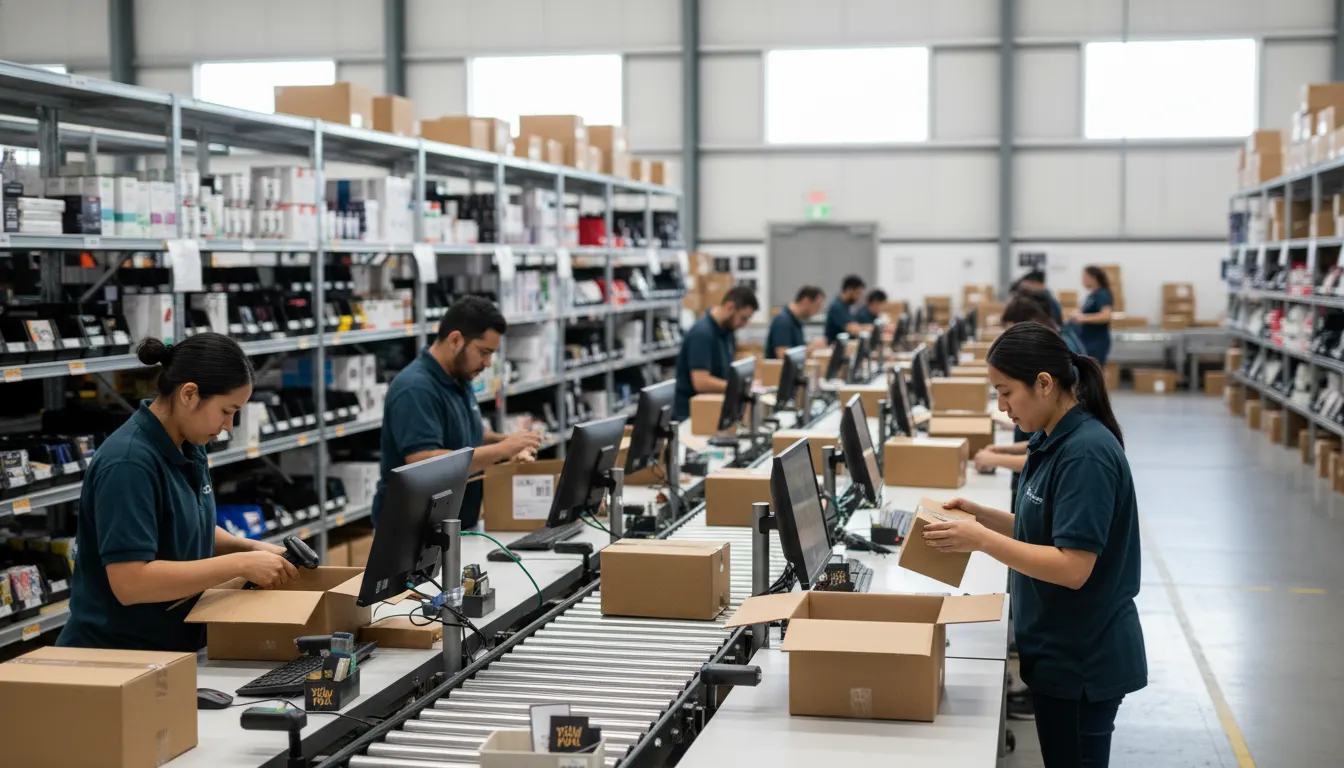
If your team is shipping DTC orders from one room in your office or a small back-of-store setup, growth can feel like a penalty. More sales should be a win. Instead, your team starts spending nights fixing address errors, chasing lost inventory, and answering “where is my order?” tickets.
That strain gets sharper in Canada. Distances are long, carrier zones can push costs up fast, and customer expectations are shaped by large marketplaces with very fast delivery windows.
This guide explains how b2c fulfillment works in Canada, what costs to plan for, where teams usually hit limits, and how to evaluate b2c fulfillment services before you sign with a 3PL.
What b2c fulfillment includes in real operations
At a high level, b2c order fulfillment has six core functions: receiving, storage, pick and pack, shipping, returns, and reporting. On paper, that sounds straightforward. In daily operations, each one has failure points that affect margin.
1) Receiving
Inbound accuracy decides whether the next 30 days run smoothly. Your partner should verify inbound counts against purchase orders, inspect for damage, and quarantine issues before inventory hits available stock.
For apparel brands, this matters even more during seasonal drops. One inbound mismatch on size curves can trigger backorders in your most profitable SKUs.
2) Storage and slotting
Storage is not just “put it on a shelf.” Fast-moving SKUs need accessible pick faces. Slow movers should be placed to reduce travel time waste. Good slotting improves labor efficiency and shortens order cycle times.
3) Pick and pack
For DTC, pick quality is a customer experience issue, not just a warehouse metric. Wrong size, wrong colour, or damaged packaging becomes a support ticket, a return label, and often a lost repeat order.
This is where b2c order fulfillment services should show clear SOPs: barcode scanning, quality checks, and packout rules by channel.
4) Shipping and carrier routing
In Canada, shipping logic must account for zone-based pricing, cut-off times by region, and cross-border handoffs when US orders are part of your DTC mix. If routing rules are weak, you pay more than you need to and still miss expected delivery windows.
5) Returns and reverse logistics
Returns are not a side workflow. They are part of the offer. The faster you inspect and restock saleable inventory, the less margin leakage you absorb.
Industry pressure here is real: Shopify’s enterprise analysis cites NRF data showing a 16.9% ecommerce return rate in 2024, with total returned merchandise at about $890 billion (Shopify Enterprise). That makes returns handling a core requirement when selecting a Canadian 3PL.
Learn how b2c fulfillment works in Canada, what it costs, and when to move to a 3PL partner. Build faster shipping, lower errors, and better margins.
Executives need weekly visibility on fill rate, order cycle time, return reasons, and landed shipping cost by region. Without this, you can’t improve operations or forecast hiring and capacity.
Why Canada changes the b2c fulfillment playbook
Many North American operators assume Canadian DTC logistics is just a smaller version of the US model. It isn’t.
Geographic spread and zone economics
Canada’s population is concentrated in a few major corridors, but customer demand still spans the full country. Shipping from a single node often means strong service in one region and expensive, slower delivery in others.
For a Vancouver-based shipper, orders to the GTA, Atlantic Canada, or northern destinations can move into higher cost zones quickly. Even small parcel cost differences, multiplied over thousands of monthly orders, can erase promotion margin.
Bilingual and label requirements
For many products, labels and mandatory package information need English and French treatment under federal rules, depending on category and use case (Consumer Packaging and Labelling guidance).
That means your fulfillment process must support bilingual inserts, compliant packaging variants, and QA checks that prevent avoidable compliance risk.
Cross-border returns and customer expectations
Canadian DTC brands selling into both Canada and the US face a two-way reverse logistics challenge: where returns land, who inspects them, and how quickly inventory goes back into available stock. If returns are routed poorly, refund speed drops and inventory sits idle.
Demand growth puts pressure on old workflows
Digital demand is not flattening. Statistics Canada reported $73.7 billion in ecommerce retail revenue in 2024, up 9.0% year over year, with total Canadian retail at $865.2 billion (Statistics Canada). More online volume means more fulfillment complexity for brands still running self-fulfillment past their operational limit.
B2C vs B2B fulfillment: where operating models differ
If your team already ships wholesale orders, it is easy to assume DTC is just smaller boxes. The operating model is different.
| Area | B2B fulfillment | B2C fulfillment |
|---|---|---|
| Order profile | Fewer, larger orders | Many small, frequent orders |
| SLA pressure | Retail delivery windows | Fast ship confirmation and consumer delivery expectations |
| Packaging | Compliance-focused cartons/pallets | Branded unboxing, parcel durability, insert logic |
| Error impact | Chargebacks and retailer disputes | Refunds, reviews, repeat purchase loss |
| Returns flow | Lower volume, case-level handling | High volume, item-level inspection and restock speed |
If you’re comparing models internally, this B2B fulfillment guide is a useful companion read. Teams managing both channels often need separate process maps and labor planning by channel, even inside one facility.
What to look for in canadian b2c fulfillment services
Not every 3PL with ecommerce on their website is built for high-velocity DTC execution. For COO and CEO teams, the decision should be capability-first.
Same-day shipping windows tied to real cut-offs
Ask for order cut-off by region and carrier, not marketing language. You need exact timestamps and performance history by order type.
Platform integrations that reduce manual work
At minimum, your provider should integrate with your storefront and OMS/ERP stack so orders, inventory, and tracking events sync in near real time. Manual CSV workflows break quickly once order volume climbs.
Branded packaging control
For consumer brands, packaging is part of product experience. Your 3PL should support branded inserts, custom carton logic by SKU profile, and packout QA.
A good benchmark is whether they can align this with a brand-control model, not warehouse convenience. Evolution’s Brand Fulfillment Model outlines this approach.
Returns program maturity
Don’t settle for “we accept returns.” Ask about inspection logic, grading criteria, restock cycle time, and reporting detail by reason code. Your return data should feed merchandising and product quality decisions.
Multi-channel readiness
If you run DTC plus wholesale or marketplace channels, your partner should already support mixed channel execution under one roof. This is where broad fulfillment services matter.
Cost structure for b2c fulfillment in Canada
Founders often ask one question first: “What does this cost per order?” That’s useful, but incomplete.
Typical fee components
Most Canadian b2c fulfillment services use a mix of:
- Receiving fees (per carton, pallet, or hour)
- Storage fees (bin, shelf, pallet, or cubic footage)
- Pick and pack fees (first item + each additional item)
- Packaging material charges
- Shipping pass-through with carrier rates
- Returns processing fees
- Value-added service fees (kitting, relabeling, special inserts)
Per-order pricing vs subscription-style models
Per-order pricing aligns cost with volume and is common for growth-stage brands. Subscription or minimum-commitment models can work when your order profile is stable and predictable.
The right choice depends on order volatility, SKU count, and seasonality. A fashion brand with heavy peak concentration may prefer variable pricing to avoid paying for idle capacity off-season.
For deeper context, see this breakdown on 3PL pricing.
The hidden cost centers teams miss
The largest overages usually come from three areas:
- Unplanned split shipments caused by poor inventory placement
- Manual exception handling from weak system integrations
- Slow return restock cycles that force avoidable reorders
These do not always appear in the first quote. They show up in month three.
When to move from self-fulfillment to a 3PL
There’s no universal order threshold, but there are clear warning signs.
You should evaluate a move when:
- Leadership time is consistently pulled into fulfillment firefighting
- Pick errors or late shipments are becoming a repeat customer issue
- Your team is delaying marketing pushes because operations can’t absorb volume
- You’ve outgrown available storage and are using overflow workarounds
- Returns are backing up and inventory visibility is unreliable
A practical scenario: A DTC apparel brand at $8M in annual revenue is shipping 120 to 180 orders/day off-peak, then 500+/day during campaigns. Self-fulfillment may hold at 120/day. At 500/day, queue times, mis-picks, and support tickets rise fast. That’s often the point where a 3PL move protects customer experience and margin instead of just reducing warehouse workload.
Implementation checklist for canadian direct-to-consumer fulfillment
Before onboarding a 3PL, align on this list:
- SKU and channel map complete (DTC, wholesale, marketplaces)
- Packaging rules documented by product type
- SLA definitions approved (cut-offs, ship speed, error tolerance)
- Integration plan approved (storefront, OMS, ERP, returns platform)
- Returns SOP finalized with reason codes and restock timeline
- Carrier strategy confirmed by destination mix and parcel profile
- Reporting cadence set (daily ops dashboard + weekly executive review)
If these are vague at kickoff, onboarding gets expensive.
90-day transition plan: moving to a canadian 3PL without service dips
Most teams underestimate migration risk. A rushed move can create inventory mismatches and missed SLAs in week one. A staged 90-day plan reduces that risk.
Days 1-30: data and process mapping
Lock down your SKU master, order-routing rules, packout instructions, and return reason codes. Run a sample week of historical orders through the new rule set before go-live.
Days 31-60: system and carrier validation
Complete storefront and OMS integration testing, then validate tracking events, order-status notifications, and exception handling. At this stage, test carrier mapping by destination region so rate shopping works before peak volume hits.
Days 61-90: controlled cutover and QA
Start with a limited cutover by product line or region, not a full switch on day one. Review first-week metrics daily: pick accuracy, on-time ship rate, support tickets, and return intake speed. Then expand only after service levels hold.
For leadership teams, this is also the right time to set weekly operating reviews with your 3PL account lead. You want issue escalation paths defined before the first major campaign, not during it.
FAQ: b2c order fulfillment in Canada
What is b2c fulfillment?
B2c fulfillment is the end-to-end process of receiving inventory, storing products, picking and packing individual consumer orders, shipping parcels, and processing returns.
How is b2c order fulfillment different in Canada?
Canada adds extra operational complexity through long shipping distances, stronger regional zone-cost variation, bilingual packaging requirements in many cases, and cross-border returns handling for brands selling into the US.
What are typical b2c fulfillment services included by a 3PL?
Most providers include receiving, storage, pick and pack, shipping label generation, carrier handoff, and return intake. Some also provide kitting, custom packaging, and channel compliance workflows.
When should a DTC brand switch from self-fulfillment?
Usually when order volume variability starts causing late shipments, frequent pick errors, and leadership distraction. If growth campaigns are limited by warehouse capacity, it’s time to evaluate a partner.
Compare SLA performance, integration depth, return cycle speed, cost transparency, and experience with your channel mix. Ask for reporting samples and exception-handling SOPs before you sign.
Build your next phase with the right fulfillment model
B2C growth in Canada is still a major opportunity, but the operating standard is higher than it was even a few years ago. Brands now need fast order flow, accurate execution, and return handling that protects margin.
If your current setup is starting to cap growth, now is the right time to review your options. Evolution Fulfillment’s B2C team can map your order profile, channel mix, and shipping footprint, then recommend an execution plan that fits your next stage.
Request a fulfillment strategy call.
