
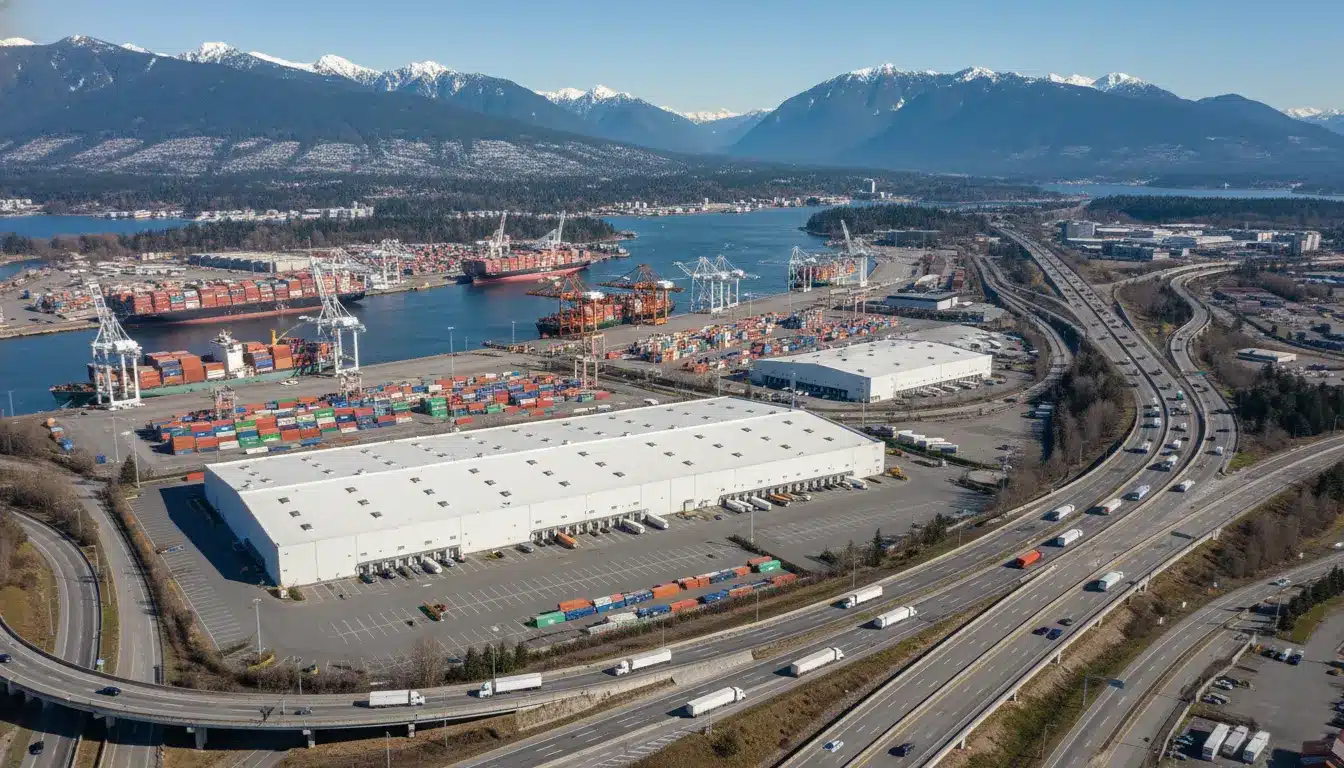
Brands looking at warehousing vancouver are usually not asking one question. They are asking three at once:
- Can we ship Canada and the U.S. West Coast from one location without burning margin?
- Can we keep transit times competitive once order volume climbs?
- Can we avoid creating a second operational mess at the border?
Those are location questions first, warehouse questions second.
Vancouver is one of the few North American nodes where port access, a major border corridor, and West Coast parcel reach sit close enough together to change your cost model, not just your map pin. If you run ecommerce plus wholesale, or if you are importing from Asia and selling into both Canada and the U.S., this geography can shift spend away from line-haul and repeated handoffs and into faster domestic delivery.
This guide breaks down how that works, who gets the biggest upside, and when Vancouver wins versus Toronto. If you want a broader strategic primer first, read the Vancouver warehousing advantage overview.
Why warehousing vancouver is a strategic decision, not just a lease decision
If you are evaluating a vancouver fulfillment center only on rack rate or square footage, you will miss the real economics.
Location affects:
- Parcel zone mix and average label cost
- Days-in-transit and cart conversion risk
- Border handoff frequency
- Inventory split complexity across regions
- Replenishment cycle time for wholesale and Amazon channels
Vancouver changes those variables because three freight realities overlap in one metro:
- Pacific import access through Canada’s biggest port gateway
- Fast truck access to the Blaine crossing for U.S.-bound flows
- Reach into BC/Alberta plus U.S. West Coast destinations from one western node
In 2023, the Port of Vancouver moved 150.4 million metric tonnes of cargo, up 6% year over year (Port of Vancouver 2023 Statistics Overview). That scale matters because carriers, dray partners, and transload networks form around throughput. High throughput usually means more routing options and better resilience during peak periods.
The Vancouver position: port, border, and Pacific Rim entry in one corridor
Most brands do not fail cross-border expansion because demand is weak. They fail because the operating model gets too expensive and too slow as volume rises.
Vancouver helps solve that by placing inbound and outbound decisions in one region.
Port adjacency and inbound control
If your containers arrive on the Pacific and your fulfillment operation sits near Vancouver, you can shorten the handoff chain:
- Container discharge
- Dray to nearby transload or warehouse
- Putaway and allocation to DTC, retail, or marketplace orders
Fewer long-distance repositioning moves after arrival means fewer paid touches. For brands importing from East Asia, that can be the difference between one western fulfillment node and a forced two-node setup too early.
If your model includes container deconsolidation or mixed-SKU imports, routing through transloading and cross-docking near the port can reduce delays between vessel arrival and sellable inventory.
Border proximity and operational speed
From the Vancouver region, the truck corridor to Blaine is close enough to support routine same-day cross-border line-haul planning. That gives operators more flexibility to move inventory and parcel injections based on order cutoffs instead of fixed weekly border runs.
The U.S. government is currently expanding the Pacific Highway Land Port of Entry with a $43.5 million total project budget (GSA Pacific Highway project page). For shippers, that investment signals sustained throughput demand on this crossing.
Why this matters for ecommerce timing
When inventory is already in the right western corridor, your team can make later decisions on channel allocation. You can commit stock to Canadian DTC, U.S. DTC, wholesale replenishment, and marketplace prep with less dead time in between.
That is often where margin is protected: not from one dramatic freight discount, but from many small cycle-time improvements that stack every week.
How location affects fulfillment cost: zones, transit time, and last-mile math
A fulfillment quote can look attractive until zone distribution is modeled against your actual destination mix.
For most consumer brands, shipping spend is driven by three things:
- How many orders stay in near zones versus far zones
- How often expedited services are needed because standard delivery is too slow
- How often inventory must be repositioned across the network
A Vancouver 3PL warehouse can improve all three for western-heavy demand profiles.
1) Zone mix changes with western inventory placement
If your buyers cluster in BC, Alberta, Washington, Oregon, and California, shipping from central or eastern nodes can push a large share of parcels into higher-zone pricing bands. Moving inventory west typically shifts part of that volume back to lower-zone pricing.
Even small shifts are material. On 8,000 monthly parcels, a $1.75 average label reduction is $14,000 per month, or $168,000 annually.
2) Transit reliability reduces paid expedite behavior
Brands rarely plan to pay for upgrades at scale. They pay when customer expectations outpace standard transit from the wrong node.
Placing inventory in Vancouver for western destinations can lower the number of orders that need paid speed upgrades to hit promised dates. That protects both logistics spend and support workload.
3) Last-mile economics improve when line-haul shrinks
Last mile is expensive because parcel carriers are handling fragmented, residential delivery. The part you can still control is how far each parcel travels before handoff.
Shorter pre-delivery distance usually means lower average parcel cost and fewer delivery exceptions tied to multi-hub routing.
This is one reason many operators pair western warehousing with cross-border domesticated shipping workflows instead of running every U.S. order as a traditional international parcel.
West Coast coverage from Vancouver: BC, Alberta, Washington, Oregon, California
A single-node model is not right for every brand. But for many growing operators, Vancouver covers a large enough demand arc to delay a second node until volume clearly justifies it.
Think of Vancouver as a west-node anchor for:
- Canadian western demand (especially BC and Alberta)
- U.S. Pacific Northwest demand
- California demand where service levels remain competitive from western inventory
The win is not “ship everywhere from one building forever.” The win is “keep one node longer while preserving delivery promise and margin.”
For teams managing wholesale plus DTC, this also simplifies inventory governance. You are not splitting safety stock across too many locations too early.
If you want to compare hub coverage and service tradeoffs, start with Evolution’s warehouse locations overview and model your destination ZIP/postal code mix against each network option.
The cross-border corridor model: Vancouver to Blaine to U.S. domestic distribution
This is where Vancouver often outperforms generic “3pl vancouver” conversations.
The core idea is simple:
- Keep inbound and fulfillment control in Vancouver
- Move consolidated U.S.-bound freight through Blaine
- Inject into U.S. domestic parcel/distribution workflows
Done well, this can reduce per-order cost and improve predictability versus sending each order individually as a pure cross-border parcel.
Why domesticated flow often wins
Canada-U.S. merchandise trade surpassed $1 trillion again in 2024, and 75.9% of Canadian exports went to the U.S. (Statistics Canada, Dec 2024 trade release). The corridor is not niche. It is core North American commerce.
For ecommerce, that means infrastructure, carriers, and customs workflows are already optimized around this traffic. Brands that route freight in bulk and deliver as domestic U.S. parcels often see better consistency than brands that process every order as a standalone border event.
A practical scenario
Imagine a Vancouver-based apparel brand shipping 6,000 U.S. orders per month.
- Model A: Every order leaves Canada as an individual international parcel.
- Model B: Orders are processed in Vancouver, moved in consolidated cross-border line-haul, then injected domestically in the U.S.
Model B usually reduces customs friction at the order level, lowers average per-parcel spend, and gives clearer SLA control.
This is exactly the type of workflow brands request when they evaluate warehouse operations in Canada for North American fulfillment and need U.S. growth without immediate U.S. warehouse expansion.
Who benefits most from fulfillment services vancouver
Not every company gets the same return from Vancouver placement. The best fit usually falls into one of these groups.
1) Canadian brands selling heavily into the U.S. West
If your order density is western U.S.-heavy, Vancouver gives proximity to both Canadian demand and the Blaine corridor. That supports faster U.S. injections while maintaining a Canadian operating base.
2) U.S. brands entering Canada without building a full Canadian network first
For U.S. brands, Vancouver can function as a practical Canadian landing node for western distribution and returns, while keeping cross-border operations manageable.
3) Pacific Rim importers serving North American channels
If your inbound origin is Asia-Pacific and your outbound demand is split between Canada and the U.S. West, Vancouver can reduce handoffs between arrival and allocation. That is especially useful for seasonal assortments and high-SKU catalogs.
4) Multi-channel operators balancing DTC, wholesale, and marketplace requirements
Brands with retailer compliance rules, DTC SLAs, and marketplace prep needs benefit when one team can coordinate all channel flows under one operational playbook.
For this audience, full service coverage across channel workflows matters more than storage alone.
Vancouver vs Toronto for fulfillment: when each is the better call
This is not a “one city beats all” decision. It is a network design decision.
Vancouver usually makes more sense when:
- Inbound containers are Pacific-oriented
- U.S. demand is concentrated in WA/OR/CA
- Canadian demand is weighted to BC/AB
- Cross-border domestication into the U.S. is a core part of the model
- You want to delay a two-node rollout while maintaining service levels
Toronto usually makes more sense when:
- Canadian order density is highest in Ontario/Quebec
- U.S. demand is more eastern or national with central/eastern concentration
- Inbound ocean freight is Atlantic-heavy
- Carrier contracts and parcel promises are tuned for central/eastern coverage
Hybrid point for scaling brands
Many brands eventually run west + east nodes. The timing matters.
Launching two nodes too early creates duplicate inventory buffers, extra transfer moves, and planning overhead. A Vancouver-first strategy can buy time until order volume and service commitments clearly justify a second facility.
If you are deciding now, compare not just storage rate. Compare fully loaded cost per shipped order, including packaging labor, zone mix, returns path, and expedite behavior. This is the same logic covered in 3PL pricing and true fulfillment cost modeling.
How to evaluate a vancouver fulfillment center before you commit
Before signing with any provider, ask for a location-specific operating model, not a generic brochure.
Checklist for decision teams
- Destination map test: What % of monthly orders land in BC/AB/WA/OR/CA?
- Zone distribution model: How does average zone change from current network to Vancouver-based inventory?
- Cross-border method: Are U.S. orders sent individually or through a domesticated flow?
- Channel requirements: Can one operation support DTC, wholesale compliance, and marketplace prep together?
- Peak plan: What changes in November-December for labor, cutoffs, and carrier pickup windows?
- Returns path: Where do west-region returns go, and how fast do they re-enter sellable inventory?
- Reporting cadence: How often do you get cost and SLA reporting by channel?
A credible partner should be able to walk through your channel mix, not just quote pallet rates.
If you are exploring options now, the fastest way to de-risk the decision is a workflow review with your actual order data and destination profile.
Book a warehouse and process walkthrough, and have your current 90-day order export ready so the model is built on real demand patterns.
FAQ: Warehousing Vancouver and cross-border fulfillment
Is Vancouver good for shipping across both Canada and the U.S.?
Yes, for many west-oriented brands. Vancouver can support Canadian western coverage and U.S. West Coast injections through the Blaine corridor. Fit depends on where your buyers actually live and what delivery promises you make.
How close is Vancouver to the U.S. border for freight operations?
Many Lower Mainland warehouse zones are within roughly 30-60 minutes of the Blaine crossings depending on traffic and exact origin point. That short corridor is one reason Vancouver is used for cross-border line-haul planning.
Can a Vancouver fulfillment center lower shipping costs?
Often yes, when your destination mix is western-heavy. Savings usually come from improved zone mix, fewer paid expedite upgrades, and consolidated U.S.-bound freight movement.
Should we choose Vancouver or Toronto for a Canada-U.S. model?
Choose based on demand density, inbound port orientation, and promised delivery windows. West-focused demand and Pacific imports often favor Vancouver. Central/eastern-heavy demand often favors Toronto.
Is Vancouver only useful for large enterprise brands?
No. Mid-market brands can benefit strongly because location mistakes are more expensive when teams are small and inventory planning bandwidth is limited.
What should we prepare before speaking with a 3PL in Vancouver?
Bring 60-90 days of order data, destination ZIP/postal distribution, SKU profile, and channel split (DTC/wholesale/marketplace). With that, a provider can model your real cost and service impact instead of giving a generic estimate.
Conclusion
The best reason to choose warehousing vancouver is not that a warehouse exists there. It is that Vancouver can connect Pacific inbound, Canadian west coverage, and U.S. cross-border execution in one operating corridor.
When that matches your order geography, you usually get better cost control, faster transit performance, and fewer cross-border headaches. If your team is deciding between network options, talk through your channel mix with a fulfillment operator that can model both parcel economics and border flow design.
Book a warehouse and process walkthrough to see whether a Vancouver-first model fits your next growth phase.