
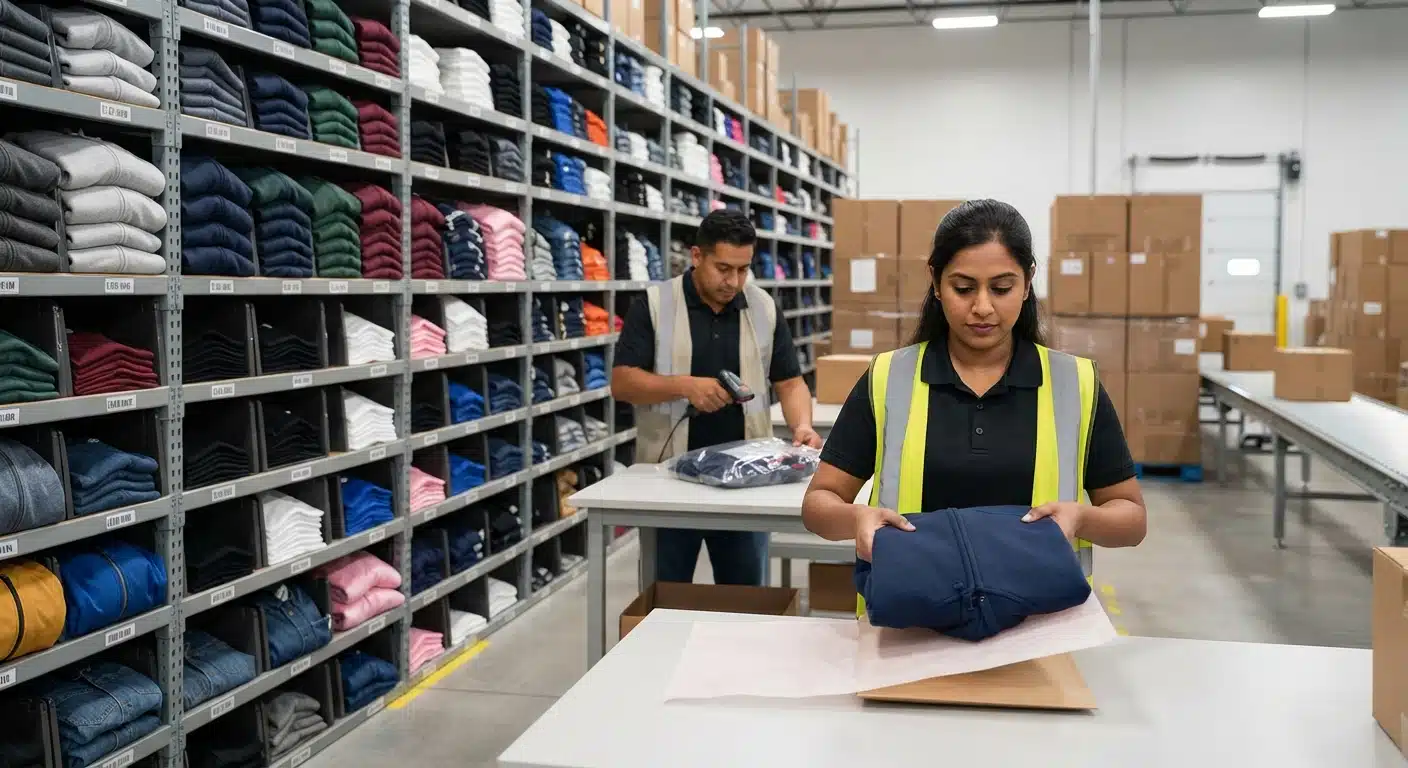
Apparel fulfillment costs rarely come from one line item. A brand may focus on the monthly storage rate, then find the real margin pressure in returns, pick complexity, size curves, polybagging, receiving, or postage. For clothing brands selling across the United States and Canada, the full cost picture needs more detail.
This guide explains us 3pl warehousing costs for apparel 2026 through the factors that actually move the invoice: SKU count, seasonality, storage method, pick and pack labour, receiving quality, value-added services, returns, and cross-border distribution choices.
Apparel warehousing costs rise with SKU complexity
A simple apparel line can become operationally complex fast. One hoodie in 6 sizes and 5 colours creates 30 SKU variants. Add two seasonal colours and a kids’ size run, and the warehouse now has more pick faces, more bin locations, more replenishment work, and more room for mistakes.
This matters because 3PL pricing often reflects activity, not just cubic space. A brand with 80 high-volume SKUs may be easier to operate than a brand with 1,200 low-volume SKUs spread across sizes, colours, bundles, and seasonal drops.
Apparel brands should review:
- Total active SKUs
- Units per SKU
- Size and colour spread
- Seasonal carryover inventory
- Slow movers and dead stock
- Hanging versus folded storage
- Case picks versus each picks
- Return volume by SKU
Evolution’s guide to 3PL pricing and the real cost of fulfillment gives a broader pricing view. For apparel, the key is to connect each fee to the physical work caused by size curves, fabric handling, packaging, and returns.
Storage fees depend on how apparel is held
Storage can be priced by pallet, bin, shelf, cubic foot, or dedicated space. Apparel may use several methods at once. Bulk seasonal stock may sit on pallets. Fast-moving ecommerce units may sit in pick bins. Premium garments may need hanging storage or special handling.
The cheapest storage format is not always the lowest-cost choice. If fast-moving units are stored only in bulk, the warehouse may spend more labour replenishing pick locations. If too many slow movers sit in prime pick space, the brand pays for poor slotting through slower picks and higher operational friction.
A practical apparel storage review should ask:
| Storage driver | Cost impact |
|---|---|
| Palletized bulk stock | Efficient for replenishment, less efficient for each picking |
| Pick-bin stock | Faster for ecommerce, requires location discipline |
| Hanging garments | More handling and space planning than folded goods |
| Seasonal carryover | Can consume space for months after the selling window |
| Returns awaiting inspection | Holds space without immediate resale value |
Good warehousing is not just storage. It is slotting, replenishment, visibility, and planning. Evolution’s warehouse in Canada supports brands that need storage connected to active fulfillment across North America.
Pick and pack fees reflect apparel handling detail
Pick and pack fees vary because apparel orders vary. A single T-shirt order is different from a five-line order with two sizes, gift wrap, a return label, and branded tissue. Wholesale replenishment is different again.
Common apparel pick and pack cost drivers include:
- Number of units per order
- Multi-line orders
- Size and colour similarity
- Branded packaging
- Tissue, stickers, inserts, or garment bags
- Folding or presentation standards
- Gift messaging
- Quality checks before pack
- Return label insertion
For DTC brands, presentation often matters. The box is part of the customer experience. For wholesale brands, pack accuracy and carton labeling matter more than unboxing. The 3PL quote should reflect those differences instead of giving one flat answer for every channel.
If your team needs a fuller category primer, Evolution’s guide to 3PL for clothing brands explains how apparel operations differ from generic fulfillment.
Receiving fees can prevent expensive stock problems later
Receiving is sometimes treated as a basic warehouse charge: count the cartons, put the product away, move on. Apparel brands need more care than that.
A clean receiving process checks purchase orders, carton counts, SKU labels, size runs, colour codes, damage, vendor packaging, and quantity variances. If inbound goods arrive with mixed SKUs or unclear labeling, the warehouse may need extra labour to sort and relabel units before they can be sold.
Receiving costs may increase when:
- Cartons contain mixed SKUs
- Vendor labels do not match the SKU master
- Units need barcodes applied
- Products require folding, bagging, or rebagging
- Counts do not match the purchase order
- Seasonal product must be staged for a launch
- Wholesale cartons need cross-dock handling
Paying for better receiving can protect the rest of the operation. A missed size variance at the dock can become oversold inventory, incorrect picks, customer complaints, or retailer shortages later.
Returns are one of apparel’s biggest cost variables
Apparel return rates are often higher than many other consumer categories because fit, size, colour, fabric feel, and customer preference all affect the purchase decision. The National Retail Federation reported that total retail returns reached an estimated $890 billion in 2024, which shows how large reverse logistics has become across retail.
For apparel, the cost is not only the return postage. Each returned item may need intake, RMA matching, inspection, condition grading, steaming or folding, rebagging, restocking, repair hold, donation, or disposal. Some units return quickly and go back to sellable stock. Others sit in review and tie up inventory value.
A 3PL quote should clarify:
- Return receiving fee
- Inspection rules
- Condition grading categories
- Rebagging or retagging fees
- Restocking time
- Non-sellable handling
- Reporting by reason, SKU, and condition
If returns are not priced and managed clearly, apparel brands can underestimate their true fulfillment cost by a wide margin.
Value-added services can be worth the fee
Value-added services include the extra work that makes apparel ready for sale, campaign shipment, wholesale delivery, or customer presentation. These fees can look optional until the brand needs them every week.
Examples include:
- Hangtag application
- Barcode labeling
- Polybagging or rebagging
- Kitting and bundles
- Gift inserts
- Retail carton labeling
- Size stickers
- Quality checks
- Light repair or repack preparation
- FBA prep for marketplace inventory
The right question is not “can we avoid these fees?” The better question is “which services protect sales, reduce errors, or keep products channel-ready?” A $0.40 label application may be worth far more if it prevents retailer chargebacks or marketplace delays.
Postage depends on geography, packaging, and promise
Postage is often the largest variable in apparel fulfillment because garments can range from light parcels to bulky outerwear. Dimensional weight, destination, service level, carrier mix, and packaging choice all affect cost.
A T-shirt in a mailer may ship cheaply. A winter coat in a large box can price very differently. A Canadian apparel brand shipping to US customers also needs to understand cross-border strategy, customs processes, returns routing, and whether US demand justifies domestic inventory options.
For 2026 planning, apparel brands should model:
- Average order weight
- Parcel dimensions by product group
- Zone distribution across US and Canada
- Free shipping threshold impact
- Return postage policy
- Carrier service levels
- Peak-season surcharges
- Cross-border shipment flows
The goal is to compare total landed fulfillment cost, not only the warehouse fee. A low pick fee does not help if packaging or carrier choices increase postage on every order.
US and Canada decisions should match demand patterns
Some apparel brands need inventory in the United States. Others can serve US customers from Canada with the right cross-border plan. The answer depends on order density, delivery expectations, duty and tax setup, return flow, wholesale needs, and margin.
A brand with heavy US ecommerce demand may need a US node or domesticated shipping strategy. A brand testing US demand may start from a Canadian warehouse while monitoring delivery time, postage, and return friction. A wholesale-heavy brand may need a different plan again, especially if major retail accounts have strict delivery windows.
Evolution’s guide to the best Canadian 3PL companies can help brands compare partner models, and the fashion fulfillment cost guide covers budget planning by product category in more depth — but apparel cost planning should always come back to product type and channel mix.
Questions apparel brands should ask before signing a 3PL contract
Before comparing proposals, ask each 3PL to explain the apparel-specific assumptions behind the quote:
- How are storage locations assigned by size, colour, and velocity?
- What counts as a standard pick versus an extra unit pick?
- How are branded pack instructions priced?
- What happens when inbound cartons are mislabeled or mixed?
- How are returns inspected, graded, and restocked?
- What value-added services are available in-house?
- How is wholesale work priced compared with DTC parcels?
- Which reports show cost by channel, SKU, and activity type?
- How are peak-season labour and storage spikes planned?
- How do Canada and US order flows affect postage and returns?
The best proposal will make the tradeoffs visible. If a quote hides too many assumptions, the invoice may surprise you later.
Faq’s
How much do US 3PL warehousing costs for apparel run in 2026?
Total apparel fulfillment cost depends on SKU complexity, storage method, pick and pack detail, receiving quality, returns volume, and postage — not one line item. Brands should model storage, pick/pack, receiving, returns, value-added services, and postage together rather than comparing a single quoted rate across providers.
What drives apparel storage costs the most?
Storage cost is driven less by the pricing method (pallet, bin, or cubic foot) and more by how well storage matches product velocity. Fast-moving units held only in bulk storage create extra replenishment labor, and slow movers sitting in prime pick space waste the most efficient storage location — both raise effective cost beyond the quoted rate.
Why are apparel returns more expensive than other categories?
Apparel return rates run higher than most categories because fit, size, color, and fabric feel all affect the purchase decision. Each returned unit may need inspection, condition grading, steaming or folding, rebagging, and a restocking decision — cost that goes well beyond return postage alone.
How does overseas textile sourcing affect 3PL warehousing costs?
Goods sourced from overseas textile manufacturing hubs typically add customs clearance, duty classification, and import documentation to the cost model before storage and fulfillment even begin. Ask any 3PL directly about their experience with your specific country of origin and HS code classifications for textiles, since duty treatment and customs handling vary significantly by sourcing country.
Build the cost model around the way apparel really moves
Apparel fulfillment has a physical reality: size runs, changing seasons, returns, presentation standards, and channel-specific rules. A useful 2026 cost model should reflect that reality instead of treating every order as a generic parcel.
Evolution Fulfillment works with fashion and apparel brands that need warehousing, B2C, B2B, Amazon support, returns, and cross-border planning tied together. The goal is to help brands understand total fulfillment cost while protecting customer experience and channel control.
If your apparel brand is comparing US and Canada fulfillment options, request a custom fulfillment cost review with Evolution. Share SKU count, monthly outbound volume, return profile, average order size, channel mix, and growth plans. A clear model will show where your costs come from and where better operations can protect margin.