
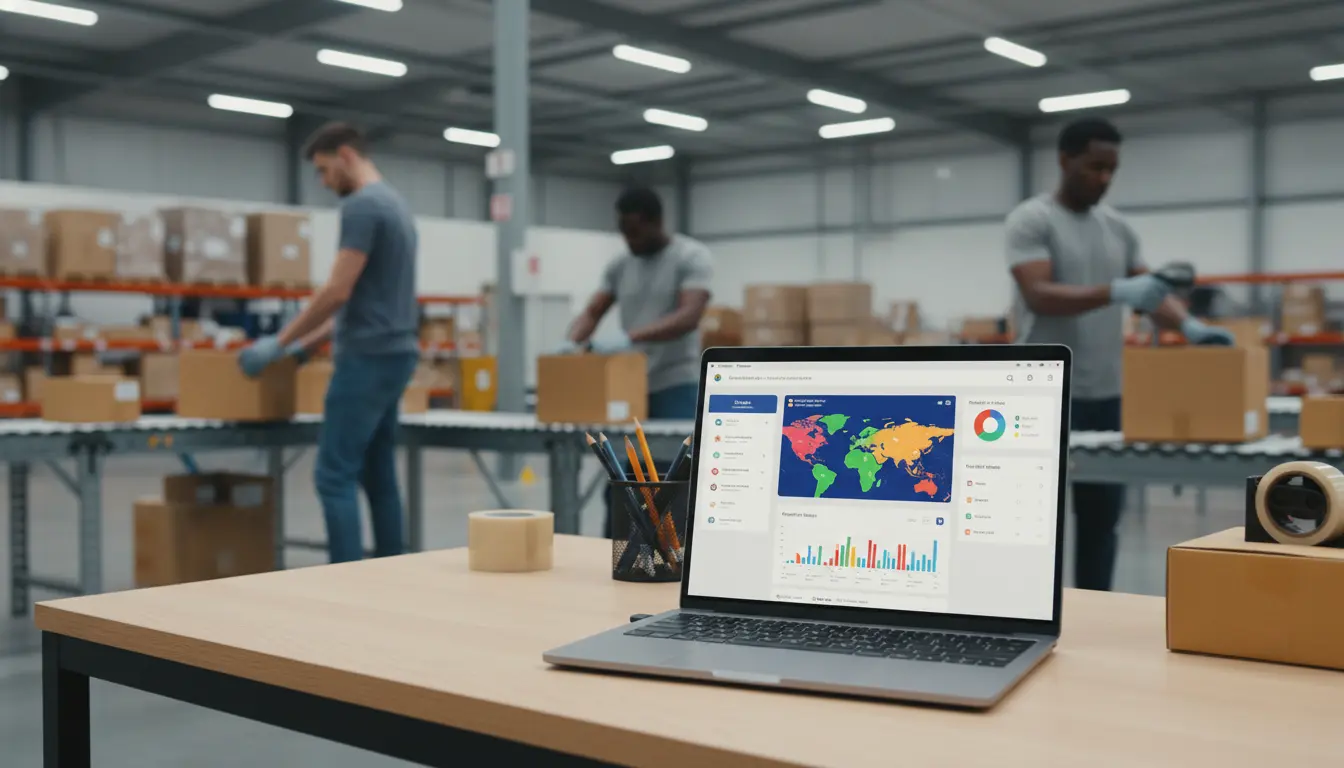
A Shopify store can look clean on the front end while the back end is starting to strain.
Orders are moving. Campaigns are working. The brand is adding SKUs, testing bundles, selling through Amazon, getting wholesale interest, or shipping into the U.S. Then the operational gaps start showing up: inventory counts drift, split shipments increase, returns sit too long, and retail buyers ask for requirements the current setup was never built to handle.
That is the real decision behind shopify fulfillment canada. You are not only choosing a warehouse to pick and pack orders. You are choosing an operating partner that can keep Shopify, inventory, customer expectations, wholesale requirements, and channel expansion aligned as the business gets more complex.
For Canadian Shopify brands, and for U.S. or international brands entering Canada, the right Shopify 3PL Canada partner should be evaluated on systems-readiness first. Location matters. Rates matter. But the questions that protect growth are more operational:
- Can inventory stay accurate across Shopify, wholesale, Amazon, and retail?
- Can SKUs, bundles, variants, and kits be handled cleanly?
- Can the 3PL route orders by channel, destination, SLA, and carrier logic?
- Can returns move back into available inventory fast enough to protect margin?
- Can the operation support branded packaging without slowing down throughput?
- Can it support B2B, retail, and cross-border growth without rebuilding from scratch?
This guide explains how to evaluate Shopify fulfillment services Canada brands can use beyond the first DTC stage.
Why Shopify fulfillment Canada decisions get harder after DTC
Most Shopify brands do not outgrow Shopify. They outgrow the fulfillment setup connected to it.
A brand doing 200 orders a month can survive with manual checks, spreadsheet fixes, and a small warehouse team that knows every SKU by memory. At 2,000 orders a month, that same setup creates hidden labour cost. At 10,000 orders a month, small errors become customer service tickets, stockouts, oversells, and delayed wholesale orders.
The Canadian market adds another layer. Statistics Canada reported that retail ecommerce sales reached $4.3 billion in December 2024 and accounted for 6.1% of total retail trade that month. Canadian retailers also finished 2024 with $803.1 billion in sales. Canada Post reported that 84% of Canadians shopped online in 2024, with 31% shopping online weekly.
That mix matters for Shopify brands. Ecommerce is large enough to demand strong DTC workflows, but many growth-stage brands still need retail, wholesale, Amazon, and cross-border channels to build a durable revenue base.
For example, a beauty brand may need Shopify DTC orders picked daily, wholesale cartons packed by retailer routing guide, Amazon inventory prepped with platform-specific labels, and U.S. customer orders shipped through a cross-border process that protects speed and cost. If the 3PL treats all of that as “just pick and pack,” the brand will feel the strain quickly.
Start with inventory sync, not warehouse space
Warehouse space is easy to understand. Inventory accuracy is harder to inspect before signing.
For Shopify fulfillment Canada projects, inventory sync should be one of the first technical checks. The 3PL should be able to explain how inventory moves between Shopify, the WMS, marketplaces, ERP tools, and any wholesale order process.
Ask practical questions:
- How often does inventory sync with Shopify?
- Are inventory changes pushed in real time or in scheduled batches?
- How are damaged, quarantined, returned, and reserved units shown?
- Can the system manage bundles, kits, and product variants?
- How are pre-orders, backorders, and partial allocations handled?
- What happens if Shopify inventory and warehouse inventory disagree?
This is where many Shopify brands discover that “integration” means different things to different providers.
A basic connector may pull orders from Shopify and send tracking numbers back. That is not enough for a brand with 500 SKUs, seasonal drops, pre-orders, bundles, Amazon inventory, and wholesale allocations. You need inventory logic that reflects how the business sells.
A good 3PL should show how inventory is received, counted, stored, picked, adjusted, and reported. If they cannot explain exception handling, the brand will end up managing exceptions internally.
SKU and catalog hygiene decide how cleanly the operation runs
Shopify makes it easy to add products, variants, bundles, gift sets, and promotional items. A warehouse has to turn those product records into physical movement.
That is where SKU hygiene matters.
Before moving into a new ecommerce fulfillment Canada setup, brands should clean up:
- Duplicate SKUs
- Inconsistent naming conventions
- Old product records still active in Shopify
- Variant confusion across size, colour, pack size, or region
- Bundle logic that does not match physical picking rules
- Barcode gaps
- Packaging instructions stored outside the system
- Product dimensions and weights that are missing or outdated
A fashion brand may know that “black rib tank small” and “BLK-RIB-TNK-S” are the same item. A warehouse system should not have to guess. The 3PL needs clean identifiers, barcode discipline, and clear receiving rules.
This becomes more important when the brand adds wholesale or marketplace channels. A retailer may use one item number, Shopify another, Amazon another, and the warehouse another unless the catalog is mapped correctly.
That mapping is not admin work. It is order accuracy work.
Brands evaluating Shopify 3PL Canada partners should ask how the provider handles SKU onboarding. Do they review the catalog before launch? Do they flag duplicate or unclear records? Do they test bundles before live order flow begins?
Order routing has to match the channel, not just the cart
A DTC Shopify order is usually simple: pick the items, pack them, ship them, update tracking.
Growth-stage brands need more decision logic.
Order routing may need to account for:
- Domestic Canadian orders
- U.S. cross-border orders
- Wholesale orders
- Amazon prep or replenishment
- Retailer routing guide requirements
- Split inventory by location
- Carrier cut-off times
- Service-level rules
- High-value orders that need extra checks
- Gift orders or branded packaging requests
A 3PL that supports B2C order fulfillment should be able to handle Shopify orders with speed and clean customer communication. But if the brand is moving beyond DTC, the same partner also needs B2B order fulfillment workflows for wholesale pick-pack, routing guides, ASN, EDI, labeling, and retailer compliance.
This is where many Shopify brands hit a wall.
Their DTC setup works well until a national retailer places a large order with strict carton labels, ship windows, routing rules, and chargeback risk. If the 3PL has no B2B process, the operations team has to manage the order manually or split channels across multiple providers.
That creates new failure points.
Returns workflows affect margin and inventory trust
Returns are not only a customer service issue. They are inventory events.
The National Retail Federation projected $849.9 billion in U.S. retail returns for 2025, with online sales expected to have a 19.3% return rate. For Shopify brands, that means a return process can affect available stock, resale value, customer refunds, exchange speed, and buying decisions.
A Shopify fulfillment partner should be able to answer:
- How are returns received and matched to the original order?
- Who inspects condition and decides sellable status?
- How quickly does inventory update in Shopify?
- Can the team handle exchanges, repairs, repacks, donations, or disposal?
- Are photos or notes captured for damaged goods?
- Are return trends reported by SKU, reason, and customer issue?
Evolution’s 3rd party returns management support is built for reverse logistics, inspection, grading, and restocking workflows. That matters for apparel, cosmetics, jewelry, housewares, and other categories where condition and packaging directly affect resale.
A slow return process creates two problems at once: customers wait longer, and sellable units stay outside available inventory.
Branded packaging should not break throughput
Shopify brands often care deeply about the unboxing experience. Inserts, tissue, stickers, dust bags, custom cartons, gift notes, and launch packaging can support brand memory.
But packaging has to be operationally clear.
Ask the 3PL:
- Which packaging rules can be stored by SKU, order type, or campaign?
- How are inserts controlled so old materials do not ship after a promotion ends?
- Can gift notes or special instructions be printed and packed accurately?
- How are packaging supplies counted and reordered?
- What packaging choices slow pick-pack speed or increase damage risk?
A good partner will not dismiss branded presentation. They will translate it into pick paths, packing stations, supply controls, and QA checks.
Evolution’s Brand Fulfillment Model fits this stage because it treats fulfillment as part of brand control, not only back-end shipping.
Amazon and wholesale expansion should be planned before they arrive
Many Shopify brands add Amazon, wholesale, or retail because demand appears. The fulfillment setup often catches up later.
That creates avoidable work: relabeling inventory, moving stock between providers, rebuilding SKU maps, manually allocating units, and reconciling reports from different systems.
Before choosing a Shopify fulfillment services Canada partner, ask how the operation would support:
- Amazon FBA prep, labeling, bundling, and carton rules
- Amazon order removals or inventory correction work
- Wholesale case packs and carton labels
- Retailer routing guides and ASN timing
- Shared inventory pools across Shopify and B2B orders
- Cross-border movement into the U.S.
The point is not to overbuild on day one. The point is to avoid choosing a provider that can only support yesterday’s channel mix.
A practical Shopify 3PL Canada evaluation checklist
Use this checklist before signing:
- Shopify order import and tracking update process is documented
- Inventory sync rules are clear for available, reserved, damaged, returned, and quarantined stock
- SKU onboarding includes barcode, variant, weight, dimension, and bundle checks
- Order routing rules are defined by channel, destination, SLA, and carrier
- DTC and B2B workflows can run from one inventory pool
- Returns are inspected, graded, and updated within agreed timelines
- Branded packaging rules are controlled inside warehouse SOPs
- Amazon prep and wholesale expansion are supported or clearly scoped
- Reporting gives order, inventory, return, and exception visibility
- Account support has named owners and escalation rules
If a provider cannot show the process, assume your team will manage the gaps.
FAQ
What is Shopify fulfillment Canada?
Shopify fulfillment Canada refers to order storage, picking, packing, shipping, returns, and inventory updates for Shopify brands serving Canadian customers or using Canada as part of a North American fulfillment model.
How do I choose a Shopify 3PL Canada partner?
Start with systems-readiness. Review inventory sync, SKU setup, order routing, returns, packaging rules, B2B support, Amazon prep, reporting, and account support before comparing only storage and pick rates.
Can one 3PL support Shopify and wholesale orders?
Yes, but only if the 3PL has both B2C and B2B workflows. Shopify orders, wholesale cartons, retailer routing guides, ASN, and EDI requirements need different process rules.
Why does inventory sync matter so much for Shopify order fulfillment?
Inventory sync affects what customers can buy, what wholesale can be promised, what Amazon can receive, and what customer service can answer. Bad sync creates oversells and manual fixes.
When should a Shopify brand move from in-house fulfillment to a 3PL?
Consider a 3PL when order volume, SKU count, returns, wholesale interest, Amazon prep, or cross-border shipping starts taking leadership time away from growth and product work.
Talk to Evolution about Shopify fulfillment Canada
Shopify growth should not force your team into daily warehouse problem-solving. If your brand is adding SKUs, channels, wholesale accounts, Amazon prep, or cross-border demand, the fulfillment model needs to support the business you are becoming.
Talk to our team about your channel mix and see if Evolution is the right long-term fit for Shopify fulfillment in Canada and North America.