Choosing the wrong fulfillment partner can cost your fashion brand hundreds of thousands of dollars. With 60% of brands changing apparel 3PL companies multiple times, the stakes are high.
The apparel logistics market reached $148 billion in 2025. Specialized clothing fulfillment companies range from tech platforms to boutique operations. This framework helps you evaluate 3PL for apparel brands and avoid costly mistakes.
What to Look for in an Apparel 3PL Company
Not all 3PLs are built for fashion. General fulfillment centers treat a hoodie like a hardware bolt — same bin, same process, same error rate. Apparel requires a different standard.
When evaluating apparel fulfillment services, the right partner should demonstrate:
- SKU-level inventory management across style, size, and colour
- Dual storage infrastructure — garment-on-hanger (GOH) rails and flat-pack shelving
- Returns refurbishment capabilities in-house, not outsourced
- Retail compliance expertise for wholesale and major retail channels
- Cross-border shipping with bonded warehousing and HS code classification
- Dedicated account management — not a rotating support queue
Use the sections below as your evaluation checklist when shortlisting providers.
Understanding True Fulfillment Costs for Fashion Brands
Most fashion brands compare per-order quotes and miss the total landed cost. When evaluating apparel fulfillment services, demand a complete breakdown.
Storage costs should be at SKU level. Fashion brands managing 750+ SKUs need providers who track 40 different size and colour combinations per pallet.
Returns process costs separate specialists from general centers. With 20–30% return rates, your ability to handle returns impacts recovered margin. Return management with cleaning, pressing, and re-tagging should be standard.
Retail compliance penalties vary. Some providers absorb chargebacks; others bill you directly. A single Costco non-compliance incident triggers $3,000+ in chargebacks.
Technology fees and minimums ($5,000–$15,000 monthly) can crush economics during slow seasons.
Calculate your true cost: Total cost = (Orders × rate) + (SKUs × storage) + tech fees + minimums. Model three scenarios: current volume, peak season (50–100% higher), and low season (30–40% below). For a full breakdown of what 3PL fees actually look like, see our guide to 3PL pricing.
Infrastructure That Matters: Warehouse Capabilities for Apparel
Physical warehouse capabilities reveal whether a provider can actually handle fashion complexity. Always request a facility tour — what you see on-site tells you more than any sales deck.
Dual Storage Systems (GOH + Flat-Pack)
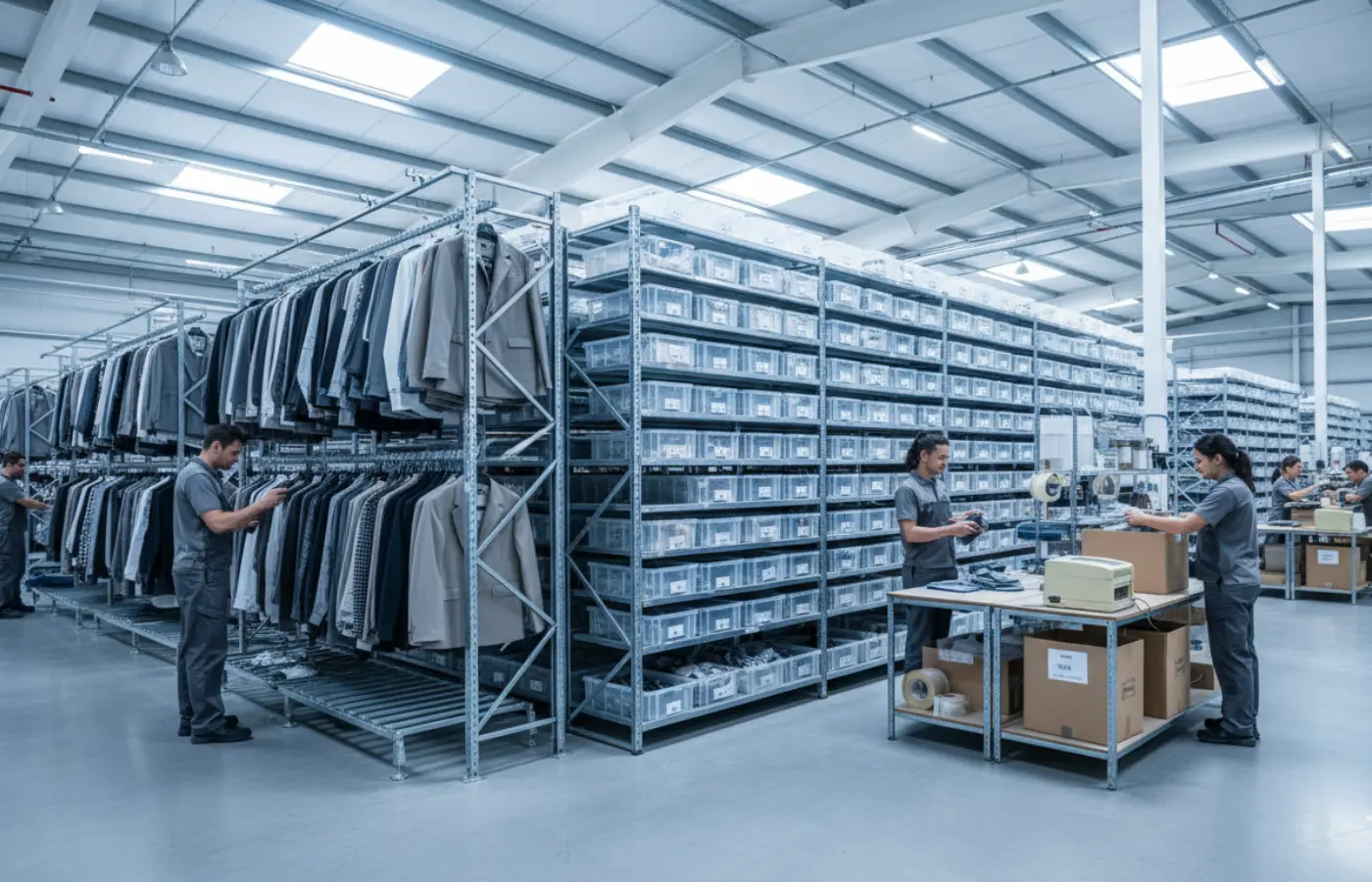
Tour the facility. Verify both garment-on-hanger rail systems and flat-pack shelving exist. About 50% of apparel inventory arrives on hangers. Channel allocation shifts constantly in the fashion industry.
Your fulfillment center must convert hanging inventory to e-commerce-ready folded packages. Ask to see GOH infrastructure: conveyor systems, climate-controlled zones, and garment bag inventory management.
Technology Built for Fashion SKU Complexity
Request a live demo. The warehouse management system should:
- Track inventory at style × size × colour level
- Support multi-channel allocation (DTC, wholesale, Amazon simultaneously)
- Provide demand forecasting by SKU
- Integrate natively with Shopify and EDI systems
- Generate retail-compliant ASNs automatically
If the demo requires manual workarounds, the system was not built for apparel.
RFID capabilities: Without RFID, apparel retailers achieve only 65% inventory accuracy. With RFID: 99% accuracy and 150 items scanned per minute — a 15× improvement. Ask whether RFID is standard or a premium add-on. Providers who quote it as an upgrade typically lack the underlying infrastructure.
Returns Processing: The Hidden Make-or-Break Factor
Returns are where apparel 3PL partners win or lose your margin. With return rates of 20–30% in fashion, the refurbishment pipeline needs to be airtight.
Request a detailed walkthrough of how returns are managed. A proper pipeline includes:
- Condition grading and quality inspection
- Quality-controlled cleaning
- Spot treatment for stains
- Pressing and steaming
- New tags applied to brand standards
- Refolded and repacked to brand spec
- New polybags with UPC applied
- Return to sellable inventory
Premier clothing fulfillment companies operate dedicated garment cleaning facilities in-house. If your provider outsources refurbishment, expect 30–50% of returns to become waste rather than recovered revenue.
Our apparel pick and pack guide covers how returns processing integrates with inbound and outbound workflows.
Retail Compliance and EDI Requirements
If you sell through major retailers, compliance expertise is non-negotiable. Chargebacks, routing guide violations, and labelling errors compound quickly.
Request case studies for Nordstrom, Costco, Saks, or Amazon Vendor Central. Ask directly about chargeback history and how the provider handles non-compliance incidents on your behalf.
EDI integration is table stakes for wholesale. Your 3PL should generate and receive EDI 850 (purchase orders), 856 (advance ship notices), and 810 (invoices) without manual intervention.
Workforce quality matters here too. Ask: “What percentage of warehouse staff are full-time versus temporary?” Apparel fulfillment requires trained staff who understand fabric care and can distinguish between similar SKUs in polybags. Top specialists maintain 85–95% full-time staff ratios. General 3PLs often exceed 100% annual turnover; specialized providers typically achieve under 30%.
Specialized Apparel 3PL vs. General Fulfillment Center
The difference in capabilities between a specialized apparel 3PL and a general fulfillment center is significant. Here’s how they compare across the factors that matter most to fashion brands:
| Evaluation Factor | Specialized Apparel 3PL | General Fulfillment Center |
|---|---|---|
| Inventory tracking | Style × size × colour (SKU-level) | Generic barcode/bin location only |
| Storage infrastructure | GOH rail systems + flat-pack shelving | Flat-pack only; no GOH capability |
| Returns refurbishment | In-house cleaning, pressing, re-tagging | Typically outsourced or discarded |
| Inventory accuracy | 99% with RFID | ~65% without RFID infrastructure |
| Staff turnover | Under 30% annually | 100%+ annually |
| Retail compliance (EDI) | Native EDI + ASN generation | Manual or third-party workarounds |
| Cross-border shipping | Bonded warehousing, HS code expertise | Standard customs only |
| Integration timeline | 3–4 weeks (Shopify, EDI, Amazon) | 8–12 weeks average |
| Account management | Dedicated team, 5+ year avg. tenure | Shared support queue |
| Retail chargeback handling | Expertise in Nordstrom, Costco, Saks | Limited experience, billed to client |
For a deeper look at how this translates to specific services, explore our complete guide to 3PL for clothing brands.
Geographic Strategy and Cross-Border Considerations
Request a coverage analysis from every provider you evaluate. What percentage of your customer base receives 2-day ground delivery? Single-facility providers cannot serve both U.S. coasts cost-effectively within two days. Bi-coastal networks enable 95%+ coverage at ground rates.
Cross-border capabilities are increasingly critical. The U.S. suspended the $800 de minimis exemption in August 2025. Tariffs reached 35% on certain goods. One fashion importer faced a $1.2 million penalty from inadequate HS code classification.
Evaluate cross-border shipping capabilities by asking:
- Do you operate bonded warehouses?
- What is your HS code classification process?
- Can I store inventory in Canada and fulfill to both Canadian and U.S. customers?
Providers with facilities on both sides of the border offer a significant advantage: store inventory in one country, fulfill to both markets, and defer duties until goods are sold.
Red Flags When Evaluating 3PL Partners
Walk away if you encounter any of the following:
- No named apparel clients — fashion fulfillment is a specialization; vague references to “retail experience” don’t qualify
- Resistance to facility tours — legitimate partners welcome operational scrutiny
- Vague answers about reverse logistics — if they can’t describe their returns pipeline in detail, they don’t have one
- Generic WMS with no live demo — a system that can’t be demonstrated working with apparel SKUs won’t work for your brand
- High client turnover — ask how many clients they’ve lost in the past 12 months and why
- Pressure for long-term contracts without a pilot — any reputable partner will offer a 30–60 day trial period
- Pooled inventory across dozens of brands — your SKUs should not be co-mingled with unrelated products in shared bins
Apparel 3PL Evaluation Checklist
Use this checklist when conducting facility visits and reference calls:
Costs & Contracts
- ☐ Full cost breakdown including storage, tech fees, and minimums provided
- ☐ Three-scenario pricing modeled (current, peak, low season)
- ☐ Pilot period offered before long-term commitment
Infrastructure
- ☐ GOH rail systems and flat-pack shelving both present on tour
- ☐ WMS live demo shows SKU tracking at style × size × colour
- ☐ RFID standard (not a premium add-on)
- ☐ Shopify / EDI integration completed in under 4 weeks for references
Returns & Quality
- ☐ Returns refurbishment fully in-house (no outsourcing)
- ☐ Eight-step returns pipeline described in detail
- ☐ 85%+ full-time staff ratio confirmed
Compliance & Retail
- ☐ Named retail compliance case studies provided (Nordstrom, Costco, Saks, etc.)
- ☐ Chargeback history disclosed
- ☐ EDI capabilities confirmed with ASN generation
Cross-Border & Geography
- ☐ 2-day ground coverage analysis provided for your customer base
- ☐ Bonded warehouse capability confirmed
- ☐ HS code classification process documented
Partnership
- ☐ Dedicated account manager assigned (not shared support)
- ☐ References from brands on your e-commerce platform provided
- ☐ Average account manager tenure confirmed (target: 5+ years)
Why Specialized Apparel 3PLs Outperform General Fulfillment Centers
General fulfillment centers optimize for volume and simplicity. Apparel optimizes for neither — it is high-SKU, high-return, compliance-heavy, and seasonally volatile. These two operational profiles are fundamentally incompatible.
Specialized apparel 3PLs invest in infrastructure general providers won’t: GOH conveyor systems, garment cleaning equipment, dedicated retail compliance teams, and WMS platforms built around fashion attributes rather than retrofitted with them. The result is measurably better outcomes: higher inventory accuracy, lower chargeback rates, better margin recovery on returns, and faster integration timelines.
For established brands doing $5–20M in annual sales, the cost of a mis-matched 3PL partner is not just operational friction — it’s margin loss at scale. Learn how our Brand Fulfillment Model is designed specifically for this segment.
Making Your Final Decision
Narrow to 2–3 finalists. Weight evaluation categories by what matters most for your brand:
- Growth brands: Prioritize technology, multi-facility networks, and variable pricing structures
- Premium brands: Prioritize returns refurbishment, custom packaging, and white-glove service
- Cross-border brands: Prioritize bonded warehouses and HS code expertise
- Wholesale brands: Prioritize retail compliance, EDI capability, and B2B pick and pack
Request a 30–60 day pilot. Ship representative inventory. Process 200–500 orders. Measure order processing accuracy, turnaround speed, and quality of communication throughout.
FAQs About Choosing an Apparel 3PL
What is the average cost of an apparel 3PL?
Costs vary significantly by provider, volume, and service level. Most apparel 3PLs charge per-order fulfillment fees ($3–$8 for DTC), storage by pallet or SKU, and monthly technology fees that can range from $500 to $15,000+. The best approach is to model total landed cost across three scenarios — current volume, peak season, and low season — rather than comparing headline per-order rates. See our detailed guide to 3PL pricing for a full breakdown.
How do I evaluate a 3PL for clothing brands?
Start with five criteria: infrastructure (GOH + flat-pack), technology (WMS with fashion-attribute tracking), returns capabilities (in-house refurbishment), retail compliance (named case studies), and cultural fit (dedicated account management, staff tenure). Always conduct a facility tour and request a live WMS demo. A 30–60 day pilot before signing a long-term contract is essential.
What should fashion brands look for in a fulfillment partner?
Fashion brands need a partner with apparel-specific infrastructure — garment-on-hanger systems, climate-controlled zones, and RFID-enabled inventory tracking — rather than a general logistics provider adapting generic systems. Look for experience with your specific sales channels (DTC, wholesale, Amazon), low staff turnover, and proven retail compliance with the retailers you currently serve or plan to enter. Our guide to 3PL for clothing brands covers this in depth.
How are apparel returns handled by 3PLs?
Best-in-class apparel 3PLs manage returns through a full eight-step refurbishment pipeline: condition grading, cleaning, spot treatment, pressing, re-tagging, refolding, repacking with new polybags, and returning to sellable inventory. This process should be performed in-house. Providers who outsource refurbishment typically result in 30–50% of returned inventory becoming waste rather than recovered revenue.
What is GOH (garment-on-hanger) fulfillment?
GOH (garment-on-hanger) fulfillment refers to the storage and movement of apparel while it remains on hangers, rather than being folded and stored flat. Approximately 50% of fashion inventory arrives at fulfillment centers on hangers, and GOH rail systems — including conveyor infrastructure and climate-controlled hanging zones — are required to handle it properly. Providers without GOH capability force all inventory into flat storage, increasing handling time, garment damage, and error rates. For a detailed look at how GOH integrates with a broader apparel workflow, see our guide to apparel pick and pack.
How long does it take to integrate with a new apparel 3PL?
Best-in-class apparel 3PLs complete Shopify, EDI, and Amazon integrations in 3–4 weeks. General fulfillment centers typically require 8–12 weeks. When checking references, ask specifically: how long did integration take, and what challenges came up? Delays in integration directly delay your ability to fulfill orders.
What is the difference between B2B and B2C apparel fulfillment?
B2C (direct-to-consumer) fulfillment involves individual orders shipped to end customers, typically with fast turnaround (same-day or next-day), branded packaging, and high return rates. B2B fulfillment involves wholesale orders to retailers, governed by strict routing guides, EDI requirements, and compliance standards. Chargebacks for non-compliance can be significant. Many established fashion brands require both capabilities simultaneously, making multi-channel expertise a key evaluation criterion.
