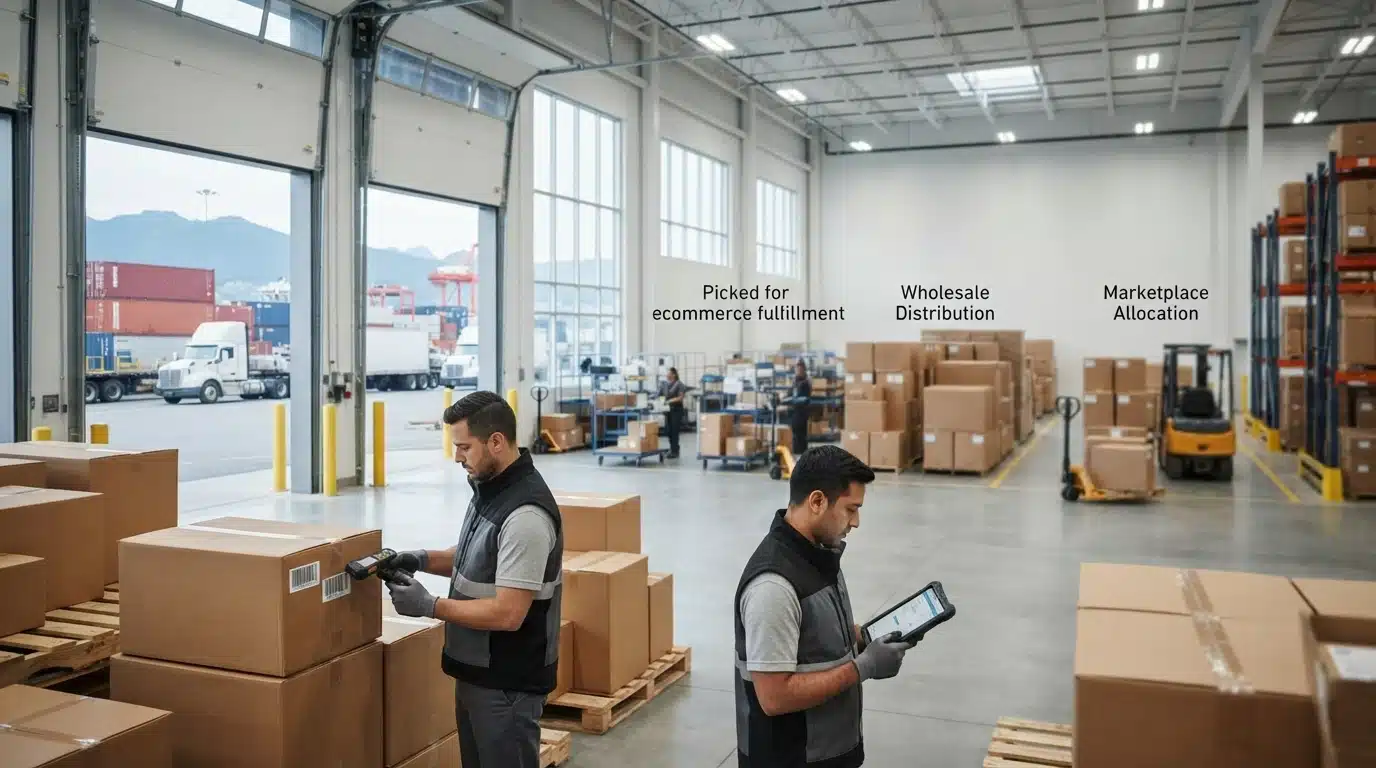
A brand can outgrow its warehouse plan before it outgrows its sales plan.
The warning signs usually arrive in small ways: containers sit longer than expected, wholesale orders compete with ecommerce picks, Amazon stock needs prep on short notice, and finance cannot tell whether storage cost is rising because the brand is growing or because inventory is sitting in the wrong place.
That is why Vancouver warehousing for brands is not only a storage decision. For omnichannel operators, the right Vancouver or Delta warehouse should connect inbound freight, inventory control, fulfillment, cross-border movement, and channel rules into one operating model.
This guide explains how to evaluate warehousing in Vancouver, when a 3PL warehouse Vancouver partner makes sense, and what port access means for Canada-US distribution.
Why Vancouver warehousing matters for omnichannel brands
Omnichannel fulfillment creates warehouse pressure because every channel asks inventory to behave differently.
A DTC order may need same-day pick, branded packaging, and a carrier label. A wholesale order may need carton labels, routing-guide compliance, and an ASN. Amazon inventory may need prep, labels, and removal workflows. A retailer may want pallet movement rather than parcel shipping.
Vancouver adds another layer. The Port of Vancouver handled 158.4 million metric tonnes of cargo and 3.47 million TEUs in 2024, according to the Port of Vancouver 2024 statistics overview. For brands importing from Asia-Pacific suppliers, that scale explains why Greater Vancouver and Delta remain strong locations for inbound freight planning.
But port access alone does not make a warehouse the right fit. A brand needs to know what happens after freight is released: how inventory is received, counted, stored, reported, picked, packed, and moved into Canada-US distribution.
For that reason, warehousing Vancouver decisions should start with channel fit, not square footage.
What port access should mean in a warehouse search
Port access is often used as shorthand for proximity. That is too narrow.
For an omnichannel brand, port access should mean faster control over inbound freight after it enters the region. It should reduce handoffs between drayage, receiving, storage, and fulfillment. It should also support decisions about whether goods should be stored, cross-docked, relabeled, split by channel, or moved onward to another market.
The Port of Vancouver’s 2024 container flow included 1.83 million inbound TEUs and 1.64 million outbound TEUs. Those numbers matter because a busy gateway rewards brands that plan receiving and allocation before the container lands.
A practical port-access review should ask:
- How quickly can the warehouse receive containers after appointment and release?
- Can the team handle floor-loaded cartons as well as palletized freight?
- Are there workflows for container devanning, pallet build, labeling, and short-term staging?
- Can freight be cross-docked when goods do not need long-term storage?
- Does the WMS update inventory quickly enough for the sales channels that depend on it?
Evolution’s Vancouver/Delta warehousing footprint is relevant here because it sits close to the port and supports both storage and fulfillment workflows. The point is not to claim that every brand needs a port-adjacent facility. The point is that brands importing into BC need a warehouse process that turns inbound freight into available inventory without losing time in manual handoffs.
For freight that needs to move through rather than sit, transloading and cross-docking support can be a better fit than standard storage.
Inventory storage is useful only if it protects channel availability
Storage cost is easy to compare. Storage quality is harder.
A warehouse rate sheet may show pallet storage, bin storage, pick fees, receiving fees, and monthly minimums. Those numbers matter, but they do not answer the bigger question: can the warehouse keep inventory accurate enough for every channel that sells from it?
A fashion brand with 600 SKUs, seasonal drops, wholesale prebooks, ecommerce replenishment, and returns does not only need racks. It needs clean receiving, bin discipline, cycle counts, and inventory status rules. Available-to-sell stock should not include units waiting for inspection, goods held for wholesale allocation, or items pending relabeling.
This is where many warehousing comparisons fall short. They treat storage as a static service. For omnichannel brands, storage is a control system.
A good 3PL warehouse Vancouver partner should be able to explain:
- How inbound counts are checked against purchase orders
- How damaged, short, or over-received goods are reported
- How inventory is separated by sellable, hold, return, and channel allocation status
- How often cycle counts occur and how variances are handled
- How your team will see inventory data inside the WMS or connected systems
If the answer is “we will send a spreadsheet,” be careful. Spreadsheet inventory can work in a small operation, but it breaks down when DTC, wholesale, marketplace, and retail workflows are all drawing from the same stock pool.
For brands that need dedicated storage capacity with fulfillment attached, Evolution’s warehouse in Canada service is designed around inventory access, operational visibility, and North America distribution planning.
Fulfillment integration separates a warehouse from an operating partner
A warehouse stores goods. An operating partner connects goods to orders.
That distinction matters when a brand sells through Shopify, wholesale accounts, Amazon, and major retailers at the same time. Each channel creates different data requirements. Ecommerce needs fast order import and carrier updates. Retailers may require EDI, ASNs, carton content accuracy, and routing-guide steps. Amazon inventory may require labels and prep rules before it can move.
The warehouse should not treat those needs as side projects. They should be part of the fulfillment design from day one.
A practical fulfillment integration review should cover:
- Storefront and ERP connections
- Order cut-off times and exception rules
- Carrier selection logic for Canada and US parcels
- Wholesale order routing, labels, and ASN timing
- Amazon prep and inventory removal needs
- Returns intake and restocking rules
- Reporting cadence for SLA, inventory, and billing review
This is also where brand control enters the discussion. Outsourcing warehouse work should not mean losing control of inventory, data, customer experience, or margin decisions. It should give the brand a clearer operating base.
Evolution’s fulfillment services are built for that kind of channel mix, with workflows that connect storage, B2C order handling, B2B shipping, returns, and cross-border movement.
Canada-US distribution needs a different warehouse lens
Brands comparing Vancouver and BC warehousing often focus on Canadian orders first. That is natural, but it can miss the bigger opportunity.
A Vancouver-area warehouse can support Canadian retail and ecommerce demand while also helping a brand plan US distribution. The question is whether the warehouse partner understands how inventory should move across the border, which carriers and service models fit the product mix, and when cross-border domestic shipping may reduce buyer friction.
The United States International Trade Administration reports that ecommerce accounted for 6.1% of total Canadian retail sales in December 2024, with online retail sales near US$3.14 billion in its Canada e-commerce market note. That share may sound modest, but it represents steady demand for parcel-ready inventory, returns handling, and warehouse systems that can support both online and wholesale demand.
For brands serving both Canada and the US, the warehouse conversation should include:
- Where inventory enters North America
- Which market needs faster replenishment
- Whether orders ship from Canada, the US, or both
- How duties, customs paperwork, and customer delivery expectations are handled
- How returns are routed back into sellable stock
A warehouse that only answers the storage question may leave the brand to solve the distribution question alone. Evolution supports Canada-US planning through cross-border domesticated shipping, which can help brands think through how goods move after they leave the warehouse.
Evaluation criteria for choosing a Vancouver warehouse
The best warehouse choice is rarely the cheapest quote. It is the one that reduces operating drag without hiding the real work.
Use these criteria when comparing Vancouver warehousing providers:
1. Location fit
Ask which freight lanes the warehouse supports best. A site near Vancouver or Delta may help with port-related movement, but it still needs the right receiving capacity, dock flow, and carrier access for your mix.
2. Channel fit
A DTC-heavy beauty brand and a wholesale apparel brand may both need storage, but their workflows are not the same. Review whether the provider supports B2C order fulfillment, B2B order fulfillment, Amazon prep, returns, or retailer compliance before you compare rates.
3. Inventory control
Ask how the warehouse manages receiving gaps, cycle counts, quarantine stock, channel allocation, and WMS visibility. If the provider cannot explain variance handling, the risk will move back to your team.
4. Freight handling range
Some providers are strong at pallet storage but weak at container unloading. Others handle cross-docking but are not built for high-SKU ecommerce picks. Match the provider to inbound and outbound reality.
5. Reporting and communication
A good warehouse partner should make exceptions visible. You should know when inventory is delayed, when counts do not match, when a routing-guide step needs attention, and when volume patterns suggest a process change.
6. Growth fit
Ask what happens when order volume doubles, a retailer adds new routing rules, or a seasonal launch brings in containers and returns at the same time. The answer should be specific, not vague reassurance.
When Evolution Fulfillment may be the right fit
Evolution Fulfillment is a strong fit for established brands that need more than storage in BC. The best-fit brand usually has a multi-channel sales model, meaningful monthly volume, and a need for clearer Canada-US operations.
That can include an apparel brand importing seasonal collections through Vancouver, a lifestyle brand balancing DTC and wholesale orders, or a cosmetics brand that needs careful inventory handling, returns inspection, and channel allocation.
Evolution’s role is to act as an operational extension of the brand: storing inventory, connecting fulfillment workflows, supporting retailer and ecommerce requirements, and helping leadership make better distribution decisions.
If your team is comparing Vancouver warehousing options, the next step is not only to ask for rates. Bring your channel mix, inbound freight pattern, SKU count, monthly volume, retailer rules, and Canada-US goals into the conversation.
Then ask how the warehouse will manage the work when all of those pressures happen at once.
To see whether Evolution is the right long-term fit, request a fulfillment strategy call and walk through your storage, port access, and distribution plan with the team.
