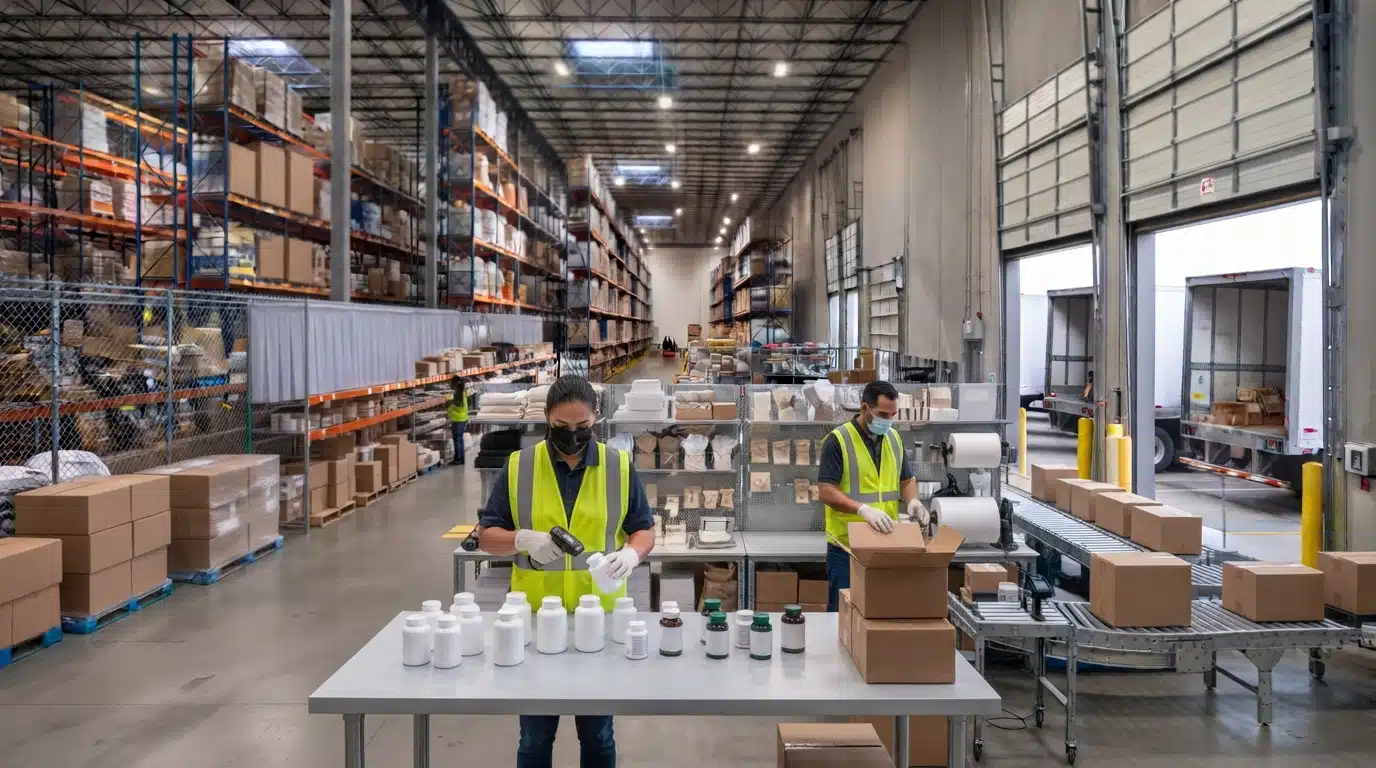
Natural health product brands carry a different operational burden from ordinary consumer goods. A missed expiry check, unclear lot record, poor storage discipline, or label mix-up can create customer service issues and inventory uncertainty fast. The fulfillment partner does not replace a brand’s regulatory advisors, but it does need warehouse processes that support careful handling.
For brands researching nhps 3pl services in canada, the practical question is this: can the 3PL receive, store, pick, pack, ship, and return natural health product inventory with the level of control the category demands?
This article is not legal or regulatory advice. It focuses on fulfillment operations: inventory controls, lot and expiry awareness, storage-condition discipline, labeling discipline, channel workflows, and partner questions to ask before moving stock.
NHP fulfillment needs tighter inventory discipline
Natural health products often have attributes that matter at unit, case, or lot level. Expiry dates, lot numbers, package condition, label version, and storage requirements can all affect whether a unit should ship.
A standard warehouse process may only ask, “Is the SKU available?” NHP fulfillment often needs extra questions:
- Which lot is this unit from?
- What is the expiry date?
- Is the packaging intact?
- Does the label version match the active selling channel?
- Is the product stored in the right condition?
- Should older stock ship before newer stock?
Health Canada’s public guidance on natural health products shows why brands in this category tend to care about product identity, labeling, and product information. The fulfillment workflow should support that discipline without making unverified claims about compliance status.
Lot and expiry awareness must be built into receiving
Receiving is where many downstream problems begin. If lot or expiry information is missed at the dock, the warehouse may have to recover that data later through manual checks. That costs time and increases risk.
A better receiving process for NHP inventory includes:
| Receiving control | Why it matters |
|---|---|
| SKU match | Confirms the product received matches the purchase order |
| Lot capture | Helps the brand trace inventory by batch if needed |
| Expiry capture | Supports first-expiry-first-out handling where appropriate |
| Quantity check | Reduces stock mismatches before orders begin |
| Condition check | Flags damaged cartons, leaks, dents, or label issues |
| Putaway rule | Places inventory in the correct location with clear system records |
For a wellness brand selling 40 SKUs across DTC, Amazon, and wholesale, these checks protect more than warehouse neatness. They affect what customer service can promise, what sales can allocate, and how quickly the team can respond when inventory questions arise.
Evolution’s core fulfillment services are built for brands that need operational control across multiple channels, not one-off storage.
Storage-condition discipline matters even without overclaiming
Some NHPs may require specific storage practices based on product type, packaging, or brand instructions. A 3PL should be able to follow documented storage rules and explain how warehouse teams know which products need which treatment.
That may include temperature-aware storage areas, separation from incompatible goods, clear location controls, carton protection, clean pick faces, and procedures for damaged or questionable units. The important point is not to accept vague promises. Brands should ask how instructions are recorded, trained, checked, and reported.
For example, if a brand ships supplements in bottles and powder pouches, the warehouse needs to know how to handle crushed cartons, broken seals, leaking product, and returned units. Those events should create exception records, not guesswork.
Labeling discipline protects channels and customers
NHP brands often sell across their own website, marketplaces, wholesale accounts, practitioners, and retailers. Each channel may have different labeling, pack-slip, carton, or routing needs. The warehouse has to know which rules apply before the order reaches the pack bench.
Labeling discipline may include:
- Correct product label version by SKU and channel
- Correct shipping label and return label
- Retail carton labels where needed
- Marketplace prep labels where applicable
- Language or market-specific packaging instructions
- Clear hold rules if labels or components are not approved
For DTC orders, B2C order fulfillment should support accurate picks, branded pack presentation, and fast shipping. For wholesale or retailer orders, B2B order fulfillment may involve carton labels, routing guides, appointment timing, and documentation workflows.
Returns need inspection rules before product comes back
Returns can be difficult for NHP brands because a returned unit may not be suitable for resale even if it looks unopened. The brand should define the decision rules, and the 3PL should be able to follow them consistently.
A return workflow may route units into statuses such as:
- Sellable after inspection
- Hold for brand review
- Damaged packaging
- Opened or tampered packaging
- Expired or near expiry
- Incorrect item returned
- Dispose, donate, or repurpose where approved and appropriate
The warehouse should update inventory only after the decision is made. If returned units are automatically placed back into sellable stock, the brand loses control over quality and customer experience.
Channel mix affects the right fulfillment model
An NHP brand selling only through its own website has different needs from a brand shipping to Amazon, health retailers, practitioners, and wholesale distributors. Channel mix changes receiving, labeling, pick rules, inventory allocation, returns, and reporting.
A DTC-heavy brand may prioritize same-day order handling, subscription continuity, and customer-friendly returns. A wholesale-heavy brand may care more about case picks, pallet moves, carton labels, and ship-window discipline. An Amazon seller may need prep work, labeling rules, and stock allocation between marketplace and non-marketplace channels.
This is where Evolution’s Brand Fulfillment Model becomes relevant. The model is designed for brands that want to keep more control than a traditional distributor path may allow. Evolution’s article on Brand Fulfillment versus distributor and direct models explains that strategic difference.
Questions to ask a Canadian 3PL before moving NHP inventory
Before choosing a 3PL, ask questions that force process-level answers:
- How do you capture lot and expiry data at receiving?
- Can you support first-expiry-first-out picking where the brand requires it?
- How are storage instructions recorded and checked?
- How are damaged, leaking, open, or questionable units handled?
- Can you separate sellable, held, damaged, and returned inventory statuses?
- How do you support DTC, wholesale, Amazon, and retailer workflows from one inventory base?
- What reports show inventory by SKU, lot, expiry, and status?
- Who approves exception handling?
- How are label changes handled during a transition?
- What happens if one channel needs inventory that another channel has already been allocated?
A strong partner will answer with systems, workflows, and examples. A weak answer will rely on general reassurance.
What a good NHP fulfillment transition looks like
Moving NHP inventory should not be rushed. A clean transition starts with product data, inventory counts, lot and expiry records, packaging instructions, channel rules, return rules, and integration requirements.
A practical transition plan includes:
- SKU master file review
- Lot and expiry requirements by product
- Storage and handling instructions
- Channel mapping for DTC, B2B, Amazon, and retailer orders
- Returns decision matrix
- First receiving audit
- Test orders before full launch
- Reporting schedule for inventory and exceptions
This approach gives the brand and 3PL a shared operating language before volume begins. It also reduces the chance that the first month becomes a series of urgent clarifications.
How Evolution supports careful fulfillment for health and wellness brands
Evolution Fulfillment works with established brands that need integrated, high-volume fulfillment across North America. For NHP and wellness brands, the fit depends on product needs, monthly volume, channel mix, and the level of inventory control required.
The role of the 3PL is to support the brand’s operating rules with accurate receiving, disciplined storage, careful picking, clear returns handling, and communication that does not leave the brand guessing.
If your NHP brand is expanding in Canada or selling across North American channels, request an operations review with Evolution. The conversation can cover SKU structure, lot and expiry needs, storage instructions, DTC and wholesale volume, Amazon workflows, and the reporting your team needs to stay in control.
