Credit: Cut & Show, “Is your brand being weighed down by the distributor model“, 07/06/2016. Author: Gregg Sayer. Reproduced with permission.
You only have two options when it comes to getting your brand into the North American market. You either find a distributor (and cross your fingers) or you build up your own direct infrastructure (and cross your fingers). Turns out there’s a third model that gives you the transparency and control of the direct model while still outsourcing all the hassles of distribution.
Brand Fulfillment vs Distributor vs Direct: Quick Comparison
| Model | Best Fit | Control | Margin Visibility | Channel Access | Operational Complexity | Fulfillment Partner Role |
|---|---|---|---|---|---|---|
| Distributor model | Brands that want quick market access and are comfortable giving up control | Lower. The distributor often controls retailer relationships, pricing influence, and sales data | Limited. Margin is reduced by distributor markups and less transparent channel economics | Depends on distributor relationships and priorities | Lower for the brand, but less visibility and flexibility | Distributor buys, sells, and manages the market relationship |
| Direct model | Brands ready to build their own local sales, warehouse, logistics, and compliance infrastructure | Highest. The brand owns the full market relationship | Highest visibility, but costs are fixed and operationally heavy | Strong if the brand has local team, systems, and infrastructure | Highest. Requires warehouse, staff, systems, compliance, tax, and logistics management | Internal team manages operations directly |
| Brand Fulfillment Model | Growing brands that want market control without building full infrastructure too early | High. The brand keeps control of pricing, customer relationships, inventory decisions, and channel strategy | Strong. Fulfillment costs are visible and tied to operations instead of distributor margin | Supports DTC, wholesale, Amazon, and retail channels from a shared operating model | Moderate. Operations are outsourced, but the brand still leads sales and strategy | 3PL acts as an extension of the brand’s business |
The Brand Fulfillment Model is not right for every company. It works best for established brands that want to grow in North America while keeping control of the customer relationship, channel strategy, and brand experience. Instead of surrendering the market to a distributor or building a full direct operation too early, the brand uses a fulfillment partner to manage the operational layer.
Time for a Nui plan
Everything was going great for Nui Organics, a children’s clothing brand whose name means big or important in the native Maori language of New Zealand.
They had big plans for the UK when, out-of-the-blue, their UK distributor threw a wrench into the gears.
“Well, basically, they called us up and said ‘sorry, we’re shutting down the business, here’s your customer list. Good luck.’” said Amanda Searancke, founder and lead designer at Nui Organics, “We didn’t have the same personal relationships that the distributor did, so we had to scramble to establish these connections – and save future orders – and then figure out how to get them our product. It was an unpleasant bump in the road that we didn’t see coming.”
Direct vs. Distributor model
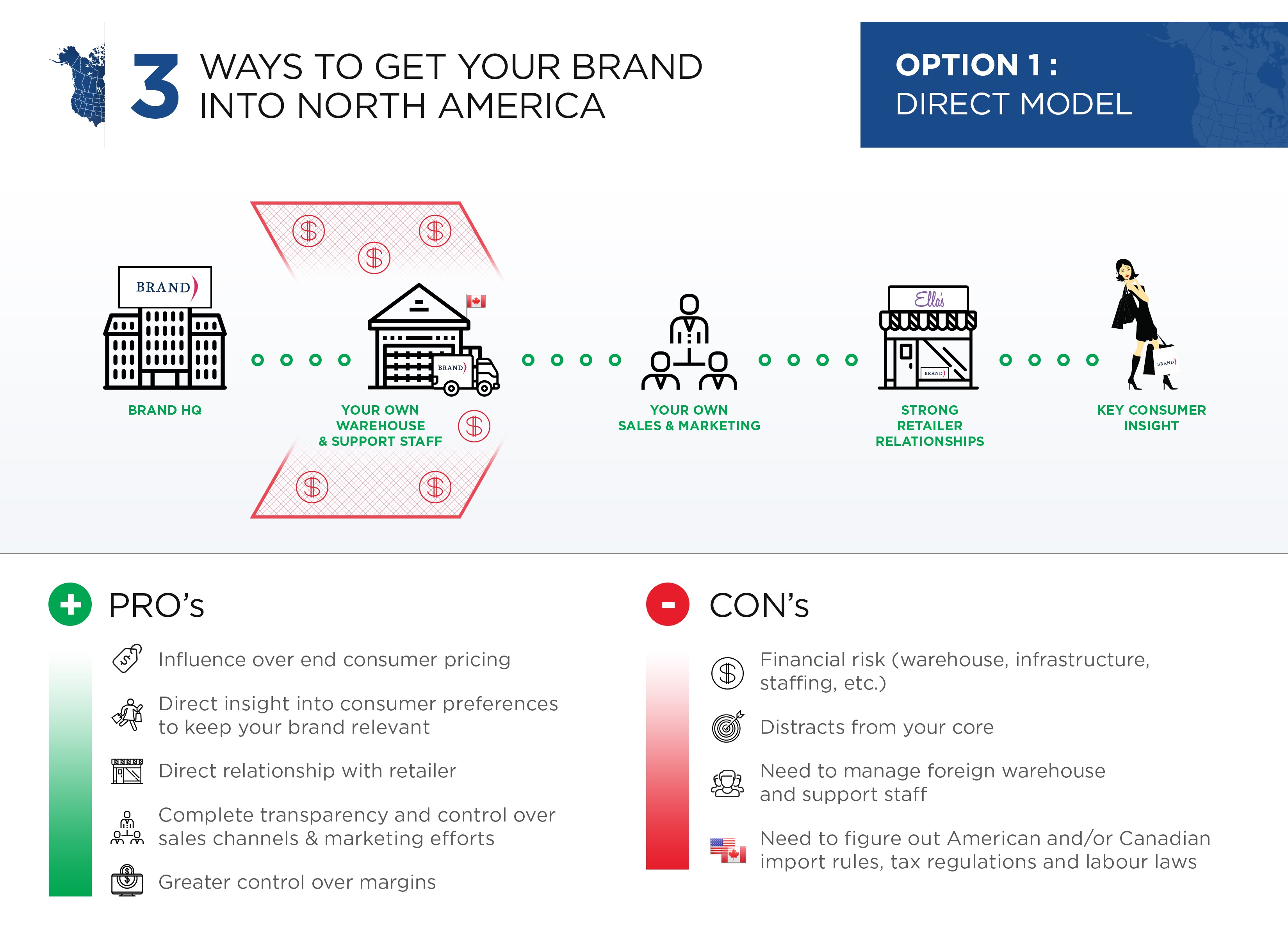
How can you avoid such disruptions to your business? One option is to invest in your own sales and logistics infrastructure. Known as the Direct Model, you have full control over the entire value chain and gain complete transparency into your customer base. On the downside, it comes with a huge investment and, especially for a small brand, a huge distraction from your core competence of designing, producing and brand building. Dollars and hours get sucked away as you hire local staff, find a warehouse and then figure out American or Canadian laws, import tariffs and currency issues. No thanks, says the small brand, I’ll go with the distributor model.
Giving up control
The traditional distributor model works well to quickly get your brand into new markets. You find a distributor, give them exclusive rights to sell your brand in that territory and go back to focusing on building your brand in your home market.
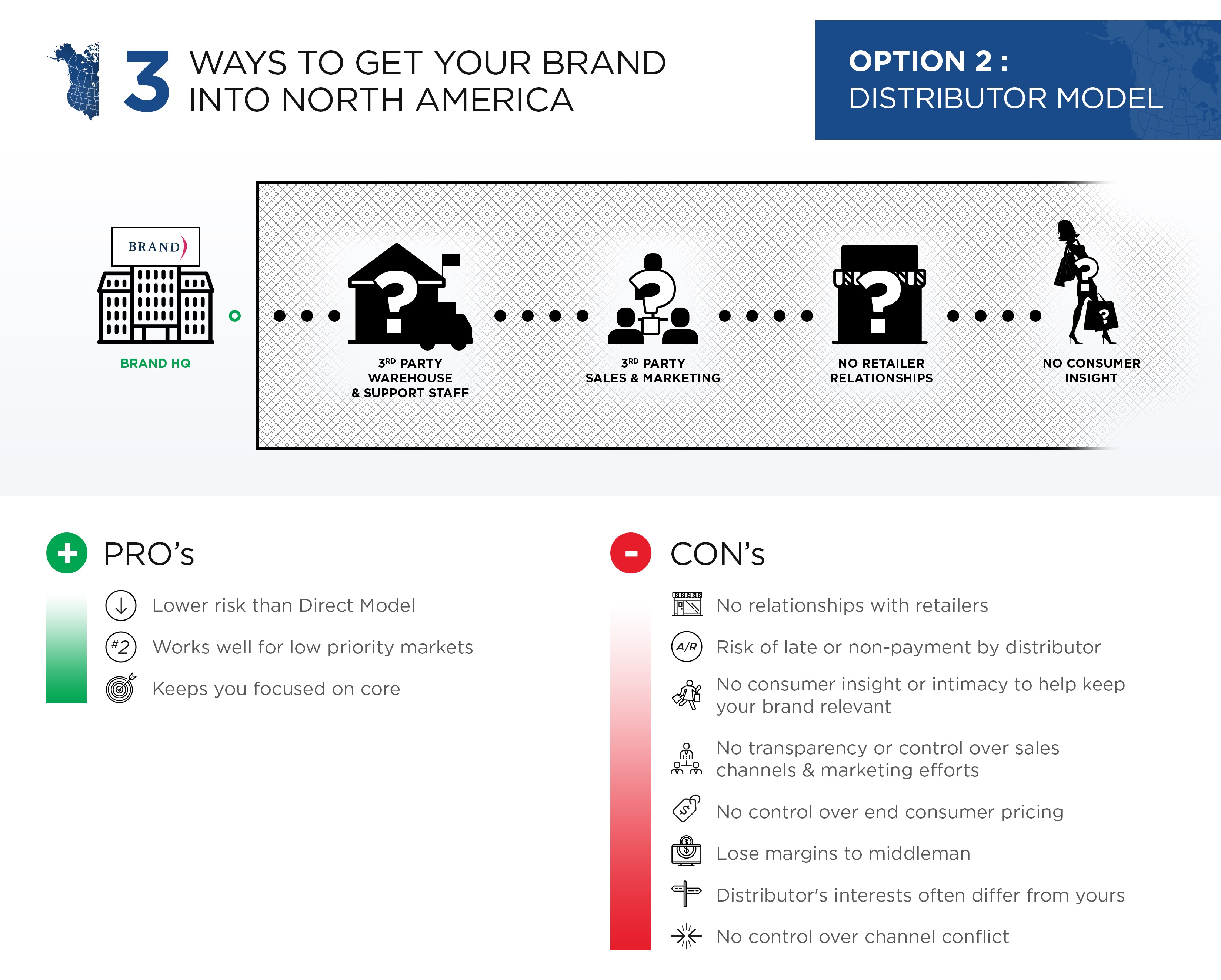
However, for key markets, the distributor model has inherent flaws that restrict the control you have over the growth of your brand or, in the worst case, ruin your brand in that market. The brand-distributor relationship, by its very nature, leaves you unable to influence key elements. The distributor owns the relationship with the retailer. They control the customer lists, the sales data and determine how much marketing effort to put into your brand. Ultimately, they control the destiny of your brand in their given market.
Not in the same boat
Not only do you sacrifice control, but your interests and the interests of the distributor often diverge. Your goal is to put your brand in good-fit stores, deliver exceptional customer service and grow your brand in the minds of consumers. The distributor’s goal is to convert inventory into cash at the best price and as fast as possible. The distributor – not the brand owner – decides how much effort to put into the brand, where to place the product and how to price it.
This lack of alignment also crimps your upside potential. Distributors are understandably cautious about their cash flow. They don’t like to take risks on holding inventory. Yes, they’ll order what’s been sold to retailers during the pre-season selling cycle and they should buy overage stock to take advantage of in-season sales, but doing so ties up cash. If you’re an emerging brand, you only have one or perhaps two seasons to prove to the distributor your brand is worth the effort and added risk. If not, they have plenty of brands in their portfolio to slot in your place. This risk aversion by your distributor stunts your ability to grow market share with in-season sales. And it definitely doesn’t give you the feeling that you and your distributor are in the same boat.
Misalignment is bad for business
The problems created by these diverging interests are compounded by the opaque nature of the brand-distributor model. There’s very little room for error and virtually no loyalty beyond the financial incentive a distributor has to move your product. To make matters worse for the emerging brand, if things don’t work out with early sales and a distributor drops you, you have very little information to figure out what went wrong. It just didn’t work. No sales data, no wholesale relationships and no consumer insight.
This critical misalignment creates serious consequences. Your goal is to maximize the growth and revenue of your brand. The distributor’s motivation is to maximize their overall growth and revenue across their entire portfolio of brands. If a more established brand sells better than your new brand or if another brand offers better commissions or has some other agreement with the distributor that you don’t know about, then it’s obvious who will lose out. Either you hold your breath and hope for the best or you spend time and money motivating the distributor with incentives or by taking on the inventory risk yourself.
Control and Margins: The Core Difference
The biggest difference between these models is control. A distributor can make market entry easier, but the brand often gives up visibility into customers, pricing, sales data, and channel priorities. A direct model keeps everything in-house, but it requires capital, local staff, systems, warehouse space, and management time.
The Brand Fulfillment Model gives growing brands a middle path. The brand keeps control of pricing, retailer relationships, customer data, sales channels, and brand presentation. Evolution Fulfillment manages the logistics work behind that strategy: receiving, warehousing, inventory management, picking, packing, shipping, returns, and operational support.
This structure helps brands protect margin because fulfillment costs are tied to actual operational services instead of distributor markups. It also makes performance easier to understand because inventory, order activity, and channel movement stay visible.
As Michael Shandler, CEO of Australian shoe brand Sol Sana, put it: “With a distributor in North America, we’d give up control over what the end-consumer pays and we hurt our margins. Not to mention that we would have no idea what’s going on. We lose that intimacy and insight that comes with a direct relationship to the customer.”
It’s all about control
As an extra link in the value chain, distributors understandably expect their pound of flesh, ultimately impacting your profitability. This is the classic economic downside of going through a middleman, but it’s the price you pay to get your products in front of consumers. But another downside is that you lose any ability to control what they end-consumer pays for your product.
“A key issue for us is control over our pricing” said Michael Shandler, CEO of Australian shoe brand Sol Sana, “With a distributor in North America, we’d give up control over what the end-consumer pays and we hurt our margins. Not to mention that we would have no idea what’s going on. We lose that intimacy and insight that comes with a direct relationship to the customer. For example, the reaction customers have to new designs, to new pricing or the opportunity to turn an customer service problem into a great experience.”
“It’s not simply a matter of control. It’s a matter of staying focused on what our customers want. ”
It’s NOT just about control
Why do brands want control? No doubt one reason is because, by their very nature, entrepreneurs desire freedom. They got into the game because they had a vision to build a brand, not to end up constrained a third-party logistics partner. But the most important business reason why brand executives crave control and transparency, as Mr. Shandler hinted at above, is relevancy.
Every brand is doing their best to ride a wave of popularity. They want to stay at the forefront of the consumer’s mind. To be on the must-have list of every retailer. To do so, any brand – growing or otherwise – has to keep their fingers on the pulse of the market or they risk missing the next wave. Therefore, the main motivation for control and transparency is so that brands ultimately have the tools to stay relevant to the consumer.
Adds Mr. Shandler, “Most definitely. It’s not simply a matter of control. It’s a matter of staying focused on what our customers want. I’d rather be talking to a key retailer in Canada about how our new product is being received by their customers than spending half a day on the phone with the Canadian tax authorities.”
“Forget third-party logistics. We’re first-party logistics”
The third option: “Brand Fulfillment Model”
Third-party logistics company Evolution Fulfillment is an example of a new breed of 3PL that is pioneering a new model that blends the best – while leaving out the worst – of the direct and distributor model.
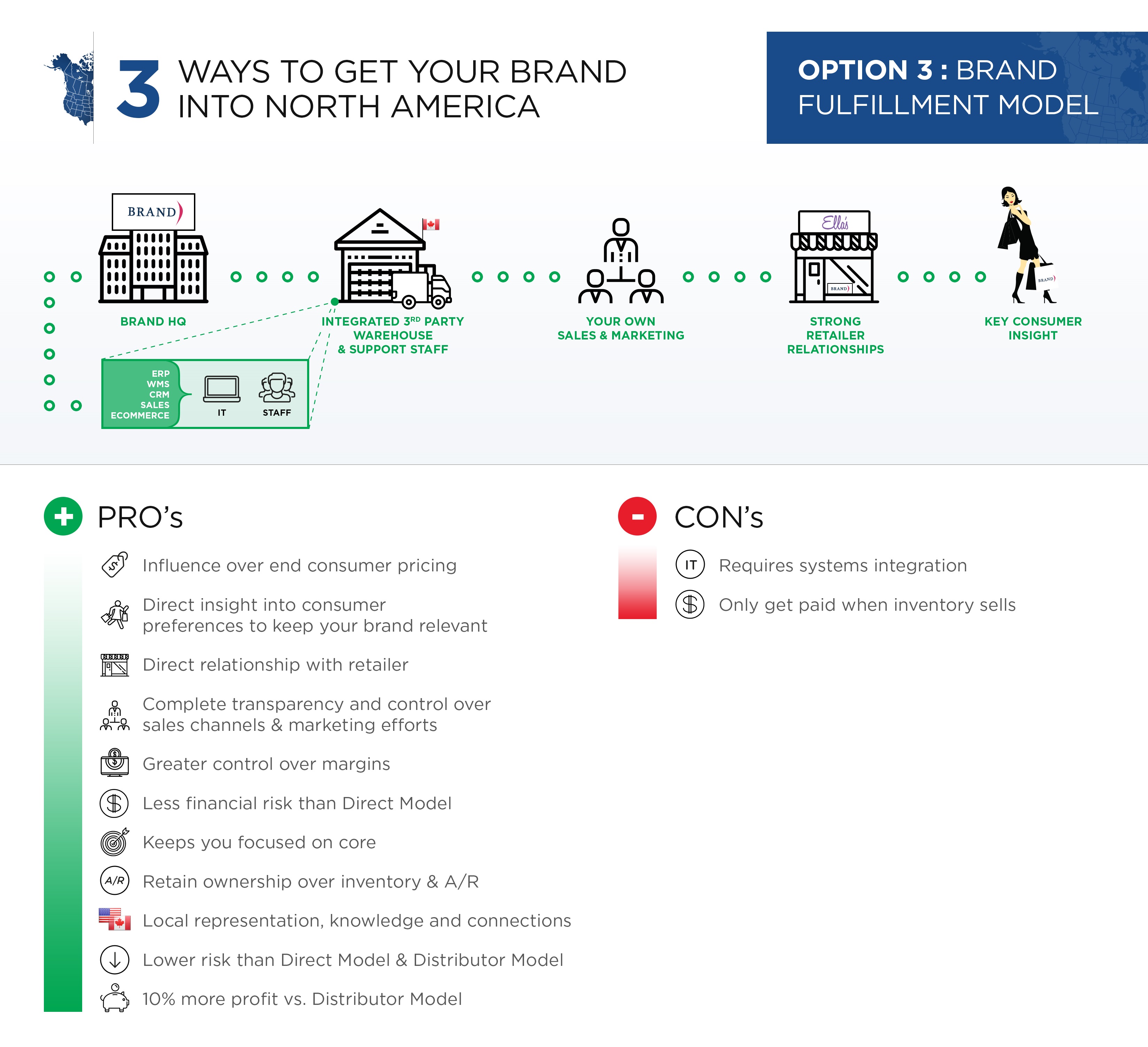
Under the Brand Fulfillment model, the brand maintains complete control over retailer relationships, including transparency into key sales data, control over sales & marketing and greater influence over end-consumer pricing. This is fundamentally different from the distributor model, where control over your brand ends once you hand over the inventory to the distributor.
“We basically act as an extension of the brand” said Evolution’s President Ben Martin, “We integrate our inventory, warehouse and accounting systems in the brand’s CRM system so they get complete visibility into their inventory and sales data. We’re completely transparent and accountable to the brand. It’s a better model for brands who want control of the growth of their business while also freeing them from the hassles of logistics so that they can focus on their core. Forget third-party logistics. We’re first-party logistics”.
Channel Access Without Losing the Customer Relationship
A traditional distributor may own the retailer relationship and decide how much attention the brand receives. That can create risk when the distributor has competing priorities, carries similar brands, or controls sales data.
With the Brand Fulfillment Model, the brand can sell through multiple channels while keeping the customer relationship intact. DTC orders, wholesale purchase orders, Amazon replenishment, and retail fulfillment can all be supported from a shared fulfillment operation. The brand still leads the commercial strategy. The fulfillment partner supports execution.
This matters for brands expanding into Canada and the United States because early market decisions shape long-term growth. Keeping control of customer relationships, channel data, and pricing strategy gives the brand more room to learn, adjust, and scale.
Inventory Visibility Across B2B, B2C, and Amazon Channels
A brand fulfillment approach works best when inventory is visible across channels. Instead of splitting stock into disconnected pools, the brand can manage DTC, wholesale, Amazon, and retail demand from one coordinated fulfillment model.
This improves decision-making. The brand can see what is selling, where inventory is moving, which channels need replenishment, and where stock should be allocated next. It also reduces the risk of overselling, channel conflict, and preventable stockouts.
Evolution’s role is to support that visibility through warehouse operations, technology integration, and hands-on service. For brands that need a North American operating base, this creates a more controlled path than handing the market to a distributor or building a warehouse team from scratch.
Nui Organics’ Amanda Searancke described her experience: “Their online portal is very sophisticated. I’m able to login from my office in New Zealand and see exactly what inventory is in Evolution’s Canadian warehouse, what’s been shipped, what I get charged by Evolution for each shipment, what customer bought it and when we’ve been paid.”
The value of accountability
Martin’s business partner and co-founder of Evolution Fulfillment, Gwen Harrison, sees their model as philosophically different from the typical 3PL model.
“We consider ourselves more than just a vendor” says Harrison, “We fully commit to a brand and fully integrate into their operations and systems. A service provider only follows the written agreement to the letter, whereas we condition our staff to think and act as if they were direct employees of your brand. We encourage them to run their part of your business as if it were their own. In practical terms, it means keeping a lid on costs, it means owning customer issues and proactively fixing them. Not because a contract says to, but because it’s in the best interest of growing a business. Our first consideration, we train our staff, is to ask ‘is this good for the brand?’”
“Our first consideration is to ask ‘is this good for the brand?’ ”
The value of advice
The nature of the brand fulfillment model requires an open line of communication between 3PL companies in Canada like Evolution Fulfillment and the international brand to keep everything and everyone aligned towards growth. Instead of only distributing a product, Evolution also provides advice and connections that help a brand market, sell and distribute within the Canadian and American marketplace. And because all parties’ interests are aligned under the brand fulfillment model, there’s every incentive for Evolution to grow a brand’s business or keep an eye out for opportunities.
Harrison adds: “We’ve had numerous situations where our staff have taken a situation where an unsatisfied customer returned product and – because they’re thinking about the brand’s best interests – have turned it into a sales opportunity”.
Case in point, a fashion T-shirt brand based out of Los Angeles was eyeing the Canadian market and eventually partnered with Evolution Fulfillment. They sold 5,200 units in their first season and then, with some good advice from Ben Martin and Gwen Harrison, tripled sales the very next season to 17,600 units.
Aligned interests
“We’ve had situations where distributors weren’t as proactive as we would have liked in pushing our brand” continues Searancke, “In some cases, it was because they had their own stores competing for the same customer as us. In another case, one retailer complained about the predatory pricing practices of another; which was under the distributor’s control, not ours. Under Evolution’s model, there’s no conflict of interest and we’re better able to manage channel conflict.”
Searancke is quick to add that distributors do work for certain markets: “We had a distributor in Romania come to us and it’s worked out great. We wouldn’t have been in that market otherwise and it helps us add volume to our production. But in Canada, we’ve always gone direct and it works great. We have our own sales reps. We know who our customers are. We ship our goods [to Evolution Fulfillment] and they handle all the logistics and warehousing. The model has worked so well so far that we plan in the future to have Evolution collect our accounts receivable and manage the accounting of everything. It’s seamless, consistent and there’s zero risk of what happened to us in the UK because we have that direct relationship with the retailer.”
According to Martin, that’s exactly the kind of statement that validates the Brand Fulfillment model: “Our interests are fully aligned and everything is transparent. There’s never, ever any conflict of interest. Our customer list is [the brand’s] customer list. Their growth is our growth.”
Going global
Although Evolution Fulfillment is a 3PL company in Canada, their focus is on providing brands from overseas turn-key North American distribution solutions. That being said, even though Evolution doesn’t have their own 3PL warehouses in Europe, they were able to step in and help Nui Organics recover from the collapse of their UK distributor by tapping into their global network of partner warehouses.
“We call it Evolution Global” said Harrison, “It means we can offer a brand from anywhere in the world the same level of service in multiple markets. In the circumstances that Nui Organics found themselves in in the UK, we were able to leverage this network and help them recover.”
Better margins = better profit
Another big advantage that would get any brand owners attention is the impact the Brand Fulfillment model has on the bottom line. Like the direct model, the Brand Fulfillment model enables brands to remove the middleman layer and increase the all important margin.
“It’s significant” adds Shandler, “Depending the product, we talking about an additional 40-50% in margin that otherwise would have gone to the distributor.”
Searancke echoes the impact on profitability: “I’d have to give a larger discount to a distributor. Sometimes discounting is worth it to get into a small market or to boost production numbers, but with Evolution’s model, I’m able to skip the middleman and squeeze out more profit on every unit sold.”
“I’ve crunched the numbers and we find we can add another 10% to a typical brand’s bottom line compared if they had gone the traditional distributor route” said Martin.
Harrison adds “This isn’t a theoretical conversation. We’ve been running this model successfully for three years and it’s a fact that it really works. We save brands money, we pad their bottom line and we work with them to grow.”
Hassle-free distribution
Besides the capital investment, the direct model also creates all sorts of distracting business challenges for a brand trying to distribute their product in North America. Challenges like: Do we need to incorporate? How do we manage the currency risk? Where do we find a warehouse? What about logistics? What are the labour laws like? How do we collect and remit taxes? What about that one Canadian province that speaks French?
“Under our Brand Fulfillment model, we take care of everything so that’s its hassle-free for the brand” said Martin, “Since we’re an extension of your company, we’re your representative here in North America. We have a local presence and local warehouses and we understand the North American business culture. We advise brands from outside North America on sales channels, currency risk, import fees, tariffs, language issues. We collect and remit taxes. We manage the entire importing process and we manage the risk for our clients. It’s a turn-key North American distribution solution.”
Beyond distribution and logistics, Evolution Fulfillment is also tuned to handle outsourced admin support activities, such as customer service issues, returns management, accounts receivable, accounts payable and bookkeeping.
Seamless systems
This new breed of 3PL also specializes in information technology that allows brands half a world a way to keep tabs on every unit of inventory. Besides Evolution Fulfillment’s standard 3PL services, they also have a programming team that can handle integrations between Electronic Data Interchange (EDI), Enterprise Resource Planning (ERP), Customer Relationship Management (CRM) and Warehouse Management Systems (WMS). Evolution even has proprietary integration software called Integreat, which ties all these systems together for one seamless information system.
For brands, this ultimately means instant visibility into key metrics, such as sales or inventory data, without the hassle or delay caused by digging into multiple sources to answer basic questions like “Which SKU sold best in Canada this year?” or “Who were my top 3 retailers in California?”
Evolution’s IT staff also understand the data routing requirements of large retailers, such as Nordstrom, The Bay, REI, etc) and speak the same data language as ecommerce giants like Amazon. This allows brands to tap into these huge distribution channels without having to know anything about the technical details. Evolution also understands how to connect up to ecommerce platforms such as Magento or Shopify and with ERP systems like Full Circle, Joor and Nuorder. With virtually any type of data a brand cares about, Evolutions’Integreat software acts as the hub to tie these silos of data into one seamless system.
“We don’t shy away from IT challenges” said Harrison, “We embrace them. We specialize in them.”
How Evolution Fulfillment Supports the Brand Fulfillment Model
Evolution Fulfillment is built for brands that need an operational partner, not just storage space. The team supports brands through white-glove service, technology and integration support, and 135,000 sq. ft. of fulfillment and warehouse capacity across three locations.
The model is especially useful for brands that want to:
- Enter or expand in North America
- Keep control of retailer and customer relationships
- Support DTC, B2B, Amazon, and wholesale channels
- Maintain better inventory visibility
- Avoid building a full warehouse operation too early
- Reduce dependence on distributor-controlled growth
The goal is simple: help the brand stay in control while Evolution handles the operational complexity behind fulfillment.
A fashion T-shirt brand based out of Los Angeles is one example. They partnered with Evolution Fulfillment and sold 5,200 units in their first season — then, with strategic guidance from the Evolution team, tripled sales the very next season to 17,600 units.
The value of timely truth
This emphasis on seamless data allows brands half the world away to get a real-time look into their business with a few clicks. This is a quantum leap better than the old model, where you sourced data from multiple sources, crammed it all into a spreadsheet and spent time trying to answer a simple question. Under this reactionary model, a brand risks being blind sided by a problem that happened in the past when it’s too late to fix it. This new ‘real-time’ model provides brand managers with accurate, timely data to help solve a small problem before it’s a big problem.
“Their online portal is very sophisticated” said Searancke, “I’m able to login from my office in New Zealand and see exactly what inventory is [in Evolution’s Canadian warehouse], what’s been shipped, what I get charged by Evolution for each shipment, what customer bought it and when we’ve been paid.”
“That level of transparency and timely reporting is critical to our brand fulfillment model” adds Martin, “Because – unlike the distributor model – the brand still owns the inventory. We may collect on invoices on the brand’s behalf, but they still own the accounts receivable. They want to know exactly what’s going on at all times.”
Good-fit, good growth
Martin says a brand that is a good fit for Evolution is one that’s well-established in their home market and who wants to expand into North America while maintaining control over their brand’s growth. With interests aligned, everyone pulls in the same direction towards growing the business. Adds Martin “We want to be part of growing something great with [the brand]”.
For Searancke and Shandler, both Evolution customers, it’s a relationship that works well.
“I trust them and they’re accountable” said Searancke, “Evolution works for us in Canada. They basically are our shipping department.”
“We understood this model immediately” said Shandler, “It’s less hassle and it’s allowed us to get quickly established in the North American market. Our relationship with Evolution is working very well.”
Would you ever switch back to the distribution model, this writer asked Shandler: “Now and then we get contacted asked if we’re interested in the distribution model. I tell them, ‘no, thank you. We’re doing just fine’.”
About Evolution Fulfillment
Evolution Fulfillment provides eight turnkey services to advance your North American distribution strategy – which you can choose independently or combine for full effect – to ensure on-time, accurate, and efficient product delivery into all sales channels.
If you’re interested in learning more about our 3PL services in Canada and in the US, visit our website at www.evolvewithus.ca.
Frequently Asked Questions About the Brand Fulfillment Model
What is the Brand Fulfillment Model?
The Brand Fulfillment Model is a fulfillment approach where the brand keeps control of pricing, customer relationships, sales channels, and inventory strategy while a fulfillment partner manages warehousing, picking, packing, shipping, returns, and operational execution.
How is brand fulfillment different from a distributor model?
In a distributor model, the distributor often controls retailer relationships, sales data, pricing influence, and market priorities. In a brand fulfillment model, the brand keeps those relationships and decisions while outsourcing the logistics layer.
How is brand fulfillment different from going direct?
Going direct gives the brand control, but it also requires local staff, warehouse space, systems, logistics management, and compliance work. Brand fulfillment keeps much of the control of a direct model while reducing the need to build operations from scratch.
Who is the Brand Fulfillment Model best for?
It is best for established brands that want to grow across North America, serve multiple channels, and keep control of the customer relationship without immediately building their own fulfillment infrastructure. See Evolution’s full fulfillment services to understand what the operational model includes.
