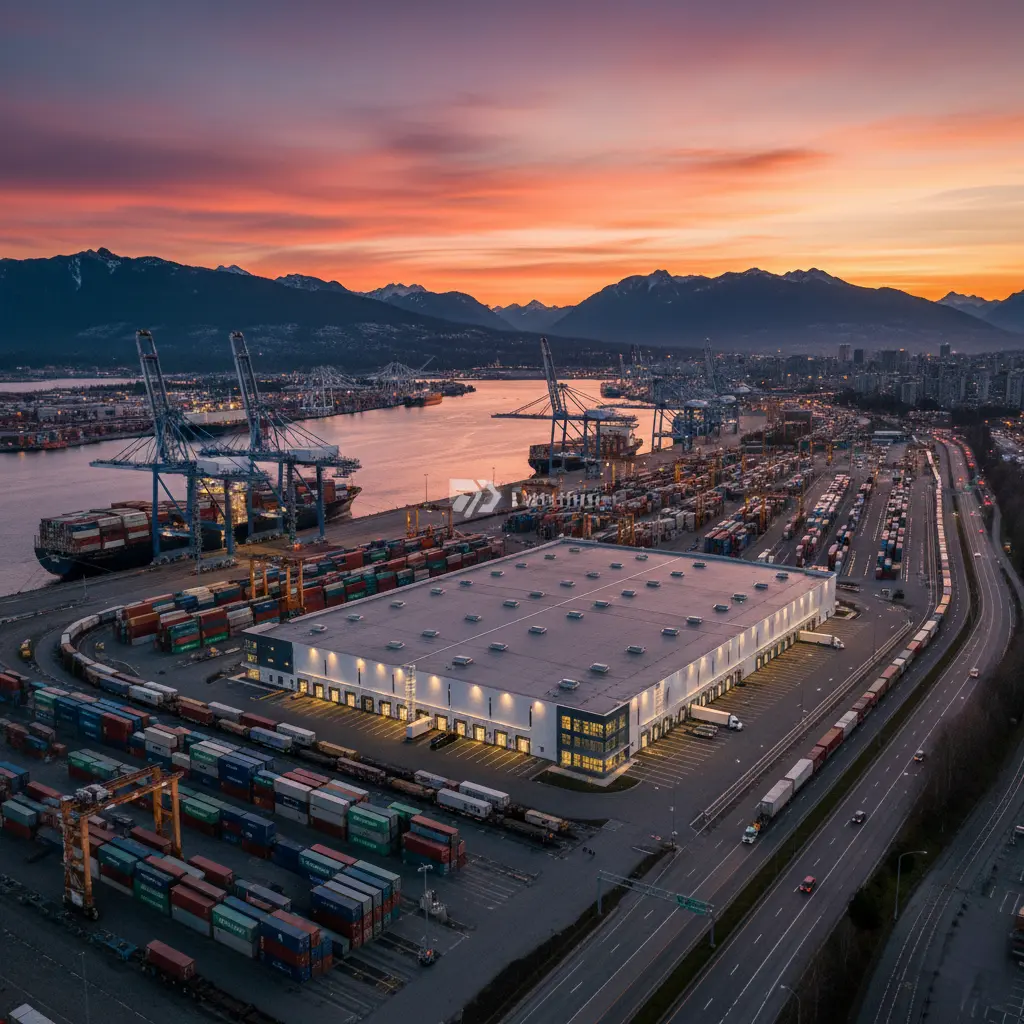
A Vancouver fulfillment center can help brands move goods from Asia to North America faster and at a lower cost. Many companies see 10–30% lower landed costs and 20–40% faster delivery times by using Vancouver instead of more inland entry points.
This advantage comes from direct access to the Port of Vancouver, strong CN and CP rail connections, and quick highway links. Together, these reduce handling time, delays, and transportation costs.
To choose the right Vancouver 3PL, brands should focus on:
- Transit times: Asia to Vancouver in about 10–14 days, then 4–7 days by rail to cities like Toronto or Chicago
- Cross-border strategies: USMCA-based “domesticated” shipping to lower duties and reduce friction into the U.S.
- Flexibility: Air–sea or multimodal options for urgent SKUs
- Proof of performance: Clear KPIs and pilot results, not just claims
When managed well, Vancouver becomes a reliable Pacific Rim gateway that supports faster growth, better cost control, and predictable North American distribution.
When a Vancouver Distribution Strategy Makes Sense
A Vancouver fulfillment center is a strong fit for brands importing from Asia and selling across Canada and the U.S. Ocean transit from Asia typically takes 10–14 days, followed by 4–7 days by rail to major hubs like Toronto or Chicago. Near-port cross-docking reduces delays, lowers storage penalties, and supports smoother cross-border shipping that functions much like domestic delivery.
Best-fit brands usually ship 2,500+ orders per month or 500+ pallets, operate across multiple channels (ecommerce, retail, Amazon), and are scaling in both the U.S. and Canada. Apparel brands expanding wholesale and DTC are a common example.
Bottom line: If your supply chain starts in Asia and you are growing across North America at meaningful volume, Vancouver is worth evaluating now.
When Vancouver Outperforms Other Gateways
For Asia-heavy imports, Vancouver often delivers faster end-to-end transit. Many lanes save 3–7 days overall compared to some U.S. West Coast routes, while offering flexible rail and cross-border options.
Port of Vancouver: Why It Improves Throughput and Reliability
The Port of Vancouver moves over 3 million containers (TEUs) per year and can handle large, deepwater vessels. Ongoing automation improves capacity and schedule reliability. More predictable berth windows mean fewer knock-on delays from blank sailings, which helps consumer goods move on time. Modern terminals also reduce container dwell and demurrage risk—ask providers to share historical data on berth delays and blank-sailing impacts.
Key Terminals for Consumer Freight: Centerm and Vanterm
- Centerm: ~1.5M-TEU capacity after expansion
- Vanterm: ~1M-TEU capacity
Both terminals offer strong crane productivity, which supports faster container turns—especially important for time-sensitive categories like fashion.
Drayage, Yard Operations, and Turn Times
Efficient drayage and yard operations directly cut container dwell. Best-in-class programs target under 24 hours from container availability to yard exit. Near-port drop-and-hook programs further reduce detention and demurrage exposure.
Takeaway: Require clear SLAs from providers on average container dwell, yard turns, and remedies if targets are missed.
Port, Rail, and Highway: Vancouver’s Intermodal Advantage
Port, Rail, and Highway: Vancouver’s Intermodal Advantage
Vancouver combines port access with daily intermodal rail and direct highway links to keep freight moving with fewer delays .Canadian National Railway and Canadian Pacific Kansas City run scheduled intermodal departures every day, while fast access to the Interstate 5 corridor and bonded trucking supports direct U.S. moves. Port-to-rail transloads in under 24 hours reduce handoffs and variability—confirm rail cutoffs and bonded capacity up front.
Rail Lanes to the Midwest and East
CN and CP offer reliable, scheduled service to major hubs like Toronto and Chicago. During peak periods, these fixed train windows are often more dependable than spot trucking.
Typical Inland Transit Times
- Asia → Vancouver: ~10–14 days
- Vancouver → Toronto/Chicago (rail): ~4–7 days
These predictable ranges improve forecasting and allow brands to carry less safety stock.
Highway and Cross-Border Trucking
Direct highway access and bonded trucking reduce border dwell and paperwork friction. Bonded loads can move into the U.S. without immediate duty payment, and near-port cross-docking to domestic trailers speeds final delivery.
Transit-Time Comparison: Vancouver vs. U.S. West Coast
For Asia-origin freight, Vancouver often delivers faster and more predictable end-to-end transit than some U.S. West Coast gateways. Ocean transit to Vancouver typically runs 10–14 days, compared with 12–18 days to parts of the U.S. West Coast. Inland moves to major hubs usually take 4–7 days from Vancouver, versus 5–9 days in some U.S. corridors. Across common lanes, this can save 2–6 days door to door, reducing carrying costs and lowering the risk of stockouts.
Why the Numbers Differ
Transit-time variance is driven by port congestion, weather, and blank sailings. During peak seasons, congested U.S. West Coast ports often add 1–3 days of delay. Routing services into Vancouver can reduce this exposure by using less congested port calls and more predictable rail handoffs.
Door-to-Door Performance Examples
On typical lanes, shipments such as Shanghai to Chicago by rail or Busan to Toronto often arrive several days faster when routed through Vancouver. Even when total transit times are similar, Vancouver routes tend to show tighter ranges, which improves planning accuracy and inventory forecasting.
The Cost Impact of Faster Transit
Inventory carrying costs commonly fall in the 15–25% annualized range. Cutting just three days from transit on $2M of in-transit inventory can save approximately $2,500–$4,000 per month in working capital. This makes transit-time differences a measurable financial input, not just an operational one.
Cross-Border Efficiency Under USMCA: Domesticated Shipping Explained
Under USMCA, eligible products can move from Vancouver into the U.S. with far less friction when the right processes are in place. With proper origin documentation, bonded storage, and advance customs clearance, cross-border shipments can flow in a way that closely resembles domestic distribution—reducing delays, paperwork, and duty-related cash strain.
Bonded Warehousing and In-Bond Movements
Bonded warehouses allow duties to be deferred until goods officially enter the U.S., improving cash flow. From Vancouver, shipments can move in-bond directly to U.S. distribution centers, often with same-day transloading. This keeps inventory moving inland without unnecessary stops or holds at the border.
Rules of Origin and Pre-Clearance
Accurate certificates of origin are critical. When USMCA documentation is prepared correctly, inspections are less frequent and border delays are shorter. Broker-led pre-clearance further reduces wait times, often cutting hours from the border process and improving delivery predictability.
Transloading and Deconsolidation
Transloading containers into domestic trailers near the port lowers shipping zones and speeds up final delivery. For retail and wholesale shipments, compliant EDI and accurate advance ship notices at the cross-dock help prevent chargebacks and downstream disruptions. Together, these steps create a smoother, faster path from port to customer.
Building Hybrid Sea–Air Multimodal Lanes via YVR
A sea–air strategy through Vancouver International Airport allows brands to combine low-cost ocean freight with fast air uplift for priority products. Containers arrive by sea, are cross-docked the same day, and select SKUs are flown out while the rest continue by ocean or rail. This approach accelerates launches and seasonal demand without the cost of flying full assortments. YVR handles 300,000+ tonnes of air cargo annually, making same-day transitions feasible.
When to Use Air Cargo at YVR
Sea–air works best for time-sensitive situations such as product launches, seasonal spikes, or recovery from stockouts. High-margin or short-lifecycle SKUs benefit most from air uplift, especially when the cost of flying is lower than the revenue or margin lost from delayed availability.
Sea–Air Cross-Docking and Split Shipments
Near-port cross-docking enables containers to be split on arrival by priority. Top SKUs move directly to air uplift at YVR, while bulk inventory continues through standard inland lanes. Clear operating procedures, service-level timelines, and exception handling are essential to keep this flow predictable.
Inventory Segmentation and Replenishment Logic
Effective sea–air programs rely on inventory segmentation. Fast-moving, high-impact SKUs are assigned to air when needed, while steady or lower-priority items stay on ocean routes. Safety stock buffers remain aligned to sea transit times, and mode selection is built into OMS and WMS rules to ensure consistent execution.
Core Capabilities of a Vancouver Fulfillment Warehouse
A high-performing Vancouver fulfillment warehouse should deliver 99.5%+ order accuracy and move inventory from dock to stock within 24–48 hours. Retail-ready packing standards help reduce chargebacks, rework, and downstream delays. Brands should expect clear proof of capability—performance metrics, customer references, and documented processes—for each sales channel they operate.
Strong technology integration is essential. Real-time visibility across inventory, orders, and returns allows brands to stay in control as volumes scale across Canada and the U.S.
B2C and B2B Fulfillment Operations
Leading facilities support both direct-to-consumer and wholesale workflows with consistent service levels. Typical benchmarks include 98%+ ship-on-time performance against defined pick cutoffs. Common value-added services include kitting, garment-on-hanger (GOH), ticketing, labeling, and custom packaging, all designed to support brand presentation and retail requirements.
Retail and Wholesale Compliance
Retail fulfillment depends on strict compliance. Accurate ASNs, UCC-128 labels, and routing guide adherence are critical to avoiding chargebacks. Mature operators track compliance rates and have defined processes to resolve issues quickly when exceptions occur.
Amazon FBA and FBM Support
For Amazon sellers, fulfillment centers should demonstrate 99%+ cartonization accuracy, along with the ability to manage removals, relabeling, and rework at scale. Direct integration with Seller Central and documented operating procedures help maintain performance during peak periods.
Returns Processing and Quality Control
Efficient reverse logistics is a core capability. Best-in-class warehouses process returns within 48–72 hours, applying clear grading rules for restock, refurbishment, or disposal. Light re-bagging and re-ticketing support resale without tying up inventory.
Temperature-Controlled Storage Options
For sensitive products such as cosmetics, temperature-controlled zones—commonly 15–25°C—with continuous monitoring are essential. Reliable providers maintain validation logs and escalation procedures to protect product integrity and meet compliance standards.
Technology and Integration: What a White-Glove 3PL Should Deliver
A white-glove 3PL is defined by visibility and control. Expect API/EDI latency under five minutes, live SLA dashboards, and real-time exception alerts. Data ownership, full audit trails, and webhook feeds are baseline requirements for any modern Vancouver fulfillment operation. For many brands, strong ESG reporting and transparency can be the deciding factor between otherwise similar providers.
OMS, WMS, and TMS Connectivity
Seamless connectivity across order, warehouse, and transportation systems is essential. Leading providers offer native integrations with platforms like Shopify and Amazon, plus ERPs, using webhooks for immediate acknowledgements. With real-time sync, inventory accuracy should consistently exceed 99.8%, supported by replayable logs for issue resolution.
Forecasting, Allocation, and Carrier Optimization
Technology should actively reduce cost, not just report on it. Effective systems rate-shop parcel and LTL shipments, optimize cartonization, and apply channel-specific allocation rules. When brands share forecasts, these tools help balance inventory across channels, reduce expedites, and surface forecast bias early.
Security, Compliance, and Auditability
Enterprise-grade security is non-negotiable. Look for SOC-2-style controls, role-based access, and comprehensive audit logs. The ability to export customs, retailer compliance, and operational reports—along with clear data retention policies—ensures accountability and simplifies audits across North American operations.
Sustainability and Social Responsibility in Vancouver Logistics
Vancouver’s logistics ecosystem offers measurable environmental advantages that matter to brands with ESG commitments. Rail transport can produce up to 75% less greenhouse gas emissions per ton-mile than trucking, making it a lower-impact option for inland distribution. At the port level, shore-power programs and cleaner-fuel initiatives reduce vessel emissions while ships are docked, and newer locomotive technologies further lower the carbon footprint of inland moves.
Environmental Programs at the Port and Rail Level
The Port of Vancouver continues to expand shore-power availability and emissions-reduction programs across its terminals. Rail partners, including Canadian National Railway and Canadian Pacific Kansas City, invest in locomotive efficiency upgrades and cleaner operating practices. These efforts reduce emissions across long-haul corridors and support more sustainable North American distribution.
Warehouse-Level Green Practices
At the warehouse level, sustainability shows up in day-to-day operations. Common practices include LED lighting, recyclable or reduced packaging materials, and structured waste-diversion programs. Many facilities now track and report environmental metrics regularly, giving brands clearer visibility into the footprint of their fulfillment operations.
Together, these port, rail, and warehouse initiatives allow brands to factor sustainability and social responsibility into logistics decisions—without sacrificing speed, reliability, or scale.
Head-to-Head: Vancouver Fulfillment Center vs. U.S. West Coast Gateways
When comparing Vancouver with U.S. West Coast gateways, the decision should be based on total landed cost, not just ocean rates. A complete model includes port fees, drayage, rail, storage, picking, parcel shipping, duties, and inventory carrying cost (typically 15–25% annually). Vancouver often delivers more consistent outcomes by reducing congestion-driven delays and exposure to blank sailings.
Total Landed Cost Inputs
Accurate comparisons must account for demurrage and detention risk, retail chargebacks, and rework caused by delays. Small changes in container dwell time or mode mix can materially shift total cost. Sensitivity testing across these variables helps identify which gateway performs better under real operating conditions.
Resilience and Congestion Risk
U.S. West Coast ports have experienced periodic congestion spikes that introduce volatility into transit times and downstream fulfillment. Vancouver’s network has tended to show lower variability across similar periods. Brands should evaluate each option’s resilience by reviewing historical disruption data and requiring clear contingency plans with defined remedies for service failures.
Taken together, Vancouver often stands out for brands that value predictability, controllable costs, and supply chain resilience—especially for Asia-origin freight moving at scale.
KPI Framework: Validate With Hard Numbers
A Vancouver 3PL should be evaluated on measurable results, not promises. Best-in-class operators consistently deliver 99.5%+ order accuracy, 98%+ on-time shipping, and 24–48 hour dock-to-stock performance. In well-matched lanes, strong providers often achieve 10–30% lower total landed costs and 20–40% faster transit times. These targets should be formalized in SLAs with clear financial remedies and transparent scorecards.
Proving Performance Through a Pilot
Before full rollout, performance should be validated through a controlled, low-risk pilot. This establishes real benchmarks and confirms execution across channels and lanes.
Core KPIs to Track
Key metrics to baseline before go-live include:
- Order accuracy
- On-time delivery
- Cost per order
- Inventory accuracy
- Returns processing cycle time
These metrics form the foundation for ongoing performance management.
Expected Outcome Ranges
High-performing Vancouver 3PLs typically deliver 10–30% cost reductions and 20–40% speed improvements on select corridors. These ranges provide practical guardrails for pilot success and contract expectations.
Reporting and SLA Governance
Effective programs rely on weekly performance scorecards and monthly business reviews focused on root-cause analysis and continuous improvement. SLAs should include defined remediation timelines and enforceable consequences if targets are missed.
Pilot Playbook: Prove the Model Before Committing
Before committing to a long-term partnership, brands should validate performance through a structured pilot. A 30/60/90-day pilot with defined SLAs, targets, and exit criteria allows for objective comparison. Running an A/B test between gateways using the same lanes and SKUs helps isolate real differences in transit time and cost. Accurate data sharing is essential to ensure fair, comparable results.
30/60/90-Day Pilot Structure
Start by clearly defining the scope—specific lanes, SKUs, and service levels. Set performance targets up front and document remedies if results fall short. To avoid skewed outcomes, freeze the variables being tested so changes in performance are attributable to the model, not shifting inputs.
Transit-Time and Cost Benchmarking
Track end-to-end metrics such as estimated vs. actual arrival, departure timing, container dwell, and carrier costs. Normalize data across gateways to ensure true like-for-like comparisons rather than headline averages.
Data Required for an Effective Pilot
To enable accurate execution and optimization, brands should provide:
- Demand forecasts
- SKU master data
- Carton and pallet specifications
- Routing guides
- Customs and compliance documentation
Complete and timely data access is what turns a pilot from a basic test into a meaningful proof of value.
RFP and Evaluation Checklist: Choosing a Vancouver Fulfillment Center You Can Trust
A strong RFP should separate marketing claims from operational reality. Request hard metrics and documented proof across compliance, capacity, and technology. Key data points include bonded warehouse status, rail allocations, peak-season capacity, and technology latency under five minutes. If your business requires it, confirm Amazon FBA prep and cold-chain capabilities. Score providers on data ownership, SLA strength, and their willingness to commit to remedies—then validate with customer references.
Due Diligence Questions to Ask
Focus on how the operation performs under pressure. Ask about drayage coverage, bonded and in-bond capabilities, USMCA documentation workflows, Amazon support, and peak-volume plans. Require real performance metrics and speak directly with current customers to confirm execution, not just intent.
Technology and Integration Requirements
Confirm API and EDI latency targets, the breadth of the connector library, and access to analytics and reporting. Full data exports, audit trails, and real-time visibility should be standard, not add-ons. The goal is control and transparency as volumes scale.
Operational Fit and Culture
Beyond systems and pricing, evaluate how the provider operates day to day. Review safety programs, employee training, and social responsibility practices. White-glove partners typically pair strong execution with clear change-management playbooks, making them easier to work with as your business evolves.
Financial Modeling: Building a Clear Business Case
A solid business case starts with a landed-cost-per-unit model that reflects reality, not assumptions. Include inventory carrying costs (typically 15–25% annually) and quantify the impact of faster transit. Saving two to seven days in transit improves cash conversion by reducing work-in-progress inventory and freeing up working capital. Sensitivity testing different mode splits and container dwell times shows how operational changes flow through the P&L.
Landed Cost per Unit
The model should capture all cost drivers: ocean and inland freight, drayage, storage, picking, parcel delivery, duties, demurrage, detention, and retail chargebacks. Tying SLAs directly to these cost components helps ensure that performance improvements translate into measurable savings.
Working Capital and Cash Conversion
Faster door-to-door movement reduces inventory tied up in transit and increases inventory turns. Presenting these effects in financial terms—lower WIP, improved turns, and reduced cash cycle days—creates a CFO-ready ROI narrative that supports decision-making.
Indicative Mini Case Snapshots
Across brands that execute well, outcomes tend to fall within clear ranges. Fashion and apparel programs often see around a 24% improvement in speed and 12% reduction in total cost, while cosmetics brands prioritizing launches can achieve up to 35% faster product availability.
Fashion and Apparel: Omnichannel Expansion
Routing ocean freight through Vancouver with inland rail improves retail on-time performance and reduces chargebacks. In practice, brands commonly experience door-to-door delivery that is roughly 24% faster and 12% lower cost compared to alternative gateways.
Cosmetics: Speed-to-Market for New Launches
For high-priority SKUs, combining ocean freight with selective air uplift accelerates launch timelines. This approach significantly reduces stockouts and can deliver around 35% faster availability for new product releases.
