Your fulfillment partner is probably not lying to you—but they are leaving out important details.
That $2.50 pick-and-pack rate may sound low, but it does not include many extra fees. Over a year, those missing costs can quietly add up to $47,000 or more, even though they were never mentioned in the proposal.
Many growing brands do not realize that choosing the wrong Canada fulfillment center can slowly reduce 15–25% of their margins. When your business reaches $5–20M in revenue, expanding into North America feels like the next step. But the wrong fulfillment partner can lead to serious problems—tariff penalties, cross-border compliance issues, and inventory losses that no one warned you about.
Most providers promise “competitive pricing” and “fast shipping.” What they do not explain are the hidden risks: incorrect tariff codes that can trigger CRA audits, missing provincial compliance that delays returns, and inventory being misplaced across warehouses, which hurts cash flow as you scale.
This is not a comparison of fulfillment vendors. It is a practical way to understand the real cost of fulfillment mistakes at your stage of growth. By the end, you will be able to see whether your current setup is truly supporting your business—or quietly costing you far more than you realize.
Why Most Canadian Brands Lose $47,000+ Annually on Hidden Fulfillment Costs
By the third month, the problem becomes obvious.
You expected a $3,800 bill, but the invoice is $6,200.
New charges appear that were never clearly explained: storage surcharges you did not approve, and an “integration maintenance fee” hidden in the contract. This situation is not rare—it is how many fulfillment agreements work.
About 60% of Canadian brands earning $5–20M in revenue run into this issue when they expand into North America. On average, these hidden costs add up to more than $47,000 per year. This is not an exaggeration. It is the result of small fees piling up when brands choose a partner without full cost visibility.
Choosing a Canada fulfillment center may feel like an operational decision. In reality, it is a financial decision. It affects your gross margin, how competitively you can price your products, and how long your cash reserves last. Still, most brands make this choice based only on per-order pricing, a warehouse tour, and vague promises of “easy integration.”
Now imagine seeing the real costs upfront—not a complex spreadsheet, but a clear framework that shows the true total cost across storage, labor, technology, compliance, and cross-border shipping.
That is what comes next. You will learn:
- Which hidden fee categories quietly cost brands $47,000+ per year
- How warehouse location (Vancouver vs Toronto vs Montreal) can change profitability by 18–24%
- Why retail compliance mistakes often lead to $25,000+ in penalties
- How weak system integrations cause inventory errors and financial losses
- When outsourcing to a 3PL actually makes more sense than running fulfillment in-house
- A due-diligence checklist to spot warning signs before signing a contract
This is not about choosing the cheapest provider. It is about choosing a fulfillment partner that protects your margins, supports growth, and avoids late-night operational failures when your inventory and warehouse systems stop working together.
What Is a Fulfillment Center in Canada (And Why Location Determines Your Profit Margin)
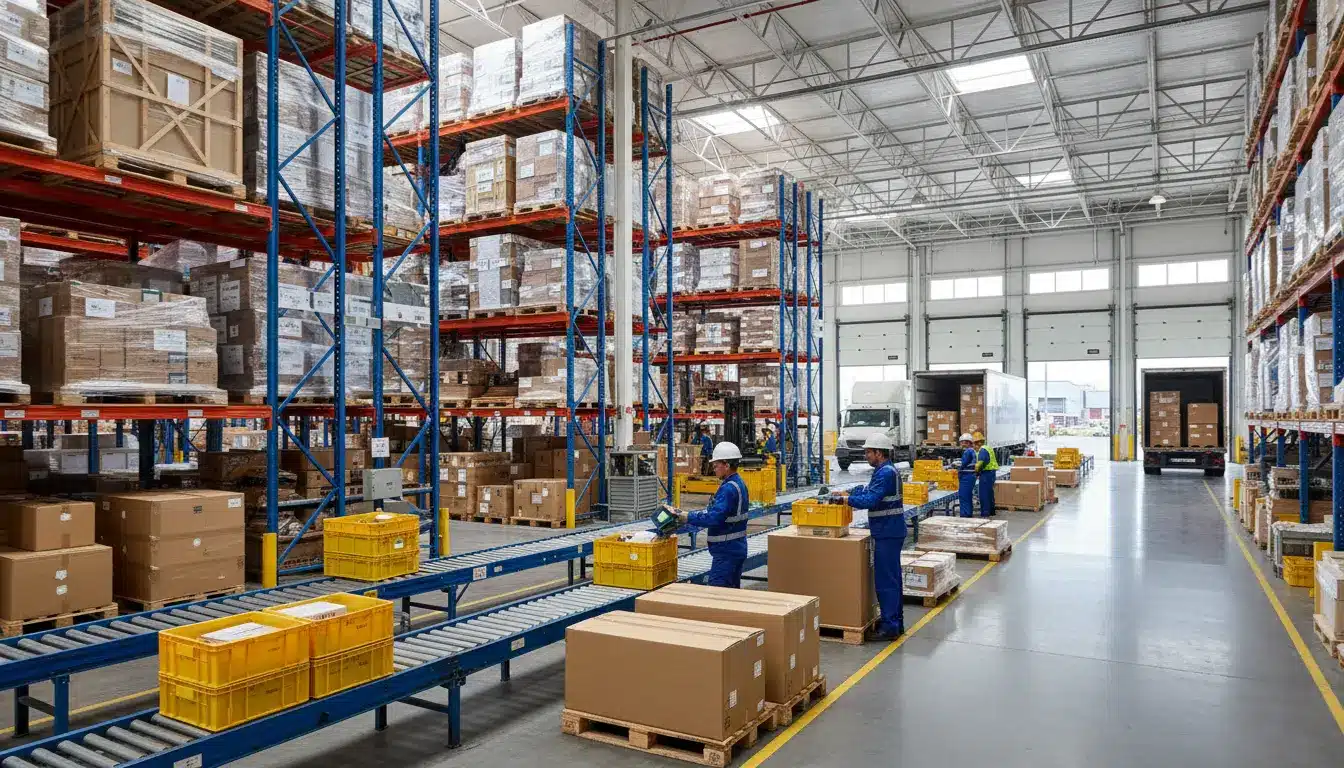
A fulfillment center in Canada is a third-party logistics (3PL) facility that handles your inventory and orders for you. It receives products from your suppliers, stores them, picks and packs customer orders, processes returns, and ships orders to customers across North America. This allows you to sell in Canada and the U.S. without running your own warehouse or managing complex cross-border logistics.
This definition is important because location affects far more than storage. It determines how fast your orders can be delivered, which shipping zones you qualify for, what tariff rates apply, and which retailers you can work with. In the end, it directly impacts how much of each sale you keep versus how much is lost to logistics costs.
For example, a fulfillment center in Vancouver gives you better access to U.S. West Coast customers than one in Toronto. A Toronto location serves central Canada and parts of the U.S. Midwest more efficiently. A Montreal facility can change your import costs and cross-border shipping math entirely. These differences are not small—they can shift your margins by 18–24%, and those changes add up every month as your volume grows.
The Strategic Difference Between 3PL Canada Partners and Traditional Warehousing
A traditional warehouse means you handle everything yourself. You rent the space, hire and manage staff, buy and maintain technology, and take on all operational risk and liability. A 3PL Canada partner takes care of all of this for you. Because they serve many brands at once, they can spread costs across clients, turning fixed expenses into flexible, usage-based costs.
The key difference is who manages the complexity. A 3PL invests in warehouse management systems, keeps up with retail compliance requirements, runs returns operations, and adjusts staffing as order volume rises or falls. With traditional warehousing, all of that responsibility stays with you.
For a brand growing from direct-to-consumer sales into wholesale and Amazon at the same time, this difference is critical. A 3PL partner enables growth without bottlenecks, while traditional warehousing often slows expansion and creates operational strain.
Storage Fees: The Compounding Cost Nobody Explains Properly
Storage pricing is not a simple flat fee. Most Canada fulfillment centers charge either per pallet in climate-controlled storage (about $40–$65 per pallet per month) or per cubic foot on shelving (around $0.50–$1.20 per cubic foot per month). At first, this seems straightforward.
The problem starts when inventory stays in storage longer than planned. During peak seasons—especially Q4—many providers apply seasonal storage surcharges, often increasing rates by 15–25%.
Then come long-term storage penalties. Inventory that does not move for 90 days or more is flagged as slow-moving and charged extra, usually $75–$150 per pallet per month. Products that sell slowly can quickly turn into costly mistakes. For example, a brand holding 40 pallets of off-season inventory could spend an additional $4,000–$6,000 per month just in penalty fees.
Many brands only realize this too late. They stock up in September for Black Friday, hit their sales goals, but still have 30% of inventory left over. By January, long-term storage penalties kick in—and those unexpected charges can erase the profits they made during Q4.
Pick and Pack Pricing Models: Per-Item vs Per-Order (With Real Numbers)
Most fulfillment centers use one of two pricing models: per-item pricing or per-order pricing.
- Per-item pricing usually ranges from $0.25–$0.85 per item.
- Per-order pricing is a flat fee of about $1.50–$4.50 per order, no matter how many items are in the box.
Each model has trade-offs. Per-item pricing becomes expensive if you sell bundles or gift sets with multiple items. Per-order pricing, on the other hand, becomes costly if most of your orders contain only one item.
For example, a brand selling three-item gift boxes at $0.50 per item pays $1.50 per order. That seems cheaper than a per-order partner charging $2.25 per order. But if that same brand also ships many single-item orders, the per-order rate still costs $2.25, while per-item pricing would only cost $0.50. When the pricing model does not match order behavior, brands often overpay by 15–30% in labor costs over a year.
Here is a real-world comparison. A brand ships 40,000 orders per year with an average of 2.2 items per order. At $0.40 per item, per-item pricing costs $35,200. At $1.75 per order, per-order pricing costs $70,000. In this case, per-item pricing is clearly better.
However, if the same brand averages 1.1 items per order, per-order pricing becomes cheaper—saving $38,500 annually.
This difference is rarely explained during a sales pitch, even though it has a major impact on total fulfillment costs.
Integration and Technology Maintenance Fees: The $500-2,000 Monthly Hidden Tax
Most Canada fulfillment centers charge separately for warehouse system (WMS) integrations. These fees are not included in pick-and-pack pricing. Setup costs usually range from $2,000–$8,000, with ongoing maintenance fees of $500–$2,000 per month, depending on how advanced the integration is and how often data is updated.
Many brands do not plan for these costs. They usually discover them in the second month, when a separate technology invoice appears. If the integration is basic—such as inventory syncing once per day instead of in real time—inventory errors start to appear.
Fixing these issues often requires manual reconciliation, which can take 10–15 hours per month. At an hourly cost of $50–$75, that adds another $500–$1,125 per month in hidden labor costs that are easy to overlook.
One beauty brand learned this the hard way. Their operations manager spent four hours every Friday manually fixing inventory mismatches. That added up to 16 hours per month—time that could have been avoided with real-time integration. The brand chose a cheaper integration option, but ended up spending the savings on labor to correct the problems that cheaper setup caused.
Geographic Cost Analysis: Vancouver vs Toronto vs Montreal Fulfillment Centers
Choosing the right Canada fulfillment center is not about being closer to your office. It is about protecting your margins.
Each location serves different U.S. regions more efficiently, and those differences directly affect shipping speed, cross-border costs, and overall profitability.
A Vancouver fulfillment center is best for the U.S. West Coast. Orders to California, Washington, Oregon, and nearby states typically arrive within two days. Cross-border shipping costs usually range from $2.50–$4.00 per unit, with standard tariff rates.
A Toronto fulfillment center is strongest for the U.S. Midwest and parts of the Northeast. Delivery times are usually 2–3 days, but cross-border handling costs increase to $3.00–$5.50 per unit. Tariffs are standard, but higher volumes significantly affect total cost.
A Montreal fulfillment center works best for the U.S. Northeast and European trade lanes. Northeast U.S. customers fall within a two-day delivery zone. Cross-border costs average $2.80–$4.50 per unit, though some regional tariff differences apply. Shipping to the U.S. West Coast is less efficient from this location.
Here is how this plays out in real numbers. A Canadian brand shipping 1,000 units per week to U.S. customers would spend:
- $2,600–$4,200 per week from Vancouver
- $3,200–$5,800 per week from Toronto
That difference equals $7,800–$19,200 per month, depending on where customers are located.
For example, if 60% of your U.S. orders ship to California, Washington, and Oregon, using a Toronto fulfillment center could be costing you an extra $9,600 per month that you do not need to spend.
Cross-Border Shipping from Canada to US: Real ROI Numbers
This is where many Canadian brands lose profit without realizing it. Shipping orders directly from Canada to the U.S. usually costs $8–$15 per box. However, when inventory is stored inside the U.S. (often called domestication), shipping costs drop to $4–$7 per box by using local U.S. carriers.
For a brand shipping 2,000 orders per month to U.S. customers, this difference can save $8,000–$16,000 every month. Over a year, that adds up to $96,000–$192,000. That is a major cost difference, not a small adjustment.
The trade-off is that domestication comes with requirements. Most fulfillment partners ask for minimum monthly volume commitments, usually 5,000 units or more, and managing inventory across Canada and the U.S. becomes more complex.
However, if your U.S. sales volume supports it, the financial return is immediate and substantial.
Tariff and Duty Management: The $25,000 Compliance Mistake
Incorrect tariff classification can lead to CRA audits, and missing retail compliance requirements can result in chargebacks from major retailers. These are not rare or theoretical problems. Many mid-sized brands experience a $25,000 penalty before they fully understand the risk.
A strong Canada fulfillment center partner has the systems and experience to manage retail compliance. This includes handling EDI requirements, GS1 barcodes, Advanced Ship Notices (ASNs), retailer routing guides, and processes designed to prevent penalties. When a fulfillment partner lacks this infrastructure, the financial responsibility falls back on the brand.
For example, if a retailer like Costco rejects a return shipment because the ASN does not match their routing requirements, the result can be a $5,000–$8,000 chargeback. That is a single error. Most brands make several similar mistakes before realizing their fulfillment partner does not actually manage retail compliance.
Run the Numbers Now
Take that $2.15 pick-and-pack quote and start adding the costs that were barely mentioned—or not mentioned at all. Add the $850 monthly integration fee that came up once during onboarding. Add $4,200 in seasonal storage surcharges that were never discussed. Then add $25,000 in compliance penalties when a retailer like Costco rejects your first return shipment because your fulfillment partner does not meet their routing or compliance requirements.
At that point, you are not saving money. You are simply delaying a margin problem.
The Canada fulfillment center partner you choose will either protect your margins as you grow or quietly reduce them by 15–25% through penalties, inefficiencies, and hidden fees that add up month after month. Most brands only realize the true cost after they are already $47,000 in and locked into a contract that makes switching difficult and expensive.
Instead of guessing, start measuring. Use a clear cost framework to test your current setup or compare new partners before you sign. The lowest quote often turns out to be the most expensive mistake.
If you want real clarity, look at fulfillment pricing that is fully transparent—where every dollar is explained upfront, with no hidden fees and no surprises waiting for you in month three.
