
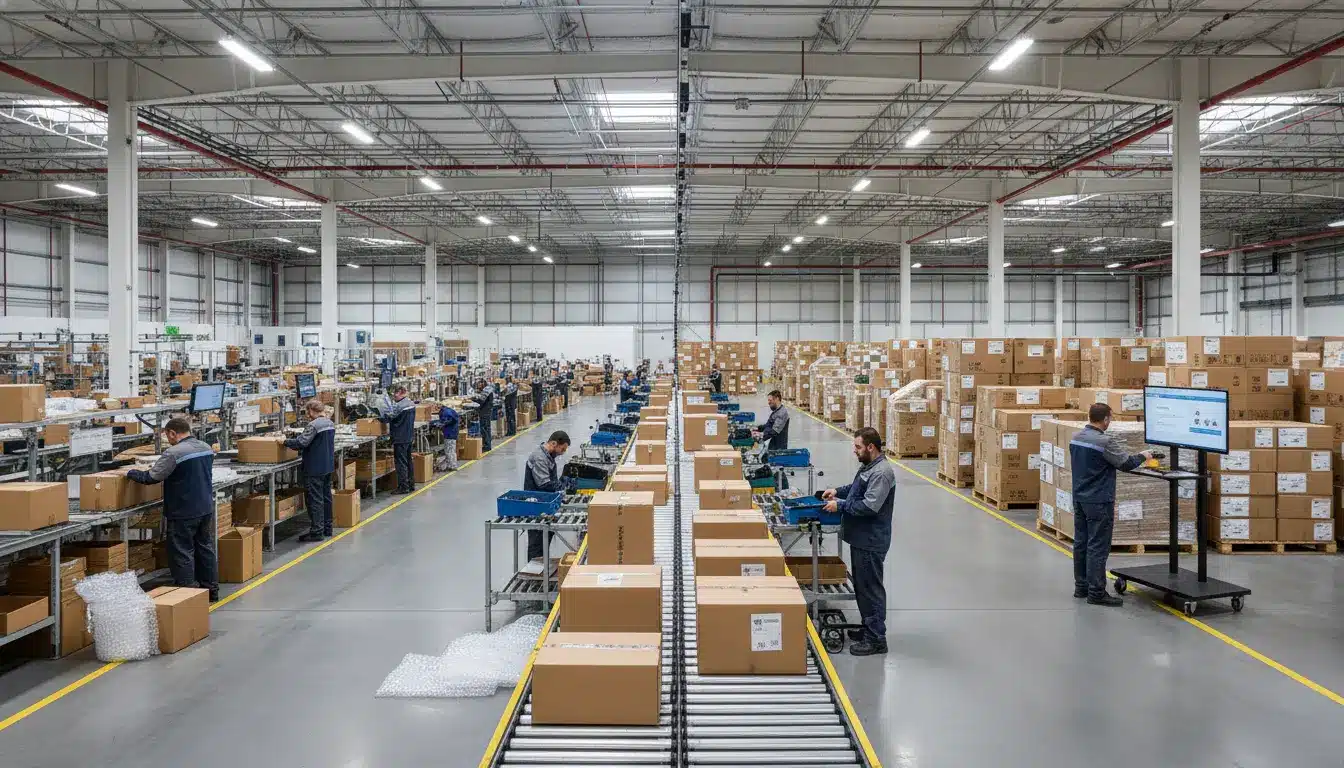
A retailer purchase order can look like growth and pressure by Friday.
For a DTC brand, one ecommerce order might mean one pick, one carrier label, one parcel, and a branded insert. Wholesale order fulfillment changes the work. A single PO may require case packs, pallet builds, GS1 labels, routing instructions, advance ship notices, freight appointments, and retailer-specific receiving rules.
That is why DTC to wholesale fulfillment is not just a sales-channel change. It is an operating-model change.
The brands that make the move well prepare before the first large PO lands. They define inventory allocation, retail-ready SKUs, EDI ownership, carton labeling, and error checks before retailers find the gaps.
Why DTC to Wholesale Fulfillment Needs a Different Operating Model
DTC operations are usually designed around speed, presentation, and customer experience. That model works well when orders are small, frequent, and shipped parcel-by-parcel.
Wholesale is different. Retailers care less about unboxing and more about receiving speed, data accuracy, carton identity, shelf availability, and compliance with their routing guide. A warehouse that performs well for B2C order fulfillment may still need new workflows before it can support retail fulfillment requirements.
DTC vs Wholesale at a glance: DTC orders may average one to three units; wholesale orders often move by case, pre-pack, pallet, or store allocation. DTC relies on carrier labels and customer notifications; wholesale may require EDI documents, BOLs, ASNs, packing slips, carton content data, and retailer portals.
U.S. Census Bureau data via FRED shows ecommerce represented 16.4% of total U.S. retail sales in Q3 2025. Online growth remains large, but most retail still happens outside pure ecommerce. The risk is treating retail as “just bigger DTC.” It is not.
Start with SKU and Inventory Discipline Before Accepting Large POs
Retail expansion exposes every weakness in the item master.
A DTC store can sometimes survive a messy SKU naming convention, a manual bundle workaround, or a warehouse note that only one operations manager understands. A retailer PO will not. The warehouse needs clean product records before it can pick, pack, label, and report cartons correctly.
Before wholesale launch, audit every retail-facing SKU for:
- UPC or GTIN accuracy
- Case pack quantity
- Inner pack rules
- Master carton configuration
- Dimensions and weights
- Country of origin
- Wholesale channel allocation
Scale example: A 40-style fashion collection with six sizes and four colours can become 960 SKU-variant records before accessories, bundles, or seasonal replenishment are added.
A practical first step: separate available-to-promise inventory by channel. Otherwise, a weekend ecommerce spike can quietly consume units promised to a retailer PO due Monday.
Build B2B Fulfillment Workflows Around Retailer Compliance
Wholesale operations should start with the retailer routing guide, not the warehouse’s preferred process.
Routing guides define how shipments must be prepared, booked, labeled, and received. They may include carton size limits, pallet height, carrier selection, delivery appointment rules, packing slip placement, barcode format, floor-loaded versus palletized shipment rules, and ASN timing.
A retail-ready workflow usually needs:
- PO intake and inventory validation
- EDI or portal confirmation
- Pick ticket generation and cartonization
- Label creation and carton content capture
- ASN transmission
- Freight booking
- Final dock audit before release
GS1’s logistic label guidance explains why carton identity matters: the GS1 Logistic Label uses a unique Serial Shipping Container Code (SSCC) so logistic units can be tracked and matched with electronic business messages. Scanning the SSCC can support cross docking, shipment routing, and automated receiving through the supply chain.
For a retailer DC, the label and the data must agree. If the ASN says carton 12 contains 24 black medium jackets but the carton label or contents differ, the receiving team may reject, delay, or penalize the shipment.
A parcel carrier label says where the box is going. A compliant retail carton label explains what the box is and how it should move through the retailer’s network.
Plan for Chargeback Prevention Before the First Shipment Leaves
Chargebacks are often treated as a finance issue after the invoice deduction arrives. Operationally, they usually come from a process issue that started earlier.
Common triggers include:
- Late shipment or wrong carrier
- Wrong carton label or missing ASN
- ASN-carton mismatch
- Wrong pallet build
- Incorrect packing slip placement
- Overages, shortages, or missed delivery appointments
For a growing brand, a 2% to 5% deduction on a large order can erase the margin that made the wholesale account attractive. Even when the deduction is disputed later, the team spends time collecting proof instead of selling or shipping.
Build a pre-shipment compliance checklist specific to each retailer:
- Has the PO been confirmed in the right system?
- Are all picked units from the approved SKU list?
- Do carton counts, weights, dimensions, labels, and ASN data match?
- Has the correct carrier or routing method been used?
- Is the delivery appointment booked inside the retailer’s window?
- Has someone completed a final dock audit?
The better model is exception reporting before shipment release: short inventory, missing carton data, label mismatch, or EDI rejection gets surfaced while the order can still be fixed.
Redesign Packaging and Value-Added Services for Wholesale Order Fulfillment
DTC packaging is often built for the end customer. Wholesale packaging is built for movement through a retailer’s receiving and store network.
That does not mean the brand experience disappears. It means brand presentation has to fit inside operational constraints.
Industry examples:
- A cosmetics brand moving from Shopify to specialty retail may need inner packs that keep fragile units stable in transit.
- A footwear brand may need pre-ticketing, size stickers, or store-ready cartons.
- A housewares brand may need drop-test-friendly packaging and clear carton markings for multi-unit cases.
Before launch, define which value-added services move from optional to required:
- Ticketing and hangtag application
- Barcode relabeling
- Kitting and pre-pack creation
- Case-pack conversion
- Quality checks
- Store-level carton sorting
- Channel-specific prep
Connect Systems Before Omnichannel Fulfillment Gets Messy
The move into wholesale raises the cost of disconnected systems.
DTC brands often begin with a storefront, a shipping platform, a basic inventory tool, and a few manual reports. That stack may work at 500 orders a month. It struggles when the same product is sold through Shopify, Amazon, wholesale accounts, and retailer POs at the same time.
A more mature omnichannel fulfillment setup needs clear data flow between the ERP, ecommerce platform, EDI provider, warehouse management system, and retailer portals.
Before accepting retail volume, map:
- Where the wholesale PO enters the system
- Who confirms inventory availability
- Who transmits the ASN
- How shipped quantities return to accounting
- How inventory updates across DTC and wholesale after shipment
The National Retail Federation reported that retailers expected 15.8% of annual sales to be returned in 2025, totaling $849.9 billion, with online return rates estimated at 19.3%. Retail returns may include overstock, damaged goods, seasonal goods, or customer returns — so the warehouse needs rules for receiving, inspection, restocking, refurbishment, donation, or disposal.
Choose a Fulfillment Partner That Can Scale with Channel Complexity
Retail expansion changes what “good fulfillment” means.
A strong DTC operation is fast, accurate, and customer-aware. A strong wholesale operation is accurate, compliant, auditable, and disciplined under larger order loads. A strong multi-channel operation is both.
When evaluating a 3PL before wholesale growth, ask operational questions:
- Which EDI documents can the 3PL support?
- Can it manage retailer-specific routing guides by account?
- How are GS1 or retailer carton labels created and checked?
- Can the warehouse capture carton contents at pack-out?
- How are DTC, B2B, Amazon, and retail workflows separated?
The right partner should help the brand prepare before volume arrives: SKU cleanup, retailer requirements review, systems mapping, workflow design, and clear go-live testing.
If your team is preparing for retail expansion, talk to Evolution about your channel mix, retailer requirements, inventory setup, and fulfillment model. A strategy call can help identify the operational gaps to fix before your first major PO becomes a warehouse fire drill.
FAQ
What is DTC to wholesale fulfillment?
DTC to wholesale fulfillment is the operational shift from shipping individual ecommerce orders to fulfilling larger B2B, wholesale, or retail orders. It usually adds retailer routing guides, carton labels, ASNs, EDI workflows, freight booking, pallet rules, and stricter inventory controls.
How is B2B fulfillment different from DTC fulfillment?
B2B fulfillment focuses on bulk order handling, retailer compliance, carton and pallet accuracy, documentation, and delivery appointments. DTC fulfillment focuses more on parcel speed, branded packaging, customer notifications, and individual consumer experience.
What should brands prepare before selling to retailers?
Brands should prepare clean SKU data, UPC or GTIN records, case pack rules, carton dimensions, inventory allocation logic, EDI workflows, routing guide checklists, ASN processes, and a clear ownership map between sales, operations, finance, and the warehouse.
Can one 3PL handle DTC and wholesale fulfillment?
Yes, if the 3PL has systems and processes for both parcel fulfillment and B2B retail compliance. The key is workflow separation: DTC, wholesale, Amazon, and retail orders can share inventory, but they need channel-specific rules for picking, labeling, documentation, and reporting.
When should a brand review its fulfillment model before retail expansion?
Review it before accepting a large retailer PO or signing a wholesale agreement with strict routing rules. Once shipment windows begin, the team has less room to fix SKU data, label formats, EDI issues, packaging, and inventory allocation gaps.