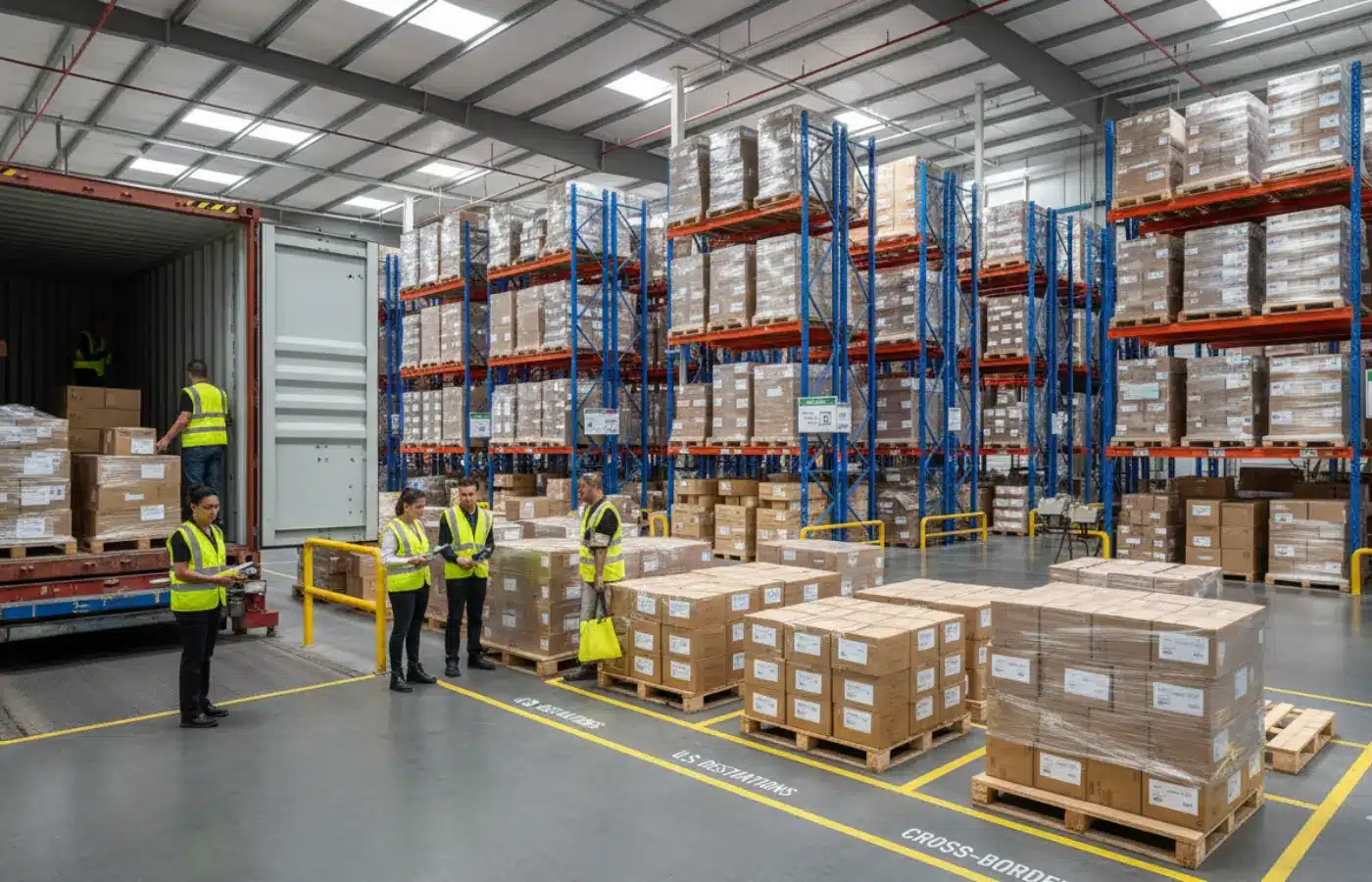
US brands usually treat logistics as a downstream task: pick a warehouse, negotiate rates, then figure out cross-border friction later. That sequence is expensive.
If you are entering or scaling in North America, your fulfillment architecture is a market-entry decision. A strong canadian 3pl can reduce landed cost variance, shorten launch time, and protect delivery promises in multiple US zones without forcing a full US network on day one.
This guide explains the operating model behind that decision. You’ll see how canadian 3pl companies handle customs paperwork, duties and tax touchpoints, inventory placement, and SLA design for 2-5 day US delivery. You’ll also get a practical 30/60/90 implementation roadmap and a Vancouver scenario you can benchmark against your expansion plan.
Why Brands Choose a Canadian 3PL for US Expansion
A canadian 3pl is not only about moving freight across the border. It can function as a control tower for North American rollout when the model is designed correctly.
1) Cost control without margin leakage
Many brands overpay during US expansion because they build for peak complexity before demand is stable. They add duplicate nodes, disconnected carriers, and reactive customs handling.
A 3pl in canada can lower that risk by:
- Consolidating inbound freight into one operating base
- Standardizing customs data before shipment release
- Routing US orders through pre-defined carrier ladders by zone and service level
- Reducing split-shipment frequency through better forward inventory planning
The real advantage is not “lowest rate.” It is lower volatility. Finance teams care about predictable cost per shipped order and fewer exception fees.
2) Faster time-to-market for US channels
If your team is launching wholesale, DTC, and Amazon at once, speed of operational setup often decides whether launch windows are hit.
Experienced canada fulfillment services teams can accelerate setup because they already run:
- EDI/ASN-ready workflows for retail compliance
- Amazon prep and removal workflows
- B2C pick-pack standards with returns loops
- Integration patterns for WMS, storefronts, and ERPs
That means less custom build work during launch and fewer post-go-live surprises.
3) Risk reduction in customs and compliance
Cross-border penalties usually come from data quality and process timing, not from one dramatic event. Wrong tariff code, incomplete commercial invoice data, missing origin details, late filing, and inconsistent broker handoff all add delay and rework.
A mature canadian 3pl operating model puts controls upstream:
- Product master data validation before first inbound move
- Document templates by lane and shipment type
- Escalation rules for exception shipments
- Broker communication standards and cutoff ownership
This prevents customs from becoming a daily fire drill.
The Core Operating Model: What a Canadian 3PL Should Run for You
When evaluating canadian 3pl companies, ask to see workflow ownership by stage. If ownership is vague, execution will be inconsistent.
Stage A: Inbound and customs readiness
Before your goods move, your 3PL should align:
- SKU master data (HS references, origin data, unit details)
- Commercial invoice fields and validation rules
- Broker handoff process (who submits what, and when)
- Pre-alert rules for inbound loads
- Exception handling tree for holds, exams, and missing docs
Outcome: fewer release delays and less manual intervention.
Stage B: Receipt, storage, and inventory logic
After entry, the warehouse should not simply “store and ship.” It should position inventory based on demand patterns and promised delivery windows.
Look for:
- Velocity segmentation (A/B/C SKU treatment)
- Zone-based replenishment logic
- Allocation rules by channel (wholesale, DTC, marketplace)
- Safety-stock governance by lead-time risk
- Cycle-count cadence tied to order criticality
Outcome: stronger fill-rate stability and fewer high-cost expedites.
Stage C: Outbound execution to US delivery SLAs
For 2-5 day US delivery, service design matters more than headline transit estimates.
Your 3PL should define:
- Carrier matrix by destination zone and parcel profile
- Service-level rules at checkout or order routing level
- Daily cutoff windows and exception fallback process
- Packaging standards that balance DIM cost and protection
- Track-and-trace escalation ownership
Outcome: SLA promises that are actually operationally defensible.
Stage D: Returns and duty-sensitive reverse flow
Returns are often where margins disappear silently. A 3PL in canada should run a clear reverse-logistics loop:
- Return authorization intake and triage
- Inspection and disposition coding
- Re-stock, quarantine, or disposal logic
- Data feedback to merchandising and quality teams
- Financial reconciliation rules for credits and claims
Outcome: faster inventory recovery and lower return-processing waste.
Duties, Taxes, and Paperwork: The Touchpoints You Need Mapped
A lot of brands ask, “Will the 3PL do customs?” Better question: “Which customs and tax tasks are operationally owned, and what data do we own?”
For US expansion through canada fulfillment services, map these touchpoints explicitly:
Commercial documentation
At minimum, define process ownership for:
- Commercial invoice creation standards
- Product descriptions and unit values
- Country-of-origin consistency
- Supporting docs for specialized product categories
Classification and brokerage workflow
Your team and 3PL should agree on:
- Who approves classification references
- How disputes or reclassification requests are handled
- Broker escalation windows and contacts
- Change control for new SKUs
Duty and tax visibility
Finance leadership should receive routine visibility into:
- Duty and tax incidence by shipment profile
- Exception fees and root causes
- Cost impact by lane and channel
- Trend reporting for planning adjustments
The key is governance, not guesswork. A canadian 3pl that can’t show duty/tax reporting discipline will create unpleasant surprises at scale.
Real Scenario: US Brand Routing Through Vancouver
Here is a practical scenario that reflects how many expansion projects are built.
A US lifestyle brand with mixed DTC and wholesale demand wants wider North American coverage without standing up multiple new US facilities immediately. The brand routes inbound containers through Vancouver, stages inventory with a Canadian 3PL, and serves both Canadian and US demand from a controlled operating base.
What changed in the operating model
Before:
- Fragmented inbound planning
- Inconsistent customs document quality
- Manual routing decisions by order team
- Low confidence in delivery commitments beyond core zones
After routing through Vancouver with a structured 3PL model:
- Standardized customs packet creation before freight arrival
- Single inventory control layer with channel allocations
- Pre-set carrier logic for US zones
- Defined returns triage and reintegration cadence
Why this setup works
Vancouver offers practical advantages for many brands with Pacific freight exposure and western North American demand. But geography alone does not solve execution. The gain comes from process discipline:
- Customs steps are repeatable
- Inventory logic reflects demand reality
- Delivery promises are tied to operational rules
- Exceptions are managed through known escalation paths
This is why brands evaluating canadian 3pl companies should focus on operating maturity, not only warehouse square footage.
How to Evaluate Canadian 3PL Companies (Decision Framework)
If you are shortlisting partners, use a weighted scorecard. Focus on execution layers that determine service reliability.
1) Customs and compliance operating depth
Ask for workflow maps, not sales claims:
- Pre-arrival documentation process
- Broker integration method
- Exception case examples
- Compliance ownership matrix
2) SLA architecture and carrier control
Evaluate whether they can prove 2-5 day US delivery design by zone:
- Carrier strategy by geography
- Cutoff discipline and same-day process
- Package engineering practices
- Performance reporting cadence
3) Multi-channel capability
Many failures happen when wholesale, DTC, and marketplace workflows collide.
Confirm readiness for:
- Retail routing guide compliance
- EDI/ASN capability
- Amazon prep/removal workflows
- Channel-priority allocation during constraints
4) Systems and integration quality
Ask how quickly they can integrate and stabilize:
- Existing connectors to your stack
- Data validation checkpoints
- Inventory visibility model
- Incident management and support model
5) Governance and partnership behavior
A strong canadian 3pl relationship is operational and strategic.
Look for:
- Weekly operational review structure
- KPI accountability by owner
- Continuous-improvement cadence
- Transparent communication on failures and fixes
30/60/90-Day Implementation Plan
The first 90 days set the tone. Here is a rollout structure brands can use.
Days 1-30: Design and data readiness
Objectives:
- Confirm scope by channel, region, and SKU profile
- Finalize customs and document standards
- Complete systems integration planning
- Define SLA matrix and reporting stack
Deliverables:
- Signed process maps
- Data dictionary for product and order flows
- Compliance checklist with owners
- Launch readiness scorecard
Days 31-60: Controlled launch
Objectives:
- Start inbound flow with validation controls
- Launch limited outbound volume by priority zones
- Monitor customs exceptions and delivery performance daily
- Calibrate inventory rules based on actual order behavior
Deliverables:
- Daily exception log with root causes
- First KPI baseline (fill rate, on-time ship, transit variance)
- Revised operating SOPs from live feedback
Days 61-90: Scale and stabilize
Objectives:
- Expand channel volume under controlled SLA thresholds
- Optimize carrier mix and packaging economics
- Finalize returns and financial reconciliation rhythm
- Move from reactive troubleshooting to weekly optimization
Deliverables:
- Executive KPI dashboard
- Cost-to-serve trend analysis
- Risk register with mitigation owners
- Q2 optimization backlog
Common Mistakes to Avoid
Mistake 1: Treating customs as a broker-only function
If the 3PL operations team does not own upstream data quality, delays will repeat.
Mistake 2: Promising 2-day delivery everywhere
Service promises should match zone economics and operational capacity.
Mistake 3: Launching all channels at full volume on day one
Use phased launch logic. Stability first, then scale.
Mistake 4: Ignoring returns design until later
Returns process affects margin, customer experience, and inventory availability. Build it early.
Mistake 5: Buying on rate card alone
Low base rates can hide exception costs, rework, and poor SLA outcomes.
Final Takeaway
For growth-stage brands, choosing a canadian 3pl can be a strategic move, not just a shipping decision. The value comes from operating design: customs workflows, compliance governance, inventory positioning, and defensible US delivery SLAs.
If your team is evaluating a 3pl in canada, ask for process maps, ownership clarity, and 90-day implementation logic. The right partner will show exactly how your model will run, where risks sit, and how performance is measured.
If you want to pressure-test your expansion plan, Evolution Fulfillment can map your cross-border operating model, identify cost and compliance risks, and build a practical rollout path for reliable 2-5 day US delivery. Schedule a cross-border fulfillment consultation with the team.
