
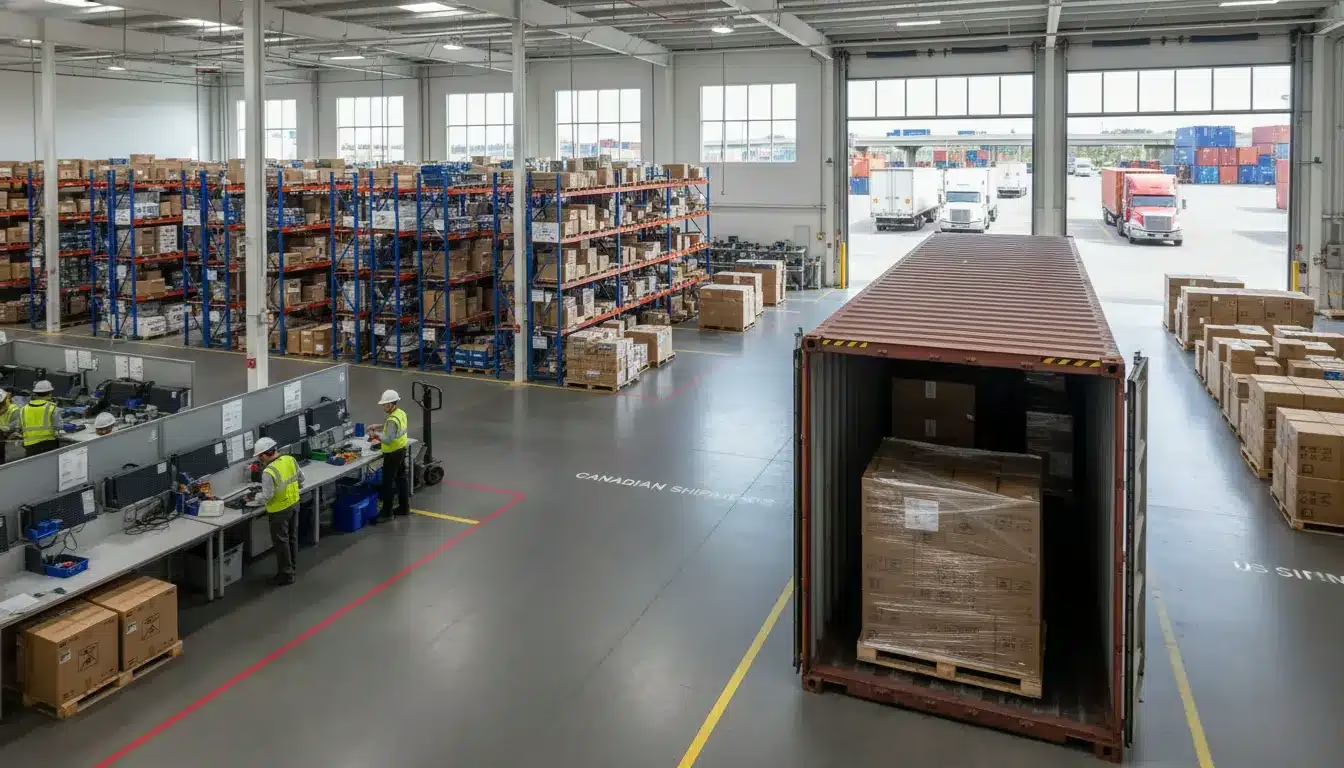
A Canada fulfillment center lets mid-sized brands enter North America without giving up margins to distributors or setting up a U.S. entity. Brands keep control of pricing, customer data, and brand experience while a Canadian 3PL manages cross-border shipping, compliance, and fulfillment from one inventory pool.
Three months ago, a €12M German skincare brand faced a common choice: accept distributor terms that would take 50–60% of their margin, or delay North American expansion altogether. Instead, they shipped their first container to Vancouver. The result was controlled growth, retained margins, and full ownership of their brand in both Canada and the U.S.
For brands in the $5–20M revenue range, Canada offers a third path—one that avoids margin-destroying distribution deals and the complexity of building U.S. operations too early.
Why Mid-Sized Brands Choose Canadian Fulfillment as Their North American Gateway
As brands scale internationally, traditional U.S. distribution models quickly become restrictive. Distributors control pricing, customer access, and inventory decisions. A Canadian fulfillment strategy flips that structure.
Under a Brand Fulfillment approach, the brand owns pricing and customer relationships, while the 3PL operates as an extension of the business. Inventory for Shopify, Amazon, and wholesale flows from a single Canadian location, eliminating the need for multiple warehouses or channel-specific stock.
The financial difference is meaningful. Distributors typically absorb 50–60% of wholesale margin, while a Canadian fulfillment partnership usually costs 10–25% of revenue, depending on volume and services. For a $15M brand generating $3M in North American wholesale sales, this can represent hundreds of thousands of dollars annually retained for marketing and growth.
Key reasons brands choose this route include:
- No immediate U.S. entity or incorporation required
- Access to USMCA tariff advantages
- Higher retained margins for reinvestment
- Ability to test demand before committing to permanent U.S. infrastructure
What Is a Canada Fulfillment Center and How Does It Enable Cross-Border Growth?
A Canada fulfillment center is a third-party logistics operation that receives inventory, stores it, and fulfills orders to customers across both Canada and the United States from one location.
Containers typically arrive through Vancouver or Montreal. Inventory is received, transloaded when needed, and distributed to:
- Direct-to-consumer customers in Canada and the U.S.
- Amazon fulfillment centers
- Wholesale and retail distribution centers
Beyond pick-and-pack, a capable Canadian 3PL provides real-time inventory visibility, automated order routing, carrier optimization, returns processing, and deep integrations with ecommerce and wholesale systems.
What separates a strategic partner from a generic warehouse is capability depth: transloading, Amazon FBA prep, B2B retail compliance, reverse logistics, and cross-border customs management. This turns the fulfillment center into the brand’s operational backbone for North America.
The Brand Fulfillment Model: Preserving Margins While Scaling North America
The Brand Fulfillment Model replaces distributor dependency with operational outsourcing. Brands sell directly to retailers and consumers at their chosen price points while paying only for fulfillment services.
Instead of surrendering $25–30 of margin on a $50 wholesale item to a distributor, a brand might pay $5–12 per order for fulfillment and retain the rest. This restores pricing power, protects customer data, and aligns logistics costs with actual growth.
How Canadian Fulfillment Centers Support Multi-Channel Strategies from Single Inventory
A Canadian fulfillment center allows brands to manage one shared inventory pool across all sales channels. Shopify orders, Amazon FBA prep shipments, and wholesale purchase orders all ship from the same physical stock. There is no need to pre-assign inventory to specific channels, and there is no risk of overselling caused by split or outdated inventory counts.
Each SKU exists in one location. A Shopify order pulls from that SKU, an Amazon FBA replenishment pulls from the same units, and a wholesale order is fulfilled from the same inventory—all in real time. Because everything is tracked through the warehouse management system, inventory stays accurate and visible across every channel. Multi-channel fulfillment becomes organized and predictable instead of complex and error-prone.
This setup saves months of operational planning and prevents excess inventory buildup. Brands no longer decide in advance how much stock goes to DTC, wholesale, or Amazon. Demand controls allocation automatically. When DTC demand increases, inventory flows there. When wholesale demand rises, ecommerce availability adjusts. The system rebalances inventory continuously without manual intervention.
How International Brands Use Canadian Fulfillment as a Beachhead for North American Expansion Without US Entities
Many brands based in Europe or Australia want to expand into North America without immediately setting up a U.S. company. A Canadian fulfillment model makes this possible through a step-by-step approach.
Step one: Import into Canada.
Goods arrive at ports in Vancouver or Montreal. Canadian import rules and customs processes are generally simpler for first-time importers. Clearance through the Canada Border Services Agency typically takes two to five business days for standard shipments. A U.S. importer of record or U.S. tax ID is not required. The Canadian fulfillment partner manages customs paperwork, duty payments when applicable under USMCA, and cargo release.
Step two: Transload and cross-dock.
When a full container arrives, it is broken down and reorganized by destination. Orders going to U.S. customers are transferred to U.S. carriers, while Canadian orders stay on domestic carriers. This approach usually reduces shipping costs and delivery times by 15–25 percent.
Step three: Sell directly across North America.
Brands are not tied to distributor agreements. They can sell through Shopify in both Canada and the U.S., list products on Amazon.ca and Amazon.com, and supply wholesale retailers across the continent. All orders ship from the same Canadian operation.
Step four: Expand gradually.
Brands often start with Canada and the U.S. West Coast, then expand into the Southwest and Midwest, and later into the U.S. Northeast. As volumes grow, they can decide whether to open a U.S. facility or continue optimizing through Canada, without large upfront investments.
USMCA supports this structure. If products qualify, tariffs are removed when distributed through Canadian operations. This keeps landed costs lower and protects margins. Many brands operate as non-resident businesses, with inventory held by a Canadian 3PL, while selling through North American ecommerce platforms without incorporating in either country.
Container Transloading and Cross-Docking Strategies for International Shipments
International containers arrive packed for ocean transport, not for fast domestic delivery. Transloading breaks containers down and reorganizes shipments by destination and carrier, reducing shipping costs and speeding up delivery.
For example, a container arriving in Vancouver with 5,000 units destined for multiple U.S. states and Canadian provinces can be split into regional pallets. Shipments headed to the Southeast move with carriers strong in that region. Canadian orders remain on domestic networks. West Coast shipments are grouped with other nearby freight.
Ocean freight from Asia typically costs about $2–4 per unit. Transloading adds roughly $0.15–$0.30 per unit, but it can reduce North American shipping costs by 20–30 percent and shorten delivery times from weeks to three to five days for most U.S. regions. For a 5,000-unit container, this can save approximately $1,500–$2,250 while getting products to customers much faster.
Cross-Border Tax and Duty Implications: Canadian vs US
If inventory is stored in Canada, brands must register for GST/HST once Canadian sales exceed $30,000 CAD per year. Tax rates vary by province. Registration is handled directly with the Canada Revenue Agency or through a tax compliance service.
Inventory stored only in Canada generally does not create U.S. sales tax obligations because there is no physical presence in U.S. states. U.S. sales tax requirements may apply later if inventory is stored in U.S. warehouses or through Amazon FBA. Economic nexus rules can also apply at higher sales volumes, so professional advice is recommended.
Under USMCA, goods made in the U.S., Canada, or Mexico qualify for zero tariffs. Products imported from Asia or Europe usually pay duty once when entering Canada. Shipments from Canada to the U.S. may qualify for duty-free entry if each shipment is under $800 USD, helping avoid paying duty twice when structured correctly.
Storing inventory and fulfilling orders from Canada does not automatically create Canadian corporate income tax obligations. Permanent establishment typically requires employees, offices, or active operations beyond inventory storage. Many international brands operate for 12–24 months without Canadian incorporation while testing the market.
Taking Control of Your North American Expansion
For brands earning $5–20M in revenue, Canada provides a practical way to enter North America without losing margins to distributors or spending time and resources on early U.S. incorporation. This approach allows brands to grow DTC and wholesale together, keep control over pricing and customer relationships, and focus on marketing and product development while logistics are handled by a specialized partner.
Brands that succeed with this strategy treat Canadian fulfillment as core infrastructure, not a temporary solution. This creates a long-term advantage built on proximity to customers, built-in regulatory expertise, and the flexibility to scale without operational complexity.
Ready to move faster in Canada? Explore how Evolution Fulfillment’s Canadian distribution services can handle the complexity while you grow the business.