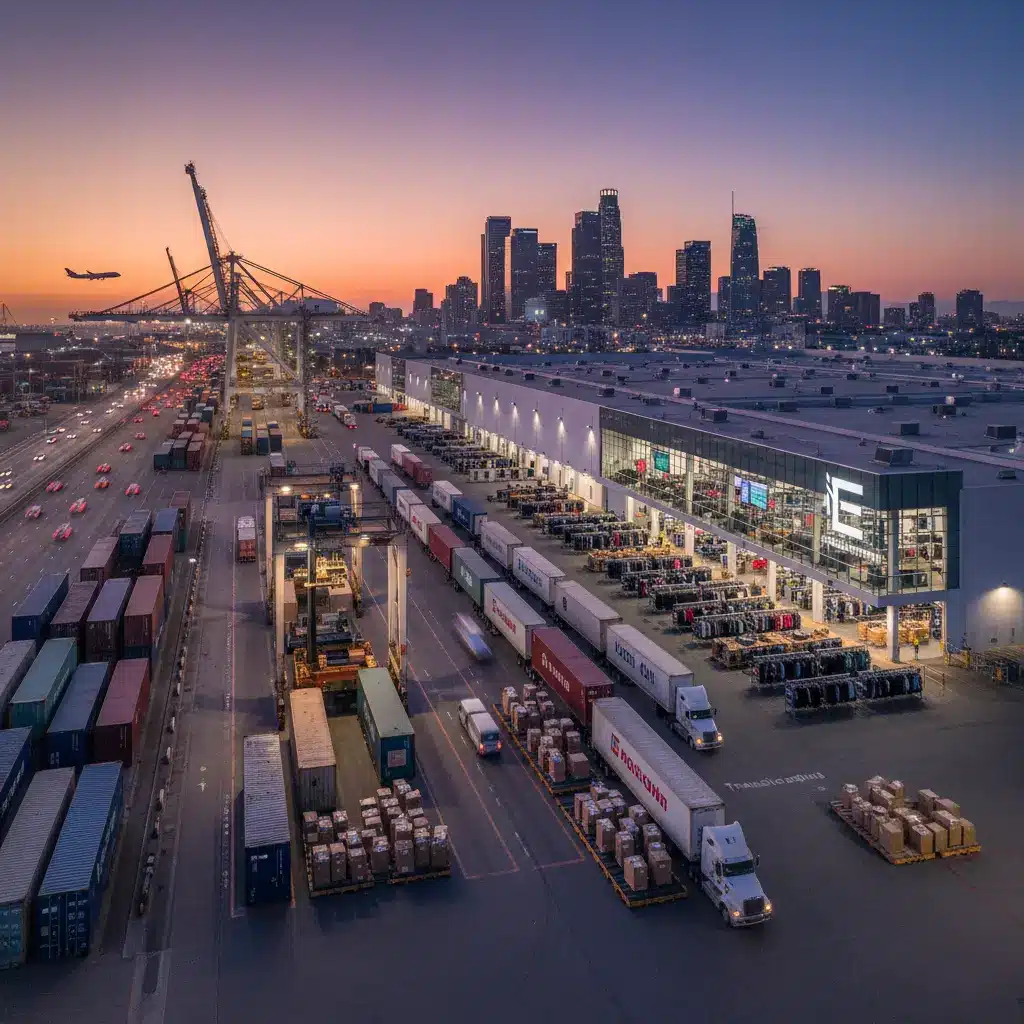
Apparel fulfillment in Los Angeles can cut ocean-to-door lead times into 1–3 days for West Coast metros, turning inbound containers into store-ready inventory faster than East Coast routing. For apparel brands, that speed—combined with port transloading, integrated WMS/ERP/Shopify connections, and white-glove pick-pack and FBA prep—reduces inventory risk, improves seasonal responsiveness, and tightens both B2B and D2C SLAs.
This article quantifies LA’s port-to-warehouse advantage, compares lane-level cost and transit tradeoffs, and outlines the operational services—transloading, domestication, returns management, and omnichannel integrations—that make the city a high-impact apparel logistics hub. It also highlights the Canadian SMB gap and how Evolution Fulfillment’s Brand Fulfillment Model, cross-border domestication, and tailored SLAs position it as a preferred partner for brands expanding across North America.
Why Los Angeles Is a Strategic Hub for Apparel Fulfillment
Transloading unloads ocean containers at the port and reconfigures cargo into domestic-ready parcels, pallets, or LTL the same day. This reduces dwell time, accelerates ocean-to-door delivery by days, and lowers storage costs by moving inventory directly into outbound networks.
Ports of LA and Long Beach handle approximately 19 million TEUs annually, offer 1–3 day ground reach to West Coast metros, and sit within a dense parcel and LTL carrier network.
A common example is a capsule collection landing on Friday and reaching LA, San Francisco, and Seattle stores by Monday.
Proximity translates directly into measurable lead-time gains.
Port-to-Door Speed: Translating Proximity Into Lead-Time Wins
Los Angeles typically delivers to West Coast markets in 1–3 days, Southwest in 2–3 days, Mountain and Midwest regions in 3–5 days.
Receiving inventory even two days earlier can reduce safety stock by 10–15%, improving full-price sell-through and reducing markdown exposure.
Lane-specific lead-time tracking is essential, as averages often hide the true ROI in apparel logistics.
Apparel Logistics Infrastructure Unique to Los Angeles
Los Angeles offers high transload density, Foreign Trade Zone (FTZ) options that defer duties on re-exports, and a deep drayage pool supported by PierPass-capable chassis.
Garment-on-hanger (GOH) handling reduces wrinkling and returns for premium apparel categories such as tailored suits.
SKU handling requirements should be matched to LA’s specialized labor force and equipment capabilities.
Port-Centric Operations: Transloading, Cross-Docking, and Flow-Through
Same-day devanning-to-parcel is achievable when appointments align, with 24–48 hour averages being common. Flow-through models reduce storage days and handling touches.
A single container can be split into D2C, wholesale, and Amazon FBA allocations by midday on arrival.
Port-to-Warehouse Workflow (Step-by-Step)
Key performance targets include dock-to-stock under 48 hours, QA defect rates below 1%, and ASN match accuracy above 99.5%.
Process flow:
- Appointment scheduling and customs release, followed by drayage
- Devanning, SKU-level quality checks, ASN reconciliation, and channel routing
- Repacking, labeling, and dispatch via flow-through, or storage with FIFO tagging
Exception handling—such as retailer label variance—is routed immediately to rework lanes to prevent chargebacks. ASN mismatches should never be left to batch reconciliation.
Omnichannel Apparel Fulfillment Services Optimized for LA
Typical benchmarks include 95%+ OTIF, 99.8%+ pick accuracy, and same-day cutoffs between 12–2 pm.
White-glove value-added services such as tissue wrap, branded polybags, and boxed presentation preserve the unboxing experience for premium launches.
D2C, marketplace, and wholesale channels require distinct SLA definitions and measurement.
D2C and Marketplace Excellence
Real-time inventory sync under five minutes, Amazon FBA turnaround within 24–48 hours, and FBM as an on-peak backup are standard expectations.
Proper polybagging, suffocation labeling, and carton prep prevent FBA rejections and protect IPI scores. OMS integrations with Shopify and ERP systems ensure live inventory allocation.
Wholesale and Retail Compliance at Scale
LA operations commonly support EDI 850/856/810 flows with UCC-128 and GS1 accuracy targets near 100%. Proper routing guide enforcement can reduce deductions by 30–50%.
Size-curve cartonization and retailer-specific packing rules prevent avoidable chargebacks. These rules must live inside the WMS, not as undocumented tribal knowledge.
Technology Stack Powering Apparel Fulfillment in Los Angeles
Dashboards tracking dock-to-stock performance and returns-reason analytics can reduce repeat defects by 15–20%.
Order management systems that prioritize preorders help protect high-velocity SKUs during constrained inventory windows. SLA dashboards should be visible to brand teams for governance and rapid decision-making.
Cost and Transit Tradeoffs: LA vs. Other U.S. Hubs
West Coast and Pacific Northwest lanes often deliver low double-digit per-unit savings compared to East Coast routing, even after accounting for drayage, PierPass, and chassis fees.
Faster inventory turns can reduce working capital requirements by 8–12%, improving cash flow. LA is not always more expensive once transit time and inventory carrying costs are included.
Lane-Level Modeling Framework
Scenario modeling evaluates inputs such as unit volume by channel, carton density, return rates, and lead-time sensitivity against outputs like landed cost per unit, days-to-shelf, and working capital impact.
In many cases, modeling shows that a dual-node strategy—Los Angeles plus Canada—reduces returns cost and cycle time for Canadian orders.
Shipping Time Benchmarks From Los Angeles
Typical ground transit ranges include:
- West Coast: 1–3 days
- Southwest/Mountain: 2–4 days
- Midwest: 3–5 days
- East Coast: 4–6 days
- Canada West: 2–4 days
- Canada Central/East: 4–7 days
Zone-skipping can improve Canada East transit by one day while lowering duty handling complexity.
Sustainability by Design: Packaging, Transloading, and Emissions
Right-sizing packaging can reduce dimensional weight by 10–20%. Transloading lowers storage-related emissions, while material changes—such as replacing polybags with paper—reduce waste.
GOH hanger reuse programs have reduced procurement costs and landfill waste.
Risk Management for LA Apparel Logistics
Appointment optimization can reduce dwell by 12–18%. Multi-carrier strategies limit outage exposure, while overflow yards and pre-booked chassis absorb port surges without full facility disruption.
Audit-ready customs and EDI documentation ensures compliance during peak periods.
The Canadian SMB Advantage: Domestication and Brand Fulfillment
Section 321 enables duty-free shipments under $800, and DDP delivery often improves conversion rates by 3–5% compared to DDU.
Dual-node programs combining LA and Canada have reduced returns cost and cycle time for Canadian indie brands.
Cross-Border Domestication Workflows
Non-resident importer (NRI) and importer-of-record (IOR) models enable Canadian delivery without a local entity. Returns can be consolidated domestically to speed refunds and reduce cross-border friction.
Amazon FBA Prep and LA Transloading for SMBs
LA-based FBA prep enables 1–3 day replenishment to West Coast fulfillment centers, with rejection targets under 0.5%.
Precise carton configuration and labeling protect IPI scores and avoid FC holds during peak.
Evaluating Clothing Fulfillment Companies in Los Angeles
Key indicators include dock-to-stock under 48 hours, cycle-count accuracy above 99%, and transparent rate cards.
On-site evaluations should include reviews of brand-protection SOPs, GOH lanes, and live EDI demonstrations. Request sample EDI files and WMS screenshots.
Implementation Roadmap: From Ocean Arrival to Steady State
Parallel runs typically last 2–4 weeks, followed by a 30/60/90-day optimization cadence.
Sandbox API and EDI testing before cutover prevents order loss and allocation errors at launch.
Mini Scenarios: Where LA Apparel Fulfillment Delivers ROI
Common outcomes include 12–18% per-unit savings on West Coast lanes and 20–30% faster wholesale delivery in select models.
Fast-fashion D2C brands benefit from higher inventory turns, premium wholesale brands reduce chargebacks, and Canadian SMBs gain from dual-node domestication.
KPIs and Governance
Track OTIF, pick accuracy, dock-to-stock cycle time, cost per order, return-to-resell rate, and chargebacks. Weekly operational reviews and monthly QBRs tie performance back to commercial goals.
Next Steps: Model Your LA-Focused Network
Start with lane density, SKU velocity, and returns profiles. Run LA-only versus dual-node scenarios, finalize SOPs and pricing, and schedule a sandbox EDI cutover.
Wrapping Up
Los Angeles is a high-leverage node for apparel fulfillment. Port proximity and same-day transloading convert ocean lead time into inventory and margin advantages, while apparel-savvy labor, GOH handling, and FBA-adjacent prep support omnichannel execution. The strongest results come from lane-level modeling, disciplined SOPs, integrated OMS/WMS/EDI systems, and tight governance. Sustainability controls and risk mitigation protect margins further. For brands—especially Canadian SMBs—pairing an LA node with clear SLAs and technology is the fastest path from ocean arrival to steady-state revenue.
