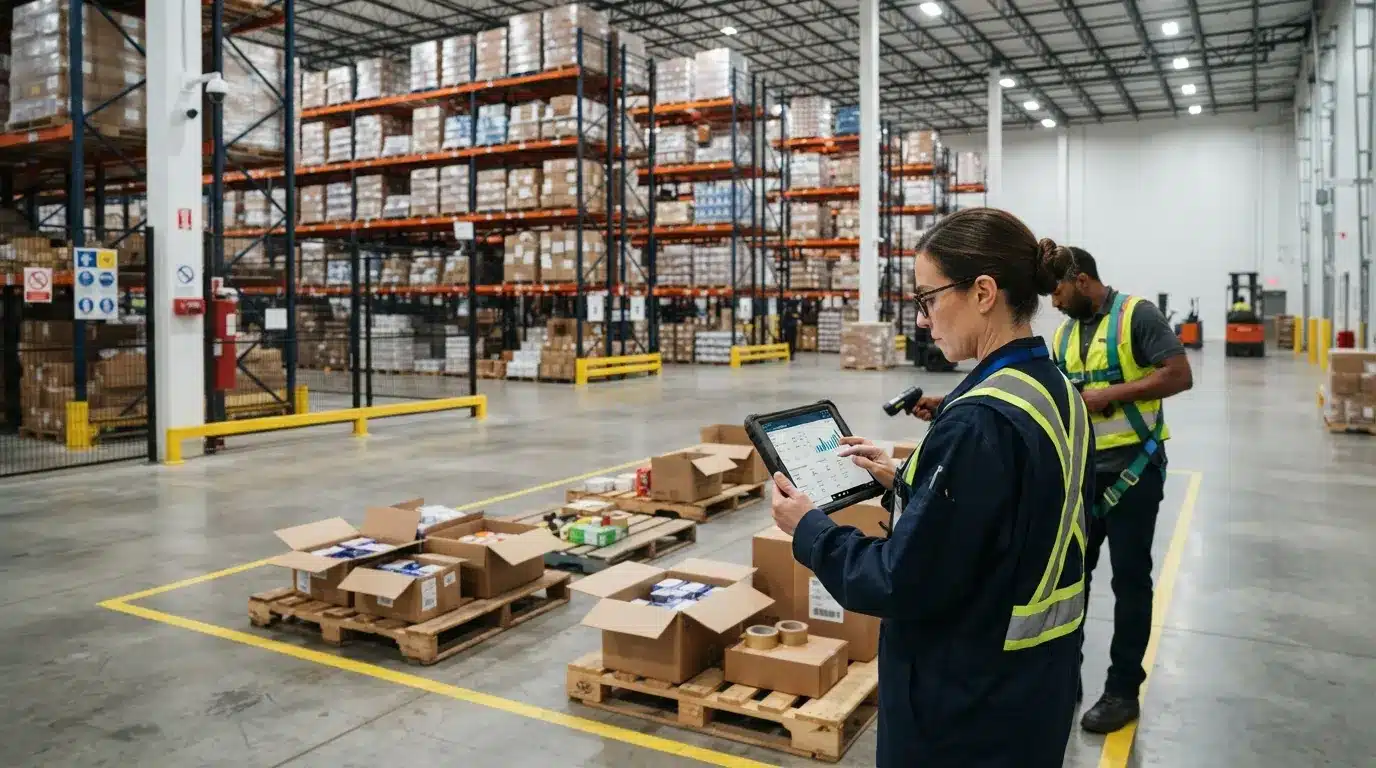
Inventory worth hundreds of thousands of dollars can sit under a 3PL’s roof while remaining the brand’s property. That physical handoff creates a question every finance and operations leader should settle before the first inbound shipment: if stock is damaged, lost, or stolen, which policy responds?
The answer is rarely “the warehouse covers everything.” A 3PL may carry commercial property, general liability, cargo, crime, cyber, and warehouse legal liability policies. None should be assumed to replace the brand’s own inventory insurance. Policy wording, contractual responsibility, deductibles, exclusions, valuation methods, and the cause of loss all matter.
This guide explains the due-diligence questions to raise with your broker, legal counsel, and fulfillment partner. It is general educational information, not insurance or legal advice.
What 3PL insurance usually means
“3PL insurance” is a convenient phrase, but it is not one standard policy. Imagine a brand placing 18,000 units across 400 SKUs in a Vancouver warehouse. The warehouse operator may have several policies protecting its buildings, equipment, employees, vehicles, and legal obligations. The brand, meanwhile, may insure its stock, business interruption exposure, and goods in transit.
That distinction matters because ownership and legal liability are different questions. A first-party inventory policy is designed to protect the policyholder’s own goods against covered causes of loss. Warehouse legal liability coverage is generally designed to respond when the warehouse is legally liable for damage to a customer’s property. A loss can occur without the warehouse being legally responsible, or the contract may cap responsibility below the stock’s retail value.
The scale of property risk is not theoretical. The Insurance Bureau of Canada reported that severe weather caused more than $8.5 billion in insured damage in Canada in 2024. Public Safety Canada also identified more than 195 major Canadian disasters between 2008 and 2018, with combined damage in the tens of billions of dollars. Those national figures are not forecasts for any one facility. They do show why brands should review flood, fire, water, and business interruption terms instead of treating insurance as a checkbox.
Warehouse legal liability is not the same as inventory insurance
Warehouse legal liability often depends on negligence or another basis of legal responsibility. If a forklift operator damages a pallet, the facts may point to warehouse liability. If a regional flood damages goods despite the warehouse following its obligations, the analysis may be different. The contract and both policies need to be read together.
The storage agreement may also use a declared value, a per-unit limit, a weight-based formula, or another cap. A brand carrying premium cosmetics at an average landed cost of $65 per unit faces a different exposure from a housewares company storing bulky products with a $12 landed cost. Using retail selling price, wholesale value, replacement cost, or landed cost can produce very different claim amounts.
Ask your broker to explain which valuation basis applies under your own inventory policy. Ask legal counsel to explain the limitation-of-liability and indemnity clauses in the warehouse agreement. Then compare the answers. A certificate of insurance can confirm that a policy existed on its issue date, but it does not replace the full policy wording or rewrite the warehouse contract.
In British Columbia, the Warehouse Lien Act gives warehouse operators statutory rights tied to charges for storing and preserving goods. That legislation deals with liens, not a promise that a warehouse insures every customer’s inventory. It is one more reason for brands storing in BC to have Canadian counsel review the agreement rather than relying on assumptions imported from a US contract.
Map coverage to the events that can interrupt your business
A useful review starts with scenarios, not policy names. Take a seasonal apparel brand preparing 9,000 units for a major retailer launch. A sprinkler discharge, theft, smoke contamination, or receiving error could delay the launch even if only part of the inventory is physically damaged.
Work through at least these events:
- fire, smoke, water escape, flood, earthquake, and other natural hazards;
- theft, employee dishonesty, unexplained shortage, and forced entry;
- damage during receiving, put-away, picking, kitting, or loading;
- loss while goods move between the port, warehouse, retailers, and consumers;
- temperature or humidity exposure where the product requires controls;
- cyber or system incidents that block order release or inventory records;
- carrier loss after the shipment leaves the warehouse; and
- recall, contamination, or product damage discovered after delivery.
For each event, identify the likely policy, named insured, deductible, limit, exclusion, reporting deadline, and evidence required. Do not assume “all risk” means every event is insured. Canadian commercial policies commonly contain exclusions and sublimits that must be checked against the actual goods and storage conditions.
Questions to take to your broker, lawyer, and 3PL
The most productive insurance conversation is specific. “Are we covered?” invites a vague answer. A better discussion uses the inventory profile and operating workflow.
Questions for the brand’s insurance broker
- Does our policy cover inventory stored at an unnamed third-party location?
- Must each warehouse address be scheduled, and is there a limit per location?
- Is valuation based on landed cost, replacement cost, wholesale value, or another measure?
- What sublimits apply to jewellery, cosmetics, electronics, samples, or other concentrated-value goods?
- Are flood, earthquake, theft, unexplained shortage, employee dishonesty, and goods in transit addressed?
- Does business interruption coverage respond when stock or a third-party warehouse is affected?
- What notice is required when inventory values rise before peak season?
A brand that normally holds $450,000 of stock but reaches $1.2 million in October needs to discuss that peak before the goods arrive. A per-location limit based on an average month can leave a seasonal gap.
Questions for legal counsel
Have counsel review the storage agreement’s liability cap, indemnity, waiver of subrogation, force majeure, claim-notice period, dispute process, and governing law. Confirm whether the agreement requires either party to carry particular insurance or name the other as an additional insured or loss payee. Those terms have different effects and should not be used interchangeably.
Questions for the 3PL
Ask what certificates can be shared, what coverage categories the business maintains, and who handles incident reporting. Then move to process evidence: receiving records, exception photos, cycle-count history, user-access logs, shipment scans, and escalation contacts.
Evolution’s dedicated warehouse services in Canada can be discussed as part of a broader onboarding review, but every brand remains responsible for confirming its own coverage with qualified advisers. Evolution does not make a coverage determination and this article does not state that its policies cover client-owned goods.
Inventory records can decide whether a claim is supportable
Insurance documents answer only part of the question. A claim may also depend on proving what arrived, where it was stored, its condition, its value, and what happened before the loss.
Suppose the warehouse management system shows 2,040 units on hand, while the brand’s ERP shows 2,180. That 140-unit gap should be investigated before an incident, not during a claim. Receiving counts, purchase orders, SKU-level values, cycle counts, adjustments, returns, dispositions, and outbound scans create the chain of evidence.
Evolution’s guide to inventory accuracy, cycle counts, and WMS visibility explains how operational records support day-to-day control. The same discipline can make post-incident reconstruction faster. It does not guarantee that an insurer will accept a claim, but missing or conflicting records can make the process harder.
Set a retention period with your broker and counsel. Keep certificates, contracts, policy endorsements, purchase invoices, landed-cost records, inventory snapshots, incident reports, photos, and correspondence in a location the warehouse incident cannot disable.
A pre-move 3PL insurance checklist
Before the first inbound appointment, complete this review:
- Build a maximum-value inventory forecast by location, not only an annual average.
- Separate landed cost, wholesale value, and retail value in the exposure model.
- Identify concentrated-value SKUs and seasonal peaks.
- Give the broker the warehouse addresses, product types, storage methods, and transit lanes.
- Compare the brand policy with the storage agreement and the 3PL’s stated coverage categories.
- Document responsibility during receiving, storage, value-added work, outbound staging, and carrier transit.
- Agree on incident contacts, reporting timelines, count procedures, and evidence retention.
- Test whether WMS and ERP reports reconcile before inventory moves.
- Revisit the review after a new location, product category, acquisition, or major channel launch.
Evolution’s warehouse locations and 3PL onboarding checklist can help operations teams prepare the location and data questions. The insurance and legal decisions should remain with the brand’s broker and counsel.
Make risk ownership explicit before stock moves
The best time to find an insurance gap is before a purchase order lands at the dock. For an established brand, the review should connect policy wording, contract terms, inventory value, physical workflow, and system evidence. A certificate alone cannot do that job.
Discuss your inventory profile, storage controls, and documentation requirements with Evolution before onboarding. Then take the proposed arrangement to your broker and legal adviser for a coverage and contract review specific to your business.
