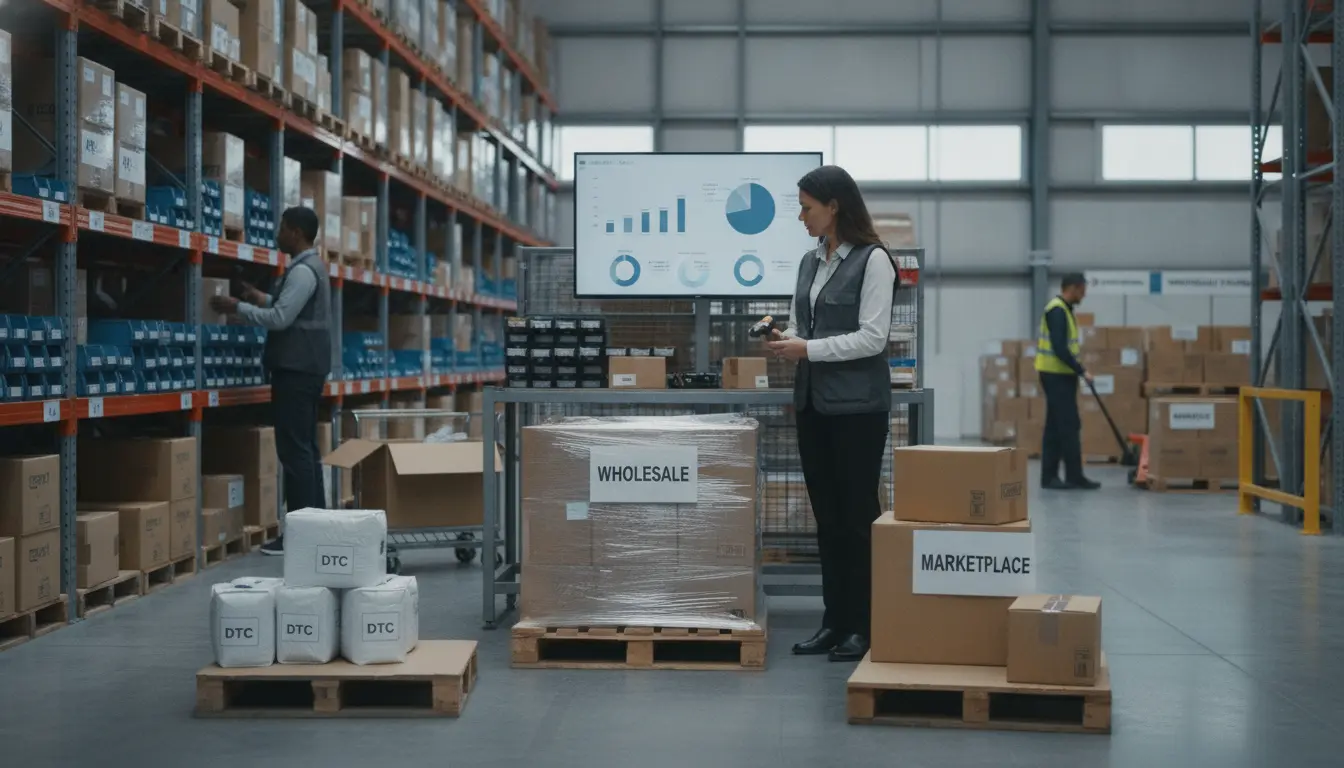
A brand can have plenty of stock and still disappoint every channel. The problem appears when DTC orders, wholesale commitments and Amazon replenishment all point at the same units without agreed reservation rules.
Picture a launch with 4,000 units on hand. Wholesale has an approved purchase order, the DTC team has scheduled a campaign, and the marketplace team wants inventory prepared for Amazon. “On hand” does not answer which units can be promised, which are already committed, or which need a different pack and handoff. That is an orchestration problem.
One inventory pool is a configured operating model in which channel demand is coordinated against shared inventory records. It does not mean every unit is always available to every channel. The model works only when inventory states, allocation authority, work instructions and exceptions have named owners.
What does one inventory pool mean across DTC, wholesale and Amazon?
The phrase sounds physical, but the key distinction is informational. Units may sit in one building while commercial teams maintain separate spreadsheets and promises. That is one location, not one controlled pool.
Shopify’s current inventory documentation distinguishes physical stock from several states, including available, committed, incoming, reserved, damaged, safety stock and quality control. It defines available inventory as stock that can be sold and is not committed to orders or incoming transfers. That is a useful discipline even when a brand uses another commerce platform: total stock and available-to-promise stock are different questions.
The pool also needs channel attributes. A unit might be physically identical but already assigned to a wholesale case pack, held for inspection, or prepared under a marketplace instruction. The record should show enough context to stop another channel from promising it by mistake.
For brands that want to retain control of channel strategy while outsourcing warehouse work, Evolution’s Brand Fulfillment Model is the relevant service framework. The final allocation policy still belongs to the brand.
Inventory changes state as orders move
A single “quantity” field hides the event sequence. Shopify documents that order creation decreases available inventory and increases committed inventory. After fulfillment, committed inventory decreases. It also notes that committed inventory is changed through the order lifecycle rather than treated like an ordinary adjustable quantity.
That creates a practical test. If a DTC order is accepted, does the orchestration process reserve the units before wholesale availability is recalculated? If a wholesale order is cancelled, who releases the reservation? If a return arrives, what approved step moves the item from inspection to available stock?
Write the state transitions before selecting software:
- inbound and not yet checked
- available for a stated channel set
- reserved by policy
- committed to an accepted order
- in warehouse processing
- shipped or transferred
- returned and awaiting inspection
- approved for sale, held, damaged or assigned another disposition
The system may use different labels. The operating meaning matters more than the label itself.
Allocation rules turn shared stock into controlled promises
Allocation decides which demand can use which stock. A brand may protect a retailer commitment, hold launch inventory for DTC, or plan a marketplace transfer. There is no universal best rule because contract terms, campaign timing, margin, account importance and stock risk differ.
Set the rule and its authority. For example: “Wholesale reservations require an approved purchase order and are released only by the operations lead.” Another rule might set a DTC safety quantity for a launch period. The point is not the number. It is that the trigger, owner, start and end are visible.
Then define conflicts. Suppose a wholesale PO and DTC campaign both need the last 600 sellable units. The warehouse should not decide which channel wins. It should place the exception with the brand contact named in the procedure and keep the existing reservation until that person decides.
Good allocation reporting shows available, reserved and committed units by SKU and reason. It also lists expired holds and unresolved conflicts. A total stock dashboard cannot replace that view.
Each channel still needs a different warehouse workflow
Orchestration does not force every order through one pack line. It coordinates different work against the same controlled inventory.
DTC orders
DTC work may include item-level picking, brand-provided packaging, inserts, shipping-service rules and customer-facing shipment data. Test an ordinary order, multi-item order, cancellation, address problem and return. Evolution’s B2C order fulfillment service is the service owner for this path.
Wholesale and retail orders
Wholesale can add case packs, labels, routing instructions, requested dates, appointments and advance shipment data. A retailer controls its program, and requirements can change. The brand and 3PL need a named process for receiving and approving those changes. Evolution’s B2B order fulfillment service covers the related warehouse work.
Amazon preparation and replenishment
Amazon describes its Multi-Channel Fulfillment service as using inventory to fulfill orders from non-Amazon channels, and its own page presents Amazon, DTC and social orders within one inventory-pool concept. That is Amazon’s program, not proof of Evolution capability or a universal design.
For a 3PL model, treat Amazon preparation, replenishment and removal as separate workflows. Record the current account instruction, barcode owner, unit preparation, carton data, appointment or carrier handoff, and the event that changes stock status. Evolution’s Amazon fulfillment support in Canada can be evaluated for work in scope. Amazon controls its program and eligibility.
Choose a source of truth for each data object
“Single source of truth” is too broad for many operations. The ERP may own item masters and financial records. A commerce platform may create DTC orders. A warehouse-management system may own bin locations and physical movements. Retailer or marketplace systems may control their order and inbound status.
Build a data-ownership table instead:
Shopify also documents that apps and 3PLs can query quantities across locations and move units between inventory states. That is an available platform model, not evidence that any named Evolution connection exists. Confirm the systems, fields, update timing and failure alerts during implementation.
Exception ownership matters more than a perfect dashboard
Every orchestration design will meet cases it did not predict: a short inbound receipt, duplicate order, late wholesale change, marketplace rejection, damaged return or system outage. The question is how quickly the case reaches someone allowed to decide.
Use an exception record with five fields: affected SKU/order, current state, blocked action, evidence and decision owner. Add an escalation time in the operating agreement only after both teams confirm the process. Do not publish a universal response-time promise.
Returns deserve the same care. A returned unit should not flow back to every channel merely because it reached the building. The brand defines inspection evidence, condition categories and disposition authority. Evolution’s returns-management service can carry out the agreed physical steps.
Ask these questions before choosing an orchestration model
A vendor demo can show a clean order. Ask for the awkward cases instead:
- What inventory states exist, and who can change each one?
- How are wholesale reservations created, approved and released?
- Which event removes a unit from available stock for each channel?
- Can reports separate available, reserved, committed, damaged and returned units?
- Who owns item data, channel mappings and pack instructions?
- What happens when two channels request the same remaining stock?
- How are Amazon program changes reviewed before warehouse work changes?
- How are cancellations, partial orders and returns handled?
- Which failures create an alert, and who receives it?
- How will both parties test the model before launch?
The right answer may involve one facility or several. “One inventory pool” describes coordinated decision-making, not a rule that all goods must occupy one address.
Talk to Evolution about your channel mix
One inventory pool works when the brand can see what is available, explain why stock is held, and send each order through the correct channel workflow. That takes written rules and clear owners before it takes another dashboard.
If your brand is coordinating DTC, wholesale and Amazon demand, bring your SKU profile, channel commitments, current systems and recurring exceptions to Evolution. We can review the warehouse work and data handoffs that fit our services, without assuming a platform connection or performance result before it is verified.