Choosing a 3PL for outdoor products Canada brands can rely on comes down to four things: where bulky gear is stored, how the warehouse handles seasonal peaks, how returns are inspected, and what the provider will not ship at all. Outdoor and sporting goods are harder to fulfill than typical apparel or accessories because items are large, demand arrives in seasons and some products fall under dangerous-goods rules. This guide explains each factor and ends with a checklist for comparing providers.
What makes outdoor and sporting goods different to fulfill?
A shirt and a tent are both products, but they behave differently in a warehouse. Outdoor catalogues mix very different items: soft goods, hard goods, accessories and sometimes large or regulated products. The table shows the traits that most often change how a brand should choose a 3PL.
| Product trait | Why it matters | What to ask a 3PL |
|---|---|---|
| Bulky or oversized | Storage is priced by space, and carriers price on size as well as weight | How is oversized stock stored and priced? |
| Seasonal demand | Stock lands months before the season and sells in a short window | How are inbound and peak periods planned? |
| High unit value | Damage and picking errors cost more per order | What checks run at pick and pack? |
| Mixed catalogue | Soft goods, hard goods and accessories need different handling | Can one account hold all three? |
| Regulated components | Fuel, aerosols and some batteries are dangerous goods | What does the provider refuse to handle? |
| Returns | Gear often comes back used or repacked | How are returns inspected and restocked? |
Storage: where bulky gear sits decides the cost
For apparel, storage is mostly shelving and bins. For outdoor equipment it is often floor space or pallet positions, which is why storage is the first thing to settle. Evolution’s own Business Manager has said that the biggest challenge with outdoor equipment is proper storage, and that the answer is space planning together with forecasting. The same interview describes spaces from 10,000–15,000 sq ft up to 100,000 sq ft, including unracked areas with open floor plans and high ceilings. You can read it in our behind-the-scenes interview on transloading and outdoor goods.
The practical point for a brand is to decide, before you sign, which items are stored on pallets, which in racking and which in bins. Our guide to warehouse slotting strategy explains how storage location affects picking speed and cost.
Seasonality: plan the year, not just the peak
Outdoor demand follows the weather and the calendar, and the cost of getting it wrong sits at both ends. Too little stock in the warehouse before the season costs sales, and too much after it costs storage. A simple way to plan is to work through four periods:
| Period | What happens | What to agree with your 3PL |
|---|---|---|
| Pre-season | Large inbound deliveries arrive | Dock appointments, space and receiving capacity |
| Peak | Orders arrive quickly and in volume | Staffing, cutoff times and carrier pickups |
| Mid-season | Replenishment of fast-moving items | Reorder points and lead times |
| Post-season | Returns and leftover stock | Inspection, restocking and clearance rules |
Evolution’s published approach to peaks is to add staffing and extend operating hours so that same-day order processing continues during high-volume periods. Ask any provider how that works for your own season, because your peak may not be Black Friday. If your products arrive by container, our transloading and cross-docking service handles palletised freight near the Port of Vancouver, and our guide to peak season fulfillment covers planning ahead.
Shipping bulky gear across Canada and into the US
Large items change the shipping maths. Carriers price on dimensional weight, which means a light but bulky box can cost as much as a heavy compact one, so packaging size matters as much as weight. Brands that sell to both countries also face cross-border paperwork on US orders.
Evolution ships from its Delta, BC warehouse, and its published service area covers all Canadian provinces and territories and the contiguous United States. Our guide to cross-border shipping from Canada to the US explains customs and duties for consumer goods. For packaging, Evolution can apply brand-specific packing, including branded materials and protective packaging for items that need it.
Returns: inspect, repack, resell
Outdoor gear comes back for fit, defects and change of plans, and it often returns opened or repacked. A good returns process logs each return against the original order, inspects the item, and either restocks it as sellable inventory or sends it to repair, liquidation or disposal, with the outcome reported back to you. Evolution’s returns management service follows this pattern at its Delta, BC warehouse. See our returns management page, and decide in advance how you want opened-box items treated.
What a 3PL will not take: dangerous goods and fuel
This is the point most outdoor brands forget to ask about. Dangerous goods rules cover items that many outdoor catalogues include: fuel canisters and stove fuel, aerosol products such as bear spray, and some battery-powered products. Evolution does not handle dangerous goods or perishables, so brands with those items need a different arrangement for them, and should check which of their SKUs fall under the rules before choosing any provider. The rest of a catalogue, such as tents, packs, apparel and accessories, can still be handled, subject to a quote.
Examples from Evolution’s own clients
Two published stories show the range. RISE Outdoor, a Whistler, BC brand, sells its AirNEST inflatable tent with an integrated mattress direct to consumers through Shopify, ships globally and uses Evolution as its 3PL partner for delivery; its founder describes fulfillment as part of the customer experience rather than just logistics. Read the RISE Outdoor story. Mons Royale, a merino performance apparel brand with roots in Wānaka and Squamish, describes how Evolution takes over logistics so the team can focus on product. Read the Mons Royale spotlight. Between them they cover a bulky hard-goods product and a soft-goods range.
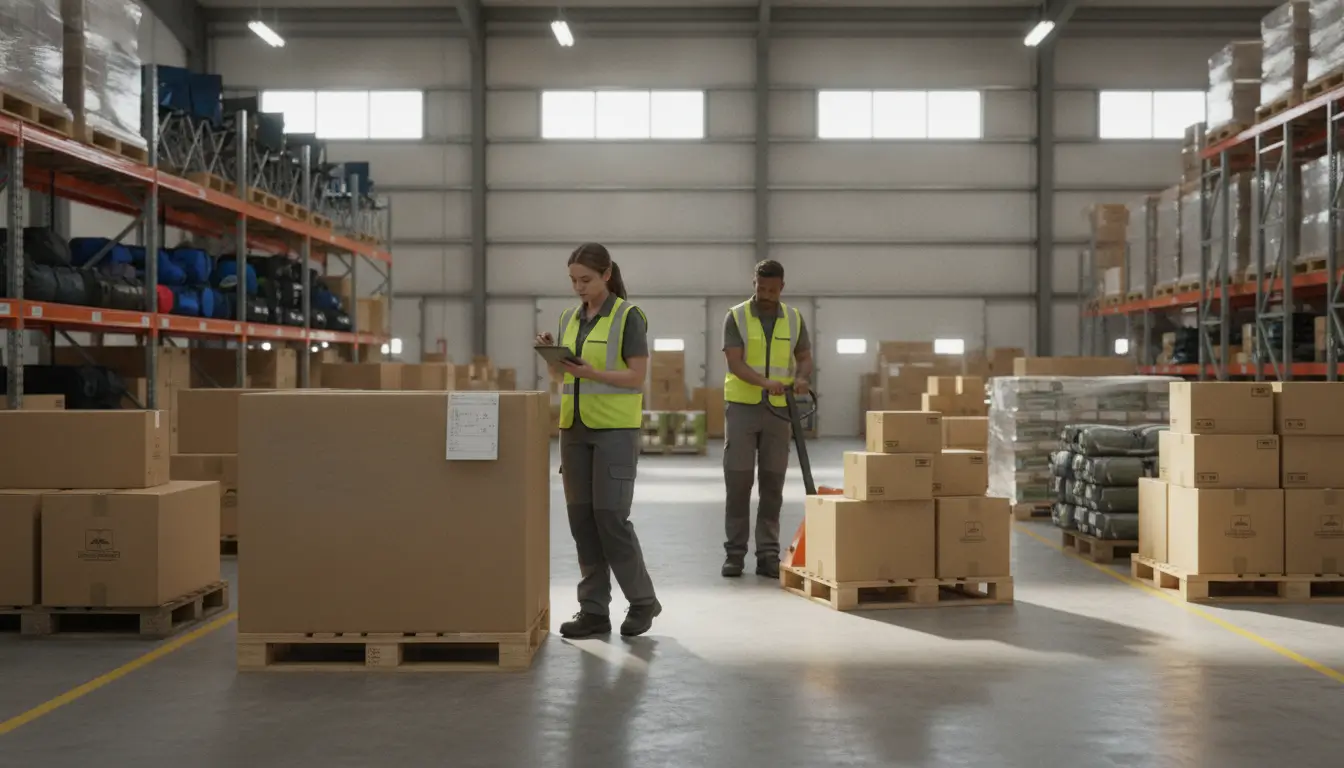
(Image: a packed AirNEST-style tent box on a pallet next to a stack of boxed apparel)
Checklist: questions to ask a 3PL for outdoor products
- How is oversized stock stored, and how is that storage priced?
- Can one account hold soft goods, hard goods and accessories?
- How are inbound deliveries scheduled before the season, and what is the receiving capacity?
- How does the warehouse handle your peak, not just a general holiday peak?
- What checks run at pick and pack to protect high-value items?
- Which of your products count as dangerous goods, and what does the provider refuse to handle?
- How are returned items inspected, restocked or disposed of?
- Can orders ship to both Canadian and US addresses, and who prepares the cross-border paperwork?
How Evolution Fulfillment supports outdoor and sporting goods brands
Evolution handles receiving, storage, order fulfillment, brand-specific packing, shipping and returns from its Delta, BC operation, with a cloud-based warehouse management system that connects to platforms including Shopify, WooCommerce, BigCommerce and Magento. It also supports transloading and cross-docking for larger shipments near the Port of Vancouver. Outdoor and sports brands are among its published clients, and it works with established brands, so the right first step is a conversation about your products, volumes and season.
To see how this would work for your catalogue, read about B2C order fulfillment or B2B order fulfillment for retail orders, or request a quote.
Frequently asked questions
What should I look for in a 3PL for outdoor products in Canada?
Look for clear answers on four points: how bulky stock is stored and priced, how the warehouse handles your seasonal peak, how returns are inspected and restocked, and which items the provider will not handle, such as dangerous goods. Also check that it can ship to both Canadian and US addresses.
Can a 3PL store oversized outdoor gear?
Yes, if it has floor space or pallet positions suited to large items. Evolution has described unracked areas with open floor plans and high ceilings, and its team plans space together with forecasting. Storage is quoted for your products, so share dimensions and volumes early.
How does seasonality affect a 3PL arrangement?
Seasonality changes when you need space and labour. Large inbound deliveries arrive before the season, orders surge during it, and returns follow it. Agree dock appointments, cutoff times and returns rules for each period. Evolution adds staffing and extends operating hours during high-volume periods.
Does Evolution handle fuel canisters or bear spray?
No. Evolution does not handle dangerous goods or perishables. Fuel, aerosol products and some battery-powered items can fall under dangerous-goods rules, so check which of your products are affected before choosing a provider. Other outdoor products, such as tents, packs and apparel, can be handled subject to a quote.
Can outdoor brands ship from Canada to the US?
Yes. Evolution ships from Delta, BC to all Canadian provinces and territories and to the contiguous United States. US orders need cross-border paperwork, and carriers price on size and weight, so quote both destinations when you plan your shipping.
Does Evolution work with sporting goods and outdoor brands?
Yes. Outdoor and sports brands, including RISE Outdoor and Mons Royale, are among Evolution’s published clients. It works with established brands, and each account is agreed individually, so request a quote to discuss your products.